Water heater article archive
Low Hot Water Pressure Solutions for Bay Area Homes | Better Water Heaters
Historical article, not newly reviewed advice. Verify current requirements, incentives and model guidance with the relevant authority or manufacturer before relying on them. Equipment and service needs require an assessment.
📋 Table of Contents
According to the U.S. Department of Energy, water heating accounts for about 18% of your home’s energy use, but that efficiency plummets when low hot water pressure forces your system to work twice as hard. You step into the shower expecting a steady stream, only to be met with a pathetic drizzle that makes rinsing shampoo feel like a part-time job.
Key Takeaways for Bay Area Homeowners
- Check the Cold Side: If both hot and cold pressure are low, it’s likely a main line or regulator issue.
- Sediment is the Silent Killer: Mineral deposits in tankless heat exchangers are the #1 cause of hot-side-only flow drops.
- PRV Life Expectancy: Most plumbing pressure regulators in hilly areas like Los Gatos or Belmont fail after 10–15 years.
- Safety First: Fluctuating pressure can lead to thermal expansion issues that stress your tank’s seams.
The Diagnosis Flowchart: Is It the Heater or the Pipes?
The biggest mistake we see homeowners make is replacing a showerhead when the actual clog is sitting thirty feet away in the garage. To find the source, you need to determine if the drop is universal or isolated.
Here’s a simple way to track it down:
- Test the Cold Water: Turn on a cold-only tap. If the pressure is fine, the problem is 100% inside your hot water system.
- Check Multiple Fixtures: If only the master shower is weak, it’s a localized clog or a bad mixing valve. If every hot tap in the house is sluggish, your heater is choking.
- Listen for Noises: Popping or banging sounds often point toward significant water heater sediment buildup.
Why Water Heater Sediment Buildup is a Pressure Killer
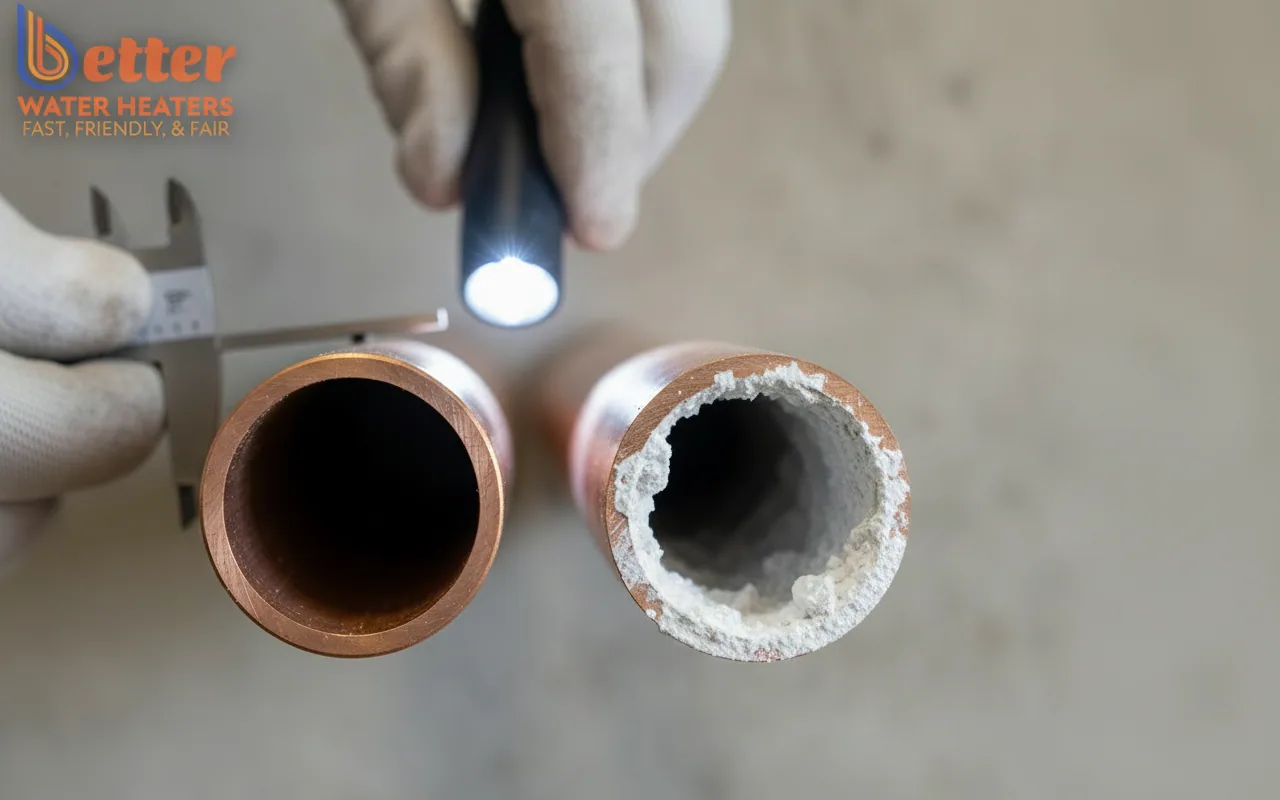
In the Bay Area, our water ranges from moderately to very hard, meaning minerals like calcium and magnesium are constantly hitching a ride into your pipes. Over time, these minerals settle at the bottom of your tank, creating a thick layer of "scale" that acts like a physical barrier to water flow.
But wait—it gets worse for tankless owners. Because tankless units use narrow copper piping in the heat exchanger to flash-heat water, even a tiny amount of scale can significantly restrict the hot water flow rate drop. Think of it like cholesterol in an artery; the pump is working, but the passage is too narrow to let the volume through.
Common signs of sediment restriction:
- The water starts hot but the pressure fades after a few minutes.
- You hear a low rumbling sound (kettling) coming from the unit.
- Your energy bills are creeping up because the heater is burning through scale to reach the water.
Need a professional eye to clear the lines? Schedule a system flush with our experts to restore your flow today.
The Role of the Plumbing Pressure Regulator (PRV)
If you live in a hilly neighborhood—think the Santa Cruz Mountains or the Berkeley Hills—your home likely relies on a plumbing pressure regulator. Municipalities often pump water at high pressures (up to 150 PSI) to get it up the hills, but your home’s plumbing is only rated for about 50–70 PSI.
The PRV acts as a gatekeeper. When it fails, it usually fails in one of two ways: it either lets too much pressure through (risking pipe bursts) or it gets stuck in a restricted position, causing a massive low hot water pressure event. In our work with established homeowners in San Jose and Redwood City, we find that a failed PRV is the most common "hidden" cause of whole-home pressure issues.
| Issue | Symptom | Primary Cause |
|---|---|---|
| Isolated Low Pressure | One shower is weak | Clogged aerator or mixing valve |
| Hot-Only Low Pressure | Kitchen and bath hot taps are weak | Sediment buildup in heater |
| Whole-Home Low Pressure | Every tap (hot and cold) is weak | Failed Pressure Regulator (PRV) |
Tankless Scale-Buildup: The Silent Pressure Killer
Many Bay Area residents have recently made the "Tankless Transition" to save space and energy. While these units are incredible, they are far more sensitive to water quality than old-fashioned tanks.
What most people miss is that tankless units require a chemical descale (usually with food-grade white vinegar) every 12 to 24 months. If you skip this, the mineral deposits harden into a glass-like substance that is nearly impossible to remove without professional-grade solvents. This is especially true for high-efficiency heat pumps, where mineral scaling on the heat exchanger can reduce heat transfer by up to 12% according to Energy.gov.
Try this: Check the error codes on your tankless unit’s digital display. Codes like "LC" or "00" often indicate scale buildup is reaching a critical level.
The Seasonal Slump and Thermal Expansion
Here’s the thing: sometimes your pressure isn't actually lower, but it feels lower because the water is colder. During the winter months in the Bay Area, the temperature of the water entering your home from the street drops significantly. Your water heater has to work harder to bridge that temperature gap, and if you have a tankless unit, it may intentionally slow down the flow rate to ensure the water reaches your desired temperature.
Furthermore, if you have a "closed" plumbing system, you likely have a thermal expansion tank. If this small tank fails, it can cause pressure spikes and drops as water heats and cools. It’s a small component, but its failure can lead to catastrophic leaks at the water heater's weakest points.
The real kicker? Most homeowners don't realize their expansion tank is failed until the T&P valve starts dripping. If you see water on the floor, don't wait—that's a sign of a system under extreme stress.
For more on maintaining these components, check out our guide on water heater maintenance tips.
When to Call a Pro vs. DIY Fixes
Before you call us, there are a few things you can do to save money. First, unscrew your showerhead and check the tiny plastic screen inside. If it’s full of white pebbles, you’ve found your culprit. You can soak the head in vinegar overnight to dissolve the minerals.
However, if the issue is inside the heater, DIY becomes risky. Flushing a tank requires handling scalding water and potentially dealing with a drain valve that won't close back up once opened. In our experience with typical Bay Area mid-market homes, a professional flush not only restores pressure but extends the life of the unit by 3–5 years.
Best practice: If your home has aging galvanized pipes, be very careful with high-pressure "blowouts." These old pipes are often held together by the very rust that is clogging them; removing the rust can lead to pinhole leaks throughout your walls.
Ready to get your morning shower back to full strength? Contact Better Water Heaters for a diagnostic visit. We’ve served the Bay Area for over 20 years and know exactly how to handle our local water conditions.
Frequently Asked Questions
Why is my hot water pressure suddenly low but cold is fine?
This is almost always caused by a restriction within the water heater itself. The most common culprit is water heater sediment buildup at the hot water outlet or a deteriorating dip tube that has sent plastic shards into your plumbing lines, clogging the fixtures.
Can a failing water heater cause low pressure?
Yes. As sediment accumulates, it takes up physical space inside the tank or heat exchanger, leaving less room for water to flow. In tankless models, scale buildup acts like a bottleneck, significantly reducing the gallons per minute (GPM) the unit can deliver to your taps.
How do I know if my plumbing pressure regulator is bad?
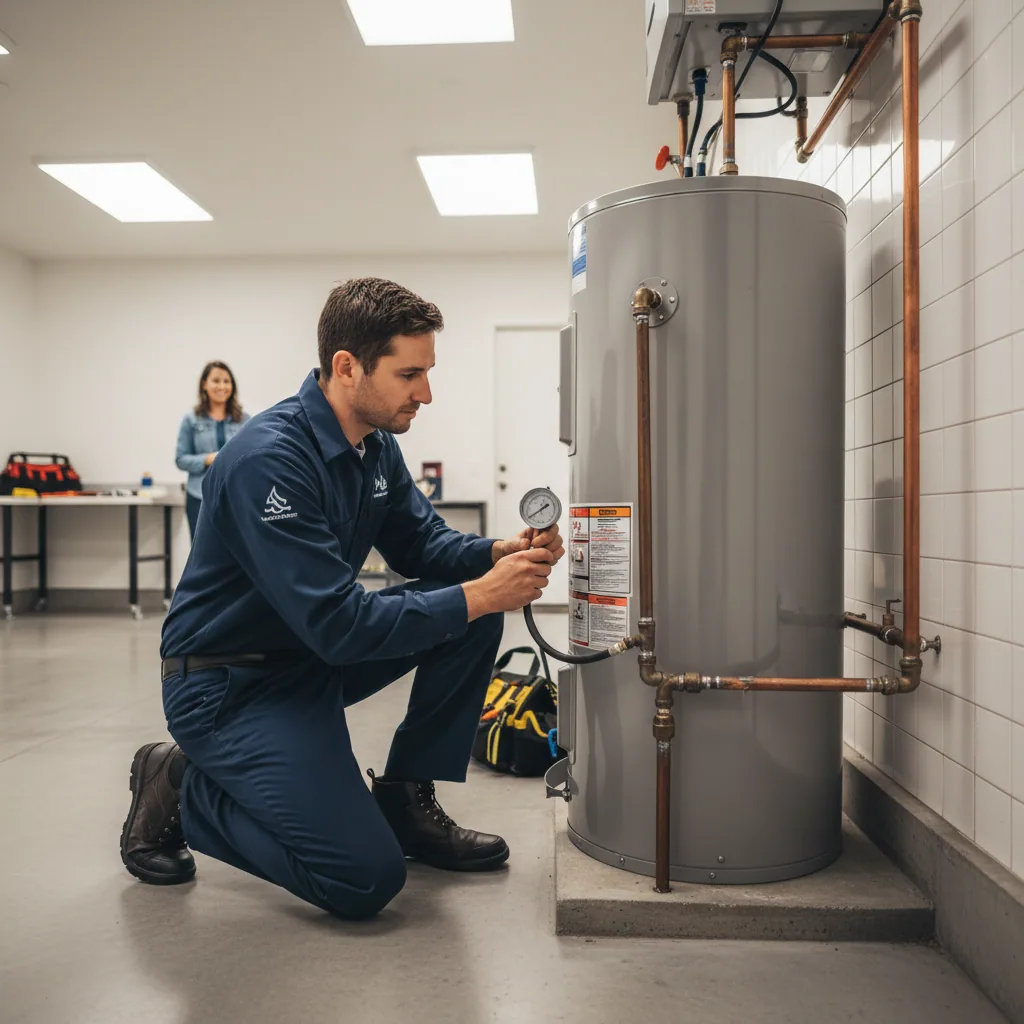
A failed PRV usually causes vibrating pipes, "water hammer" sounds, or a sudden, uniform drop in pressure across all faucets in the house. You can test this by attaching a simple pressure gauge to your outdoor hose bib; if it reads above 80 PSI or below 40 PSI, the regulator likely needs replacement.
Will flushing my water heater improve pressure?
In many cases, yes. A professional flush removes the loose sediment that blocks the intake and outflow valves. However, if the scale has already hardened onto the heating elements or heat exchanger, a standard flush may not be enough, and a chemical descaling treatment may be required.
Does hard water affect my hot water pressure?
Absolutely. The Bay Area’s mineral-rich water creates limescale. This scale builds up faster in hot water pipes and heaters because heat accelerates the crystallization of minerals. This is why you often notice pressure drops on the hot side long before the cold side is affected.
Final Monday Morning Action: Go to your kitchen sink and compare the flow of full-cold vs. full-hot. If the hot side is visibly thinner, check your water heater’s age. If it's over 8 years old, it’s time to schedule a professional flush before the sediment turns into a permanent blockage.