
📋 Table of Contents
According to the California Energy Commission, water heating accounts for roughly 25% of a typical California home’s energy use, yet the mechanical room ventilation required to sustain that efficiency is often the most neglected component of a home renovation. In the tight confines of San Francisco Victorians and modern Silicon Valley ADUs, a lack of proper airflow isn’t just an efficiency killer—it’s a localized code violation that can lead to premature equipment failure or dangerous backdrafting.
Whether you are upgrading to a high-efficiency gas unit or transitioning to a heat pump, your utility closet must act as a functional lung for your home. This guide introduces the 4-Zone Ventilation Audit, a technical framework we use at Better Water Heaters to evaluate if your space meets rigorous Bay Area building codes and manufacturer-specific water heater airflow requirements.
Zone 1: The Cubic Foot Capacity & Combustion Air Calculation
The real kicker is that a water heater doesn’t just need air to ‘breathe’; it needs a specific volume of stagnant air to prevent a vacuum effect known as negative pressure. For atmospheric gas units, the standard rule of thumb is 50 cubic feet of space for every 1,000 BTU/hr of input, a requirement that many cramped Bay Area closets fail to meet without supplemental venting.
- Volume Assessment: Measure the height, width, and depth of the room to determine total cubic footage.
- BTU Mapping: Cross-reference the room volume against the total BTU input of all gas appliances (water heater, furnace, etc.).
- Confined Space Identification: If the volume is less than 50 cubic feet per 1,000 BTU, the room is legally a “confined space” under California Title 24.
In our work with Series B SaaS founders building high-tech ADUs in Palo Alto, we often find that soundproofing efforts inadvertently seal off the mechanical room ventilation, leading to oxygen-starved burners that soot up within months. If your room is too small, you must install permanent openings to an adjacent room or the outdoors to satisfy combustion air calculation standards.
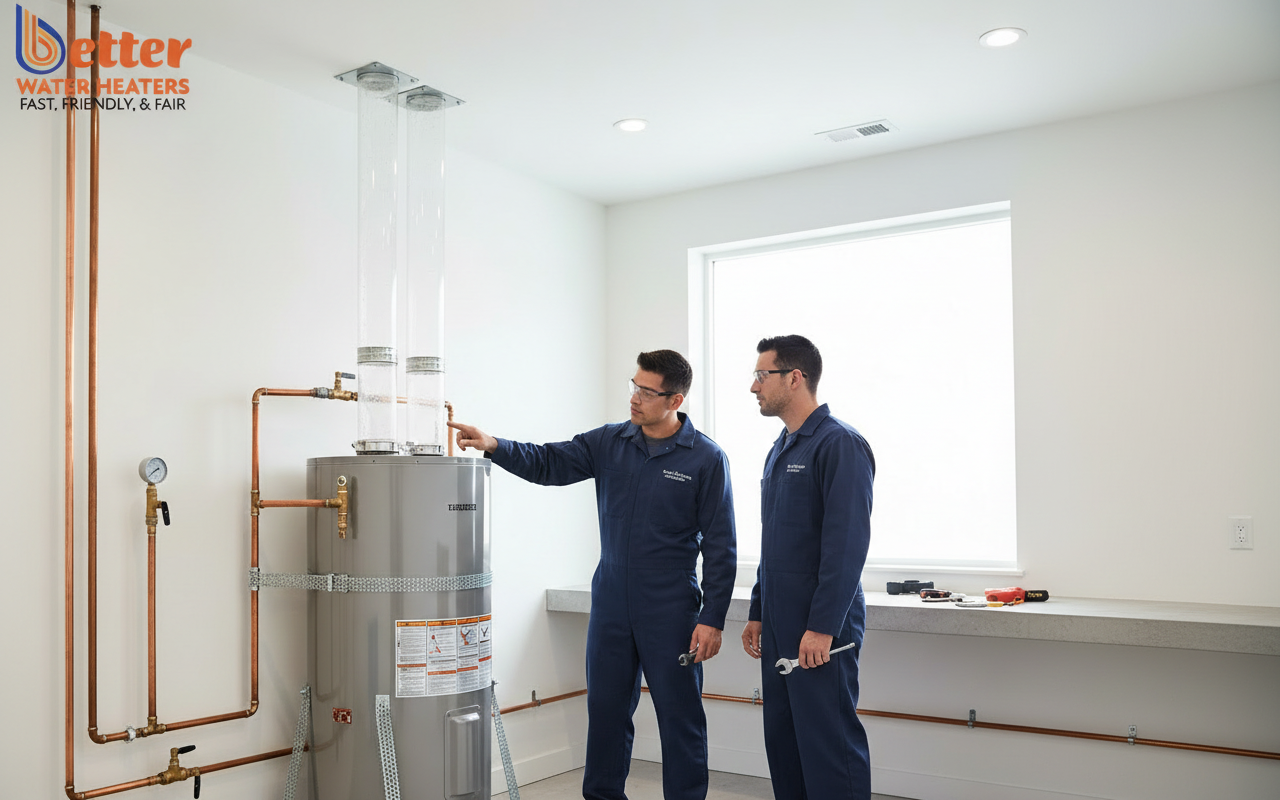
Zone 2: Intake Dynamics and Title 24 Water Heater Compliance
What most people miss is that high-efficiency heat pump water heaters (HPWH) don’t burn fuel, but they move massive amounts of air to extract heat, requiring roughly 700 to 1,000 cubic feet of air to operate effectively. Without proper water heater airflow requirements, a heat pump will turn your utility room into a refrigerator, causing the unit to work twice as hard and slashing its lifespan.
- Passive vs. Active Intake: Evaluate if your closet uses louvers (passive) or dedicated ducting (active) to pull fresh air.
- Wildfire Smoke Considerations: In the Bay Area, intake vents should be equipped with high-quality dampers to prevent smoke infiltration during fire season.
- Cross-Ventilation: Ensure that air isn’t just entering the room, but circulating across the unit’s heat exchanger or burner assembly.
Transitioning to all-electric? Learn more about heat pump requirements before you sign a contract. Proper intake design is the difference between a 15-year appliance and a 5-year headache.
Zone 3: Exhaust Path & Backdraft Testing Bay Area Standards
Here’s the thing: air leaving the room is just as important as air coming in, especially in older Victorian-era homes where “leaky” envelopes are being tightened for energy efficiency. When a powerful kitchen range hood or bathroom fan turns on, it can pull air down the water heater flue, bringing deadly carbon monoxide into the living space—a phenomenon known as backdrafting.
| Ventilation Type | Risk Factor | Bay Area Suitability |
|---|---|---|
| Atmospheric Vent | High (Backdrafting) | Legacy homes only; being phased out |
| Power Vent | Low (Forced Air) | Great for tight closets/closet-to-wall runs |
| Direct Vent | Zero (Sealed) | Best for modern, airtight builds |
A professional backdraft testing Bay Area audit involves a “worst-case scenario” depressurization test. We turn on all exhaust fans to ensure the water heater flue still maintains a positive upward draft. For a typical Bay Area mid-market client, upgrading to a power-vented or direct-vent system is often the safest way to bypass the limitations of an old chimney. Need an expert eye? Schedule your free ventilation estimate today.
Zone 4: The Micro-Climate Impact & Seismic Integrity
The real kicker in the Bay Area is our unique humidity profile; fog-heavy regions like Daly City or the Sunset District create a “Micro-Climate” within the mechanical room that accelerates corrosion if airflow is stagnant. Stagnant, moist air reacts with combustion byproducts to create a mild acidic wash that eats through galvanized vents and tank jackets.
- Corrosion Check: Inspect vent connectors for white powdery residue (oxidation) or rust streaks.
- Seismic Strapping & Clearances: California code requires specific clearances around vents so that in a tremor, the water heater doesn’t shift and crush its own mechanical room ventilation ducting.
- Noise Mitigation: In luxury condos, we balance high-CFM airflow with acoustic dampening to ensure the “hum” of a heat pump doesn’t vibrate through the floorboards.
But wait—don’t assume that more air is always better. Over-ventilating a room in the winter can lead to pilot light outages on older models or freezing pipes in unconditioned spaces. It is about controlled exchange, not just an open hole in the wall.
Why Local Expertise Matters for Bay Area Building Codes
Navigating Bay Area building codes feels like a full-time job because each municipality—from San Jose to Berkeley—has slightly different interpretations of the Uniform Plumbing Code (UPC). For instance, San Francisco’s all-electric mandates mean that new installations must prioritize heat pump airflow over gas combustion air entirely.
At Better Water Heaters, we utilize a specialized internal workflow (similar to how our internal AI content engine, Ingest.blog, streamlines complex data) to track code changes across 40+ Bay Area jurisdictions. This ensures that every 4-Zone Audit we perform isn’t just a safety check, but a future-proofing measure for your home’s value.
Contrarian Insight: Most contractors will tell you to just “add a louvered door” to fix airflow. However, in many airtight modern homes, a louvered door just moves the negative pressure problem to your bedroom or hallway. The only real solution is often a dedicated fresh air intake from the building exterior.
Key Takeaways for Homeowners
- Measure First: Know your room’s cubic footage before buying a new unit.
- Test for Backdraft: Especially if you’ve recently upgraded your windows or kitchen fans.
- Plan for 2027: With upcoming gas water heater bans, ensure your room is ready for the airflow needs of a heat pump.
- Consult a Specialist: General plumbers often overlook the complex physics of mechanical room ventilation.
Ready to ensure your home is safe and compliant? Don’t leave your family’s safety to guesswork. Contact Better Water Heaters at (408) 250-6672 for a comprehensive 4-Zone Ventilation Audit and professional installation.
Frequently Asked Questions
Do I need a permit for mechanical room ventilation changes in the Bay Area?
Yes, most Bay Area jurisdictions require a permit when modifying combustion air or exhaust venting. This ensures the work meets California Title 24 standards and prevents fire hazards. At Better Water Heaters, we handle the entire permitting process for our clients to ensure full compliance with local safety regulations.
How much airflow does a heat pump water heater actually need?
Typically, a heat pump water heater requires at least 700 to 1,000 cubic feet of unconfined space to operate efficiently. If your mechanical room is smaller, you must install louvers or duct the intake and exhaust to a larger room or outdoors. Insufficient airflow will significantly increase your electricity bills and reduce the unit’s cooling efficiency.
What are the signs of poor water heater airflow?
Common signs include a pilot light that frequently goes out, soot buildup around the burner, a faint smell of exhaust, or the water heater tank feeling excessively hot to the touch. In extreme cases, you may notice moisture or condensation on the walls of the mechanical room, which indicates poor moisture evacuation and stagnant air.
Can I use a louvered door to satisfy Bay Area building codes?
While a louvered door is a common solution for providing combustion air, it may not be sufficient for modern high-efficiency units or in homes that are highly sealed for energy efficiency. A professional audit will determine if you need “make-up air” drawn directly from the outside to prevent house-wide negative pressure issues.