
📋 Table of Contents
According to the Bay Area Air Quality Management District, traditional gas water heaters will be phased out for new installations starting in 2027, making your current home remodel plumbing strategy a critical financial decision rather than a simple utility swap. If you are currently gutting a kitchen in Palo Alto or adding an ADU in Walnut Creek, the sequence in which you touch your plumbing and electrical systems can be the difference between a $3,000 upgrade and a $12,000 infrastructure nightmare.
The real kicker? Most homeowners wait until their tank leaks to think about replacement, but in the Bay Area’s high-cost regulatory environment, that ’emergency’ approach is a guaranteed way to overpay. By integrating your water heater transition into a planned remodel, you can stack local incentives and avoid duplicative permit fees.
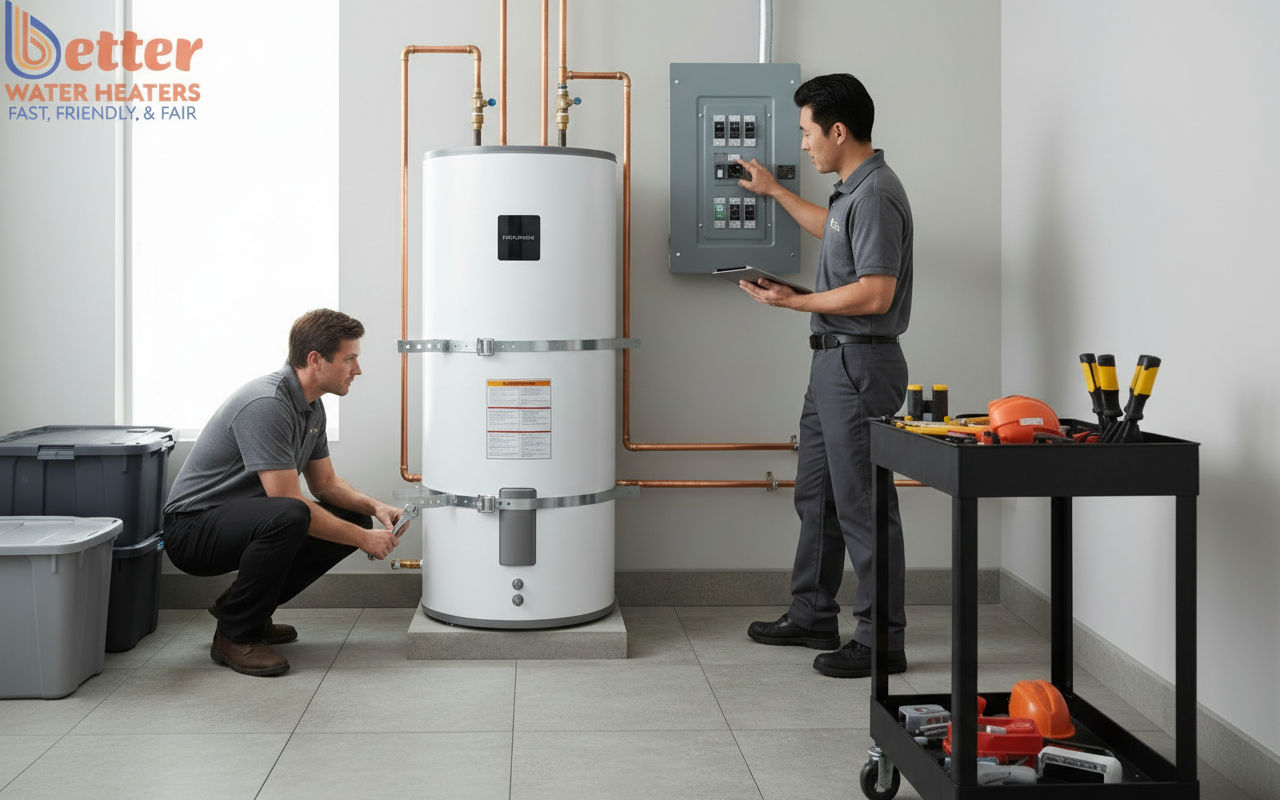
The Hidden Cost Matrix: Why Retrofits Often Surprise Homeowners
A home remodel plumbing strategy must account for the fact that a $2,000 heat pump unit can easily balloon to an $8,000 project once Bay Area electrical and venting upgrades enter the chat.
- Electrical Panel Constraints: Many older homes in San Jose or Oakland have 100-amp panels that cannot support a standard 240V heat pump without a $5,000 upgrade.
- Venting and Airflow: SB 1414 compliance now strictly regulates atmospheric venting in retrofits, often requiring stainless steel liners or complete re-routing.
- Seismic Requirements: Every water heater retrofit guide for California must emphasize that moving a unit even three feet triggers modern seismic strapping and expansion tank codes.
What most people miss is the ‘Electrification Friction’—the point where your home’s existing infrastructure fights your desire for efficiency. However, for a typical Bay Area mid-market client, we often recommend the new 120V ‘plug-and-play’ heat pump models to bypass the need for a heavy-duty electrical panel upgrade.
New Construction vs. Major Additions: Navigating Title 24
The 2024 Title 24 Update has essentially forced the hand of anyone building a major addition, requiring high-efficiency heat pump technology as the baseline standard. Here’s a comparison of how the rules change based on your project scope:
| Factor | Retrofit (Existing Space) | New Construction / Addition |
|---|---|---|
| Technology Requirement | Heat Pump or High-Efficiency Gas | Heat Pump (Electric-Preferred) |
| Permit Complexity | Moderate (Plumbing + Electrical) | High (Full Building Review) |
| Max Rebate Potential | Up to $4,900+ (TECH/SGIP) | Varies by Utility (PG&E/SVCE) |
But wait—if you are doing a kitchen remodel, you should never pull a standalone plumbing permit for the water heater. Instead, bundle it into the master Bay Area construction permits for the entire project to save on administrative fees and inspection coordination.
The 120V Revolution: A Game Changer for Retrofits
The best way to avoid a $5,000 PG&E electric panel upgrade is to look toward 120V heat pump water heaters, which can often plug into a standard outlet. According to Energy.gov, these units are specifically designed for the retrofit market where running new 240V lines is cost-prohibitive.
- Space Efficiency: These units are perfect for tight SF utility closets but require specific cubic footage of air for the heat exchanger.
- Load Shifting: Modern 120V units allow for ‘load shifting’ to avoid peak PG&E rates, heating water when electricity is cheapest.
- Installation Speed: Because they don’t require a full panel upgrade, the installation timeline is cut in half.
Need help deciding which model fits your panel? Schedule a free consultation with our specialists to map out your electrical capacity.
Strategic Sequencing: Don’t Pay for Plumbing Twice
The real friction in a home remodel plumbing strategy happens when the tile guy finishes the floor before the plumber confirms the new drain line for a heat pump’s condensate. Here is the contrarian truth: you should pick your water heater before you pick your kitchen cabinets.
- Identify the Hub: Determine if your new layout allows for a centralized water heater location to reduce ‘wait-to-hot’ times.
- Pre-Wire Everything: Even if you aren’t ready for a heat pump today, run the 240V wire while the walls are open during your remodel.
- Condensate Management: Heat pumps create moisture; planning the drain line during the rough-in phase saves thousands in future concrete cutting.
In our work with tech-forward homeowners in the Peninsula, we’ve seen that integrating these systems with home solar and Powerwalls creates a ‘resiliency loop’ that keeps hot water running even during PG&E public safety power shutoffs.
Rebate Stacking: 2024 Incentives for Bay Area Homeowners
While many see the upfront cost of a water heater retrofit guide as a barrier, the 2024 rebate landscape is the most aggressive we have ever seen. You can often stack TECH Clean California incentives with HEEHR federal funds and local utility bonuses from providers like Peninsula Clean Energy or Silicon Valley Clean Energy (SVCE).
- TECH Clean California: Can offer thousands for switching from gas to heat pump.
- Federal Tax Credit (25C): Provides 30% of the project cost, up to $2,000 annually.
- Local Utility Bonuses: Some Bay Area cities offer an additional $500 – $1,000 for decommissioning gas lines.
The real kicker? These rebates are often only available if you use a certified TECH contractor. Do not leave $4,000 on the table by hiring a generalist who doesn’t know how to navigate the paperwork.
Local Compliance: Berkeley vs. San Jose vs. San Francisco
Your home remodel plumbing strategy must be hyper-local. While Berkeley and San Jose have led the charge with gas bans in new construction, San Francisco has unique venting challenges due to the proximity of neighboring buildings.
Here’s the thing: Every municipality handles Bay Area construction permits differently. For example, some cities require a separate electrical permit for a water heater even if it’s part of a larger remodel, while others allow a ‘combo’ permit. We handle these nuances daily so you don’t have to spend your Monday morning at the building department.
Building Your Decision Matrix
To finalize your strategy, ask yourself these three questions: Is my electrical panel at capacity? Am I adding more than 50% to my home’s square footage? Do I plan to stay in this home for more than 5 years? If the answer to any of these is ‘yes,’ a planned heat pump transition is significantly more cost-effective than a like-for-like gas replacement.
Ready to lock in your 2024 rebates and future-proof your home? Contact Better Water Heaters today for a professional assessment of your remodel plans. We’ll help you navigate the 2027 regulations and ensure your plumbing strategy is as smart as the rest of your home.
Frequently Asked Questions
How do I know if I need an electrical panel upgrade for a heat pump water heater?
Most standard 240V heat pumps require a dedicated 30-amp circuit. If your current panel is 100-amps and already powers an A/C unit and an electric dryer, you are likely at capacity. However, new 120V ‘plug-in’ models can often work on existing circuits, saving you $5,000 in upgrade costs.
Can I keep my gas water heater during a major Bay Area remodel?
Currently, yes, for retrofits. However, if your remodel is classified as ‘New Construction’ (often defined as over 50% of the home being rebuilt), local codes in cities like San Jose may require a transition to electric. Additionally, the 2027 phase-out means any future replacement will likely be electric anyway.
What are the specific Bay Area construction permits needed for a water heater?
Typically, you need a plumbing permit and an electrical permit. In many Bay Area jurisdictions, these are bundled into a ‘Building Permit’ for remodels. You must also ensure the installation passes a Title 24 compliance check and meets CA seismic strapping requirements.
How much can I actually save with TECH Clean California rebates in 2024?
Depending on your utility provider and current fuel source, homeowners can often access between $1,000 and $4,800 in direct rebates. When combined with the federal 25C tax credit of up to $2,000, the net cost of a heat pump can be lower than a traditional gas unit.