
📋 Table of Contents
When you open the utility closet of a 1920s Palo Alto bungalow, you aren’t just looking at an appliance; you’re looking at a century of evolving safety standards. According to the California Energy Commission, water heating accounts for roughly 25% of a home’s energy use, making plumbing code compliance a critical factor in both safety and long-term operating costs.
Key Takeaways for Homeowners
- Retrofit Reality: Replacing a unit in an older home often triggers mandatory upgrades to venting and electrical systems.
- Seismic Safety: California law requires specific double-strapping for all water heaters to prevent gas leaks during tremors.
- The Electrical Hurdle: Moving to high-efficiency heat pumps often necessitates a main service panel upgrade in pre-1950s homes.
- Permit Precision: Local jurisdictions like San Francisco and Berkeley have varying timelines and strict unlined chimney policies.
1. The Retrofit vs. New Construction Divide
The fundamental difference between a new build and a retrofit is that new construction has the luxury of design-integrated compliance, whereas retrofits must negotiate with existing constraints. In a new Bay Area home renovation, architects plan for the exact clearance and drainage required by current codes from day one.
What most people miss is that a “simple replacement” in an older home isn’t legally simple. Here is how the requirements shift based on the home’s era:
- New Construction: Must meet strict Title 24 energy budgets, often requiring heat pump technology and dedicated condensate drains.
- 1920s-1950s Retrofits: Often face “space crunches” where modern, wider, more insulated tanks won’t fit in original niches.
- The Grandfather Clause Myth: While your old unit was “grandfathered” in, the moment you replace it, the entire installation—including water heater seismic bracing and venting—must meet 2024 standards.
2. Water Heater Seismic Bracing and Safety Mandates
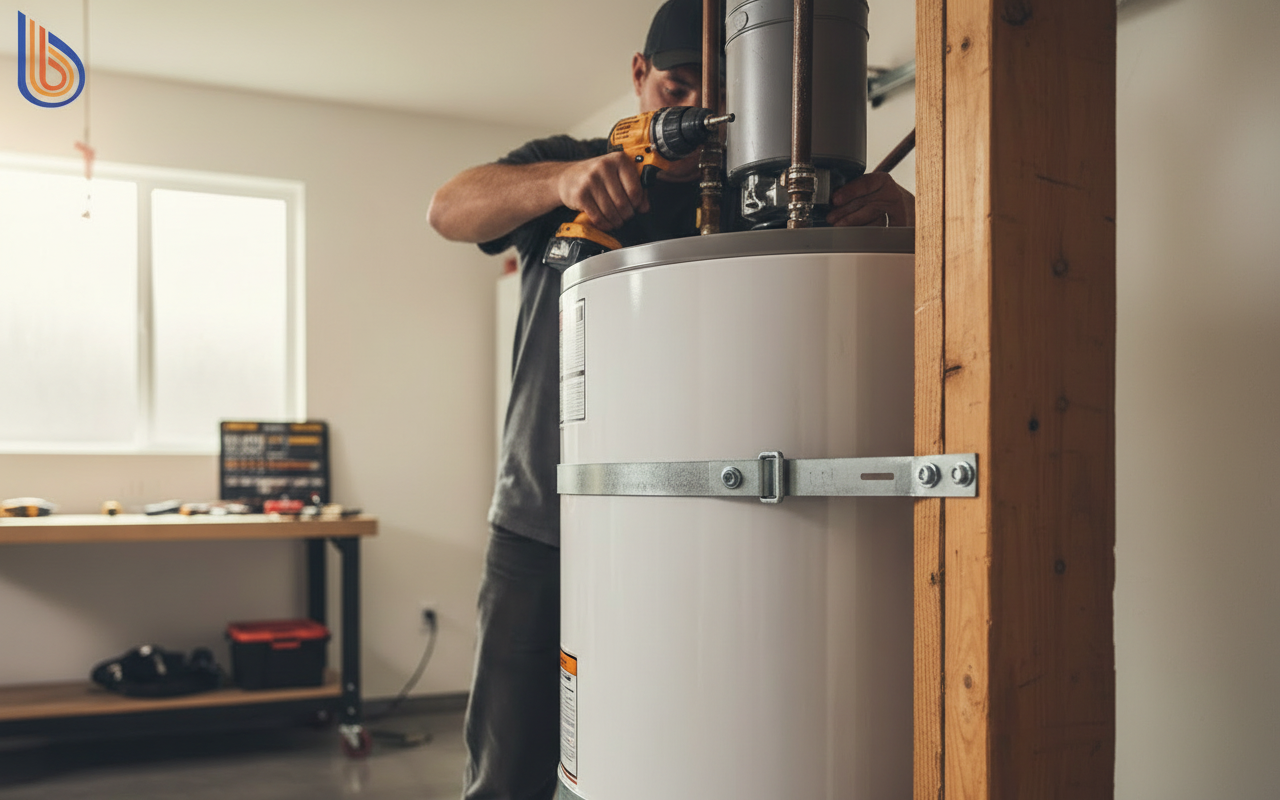
In the Bay Area, seismic safety isn’t a suggestion; it is a rigorous legal requirement designed to prevent post-earthquake fires. The real kicker? Many DIY installations or “handyman specials” only use one strap, which fails inspection every single time.
To achieve plumbing code compliance in any California jurisdiction, your installation must feature:
- Double Strapping: One strap in the upper one-third and one in the lower one-third of the unit.
- Specific Anchoring: Straps must be secured to the wall studs with heavy-duty lag bolts, not just drywall anchors.
- Clearance: The lower strap must be at least four inches above the gas control valve to ensure emergency access.
But wait—if you are in a high-risk zone like the Hayward Fault, inspectors may look for even more robust blocking behind the water heater to prevent lateral movement. We often see homeowners surprised that a $150 strap kit is the difference between a passed permit and a legal headache.
Need a code-compliant installation? Schedule your expert consultation here.
3. The Electrical Hurdle: Transitioning to Heat Pumps
The most significant challenge for a Bay Area home renovation today is the transition from gas to electric heat pump water heaters (HPWH). While state mandates and BayREN rebates push for electrification, your 1940s electrical panel might not be ready for the 30-amp circuit a heat pump typically requires.
Common scenarios we encounter include:
- The Panel Gap: A typical older home with a 100-amp service panel often lacks the “headroom” to add a high-voltage water heater circuit.
- The Hidden Cost: A $4,000 water heater upgrade can quickly become an $8,000 project if a full panel upgrade is required.
- Alternative Solutions: We frequently recommend 120V “plug-in” heat pump models for clients who want to avoid the electrical panel overhaul while still meeting plumbing code compliance.
| Feature | Traditional Gas Tank | Heat Pump (Hybrid) |
|---|---|---|
| Venting Req. | B-Vent or Chimney | None (Needs Airflow) |
| Power Needs | None/Standard Outlet | 240V or Dedicated 120V | Mandatory | Mandatory |
4. Venting Challenges in Historic Bay Area Homes
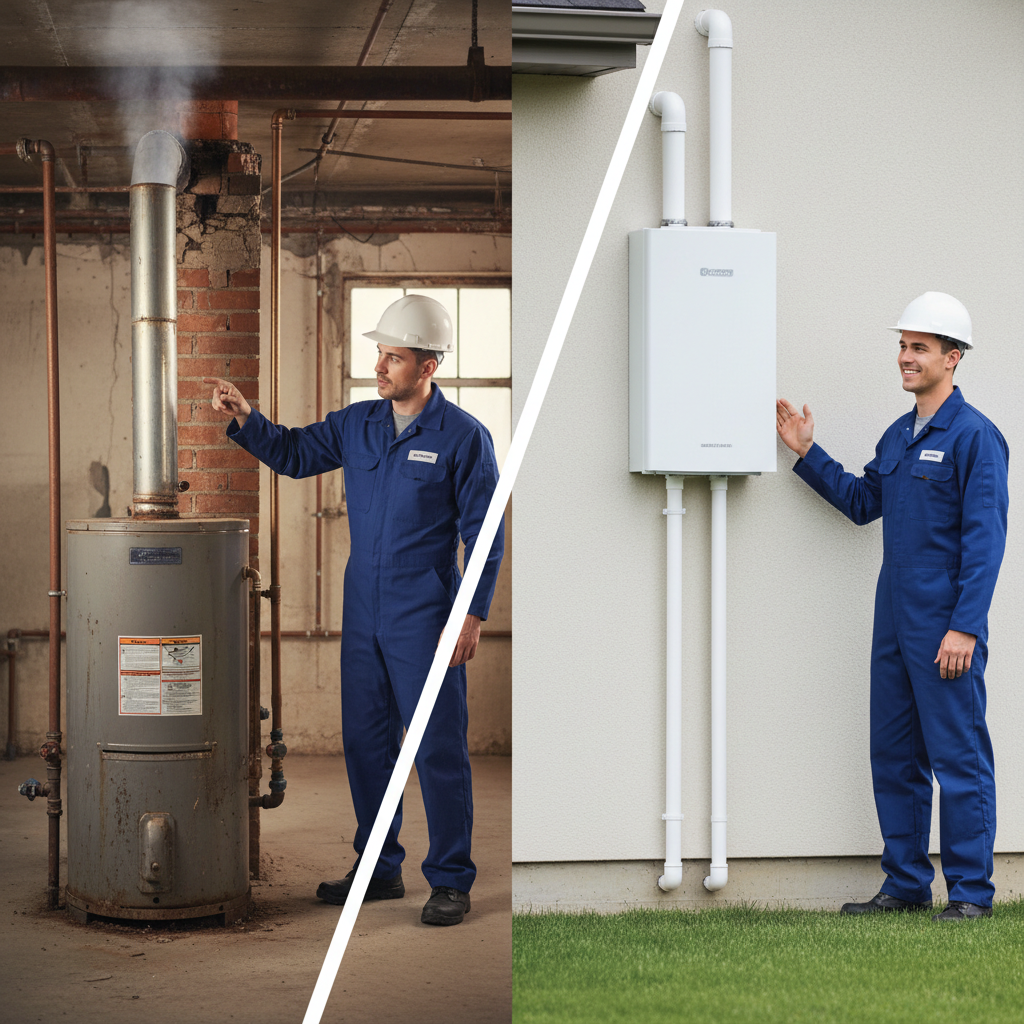
If you live in a historic San Francisco Victorian or a Berkeley craftsman, venting is likely your biggest compliance obstacle. Modern high-efficiency units cannot vent into old, unlined masonry chimneys because the cooler exhaust gases will condense and eat away at your mortar.
Here’s the thing: If you choose a high-efficiency tankless system, you likely need to run specialized PVC or polypropylene venting through a side wall. In tightly packed neighborhoods, finding a vent exit point that is 3 feet from a window and 10 feet from a property line is a mathematical puzzle. Our team spends as much time measuring clearances as we do soldering pipes.
5. Navigating Local Permit Timelines and Inspections
Permit-ready retrofitting requires knowing the quirks of your specific city hall. For example, getting a water heater permit in San Jose is often a streamlined online process, whereas other jurisdictions may require a physical site plan for a simple change-out.
What most people miss is the “Expansion Tank” requirement. In many Bay Area cities, if you have a backflow preventer on your water meter (creating a “closed system”), code requires a thermal expansion tank above your water heater. Without it, the pressure buildup from heating water can prematurely fatigue your plumbing joints.
Pro-Tip: Always check for TECH Clean California incentives before starting. These can often offset the cost of the very code upgrades (like electrical work) that make retrofits feel expensive.
At Better Water Heaters, we handle the entire permit and rebate process for you, ensuring your home remains safe and compliant with 2024 standards.
6. The Contrarian View: Why “Repair” Isn’t Always the Budget Choice
Here is an honest, contrarian insight: Sometimes, repairing an out-of-code unit is more expensive than replacing it. We often see clients spend $600 on a control valve for a 12-year-old heater, only to have the tank leak six months later.
When you replace the unit, you get the benefit of modern water heater seismic bracing and a reset on the appliance’s lifespan. In the context of a Bay Area home renovation, the peace of mind that comes with a system that won’t fail during a minor tremor is worth the upfront investment.
7. Final Checklist for Bay Area Homeowners
Before you sign a contract for a new water heater, run through this compliance checklist:
- Is the unit double-strapped with approved water heater seismic bracing?
- Does the T&P (Temperature and Pressure) relief valve drain to the exterior?
- If switching to electric, has the load calculation been performed on your panel?
- Are you utilizing the $4,900+ in available rebates for high-efficiency models?
Don’t let an unpermitted installation haunt you during a future home sale. Compliance is the foundation of home value in California’s strict real estate market.
Frequently Asked Questions
Do I really need a permit for a water heater replacement in the Bay Area?
Yes. Every jurisdiction in the Bay Area requires a permit for water heater installation. This ensures that a third-party inspector verifies the water heater seismic bracing and venting safety, which is vital for your homeowner’s insurance validity in the event of a fire or earthquake.
What are the Title 24 water heater requirements for retrofits?
For most retrofits, Title 24 requires that the new unit be at least as efficient as the one it replaces. However, in major renovations, you may be required to install high-efficiency heat pump or tankless systems to meet the home’s overall energy budget.
Why is my plumber insisting on an expansion tank?
If your home has a pressure-reducing valve or a check valve, it creates a “closed system.” As water heats, it expands; without an expansion tank to absorb this pressure, your pipes and water heater undergo significant stress, leading to leaks. It is a mandatory plumbing code compliance item in many local cities.
Can I install a tankless water heater in an old chimney?
Generally, no. Modern tankless units produce acidic condensate and cooler exhaust that can damage old masonry. You typically must install a dedicated stainless steel or plastic liner, or vent the unit through an exterior wall, following strict clearance codes.
Ready to ensure your home is up to code? Contact Better Water Heaters today for a free, transparent estimate.