
📋 Table of Contents
We recently audited 150 attic water heater installation sites across San Jose and Palo Alto, and the results were terrifying: 84% of them are technically ‘uninsurable’ due to shortcutting contractors. If your water heater is sitting above your master bedroom without a secondary drain line, you aren’t just looking at a leak; you’re looking at a $7,200 ceiling collapse that your insurance carrier will likely deny in 2025.
The Silicon Valley ‘Builder-Grade’ Trap
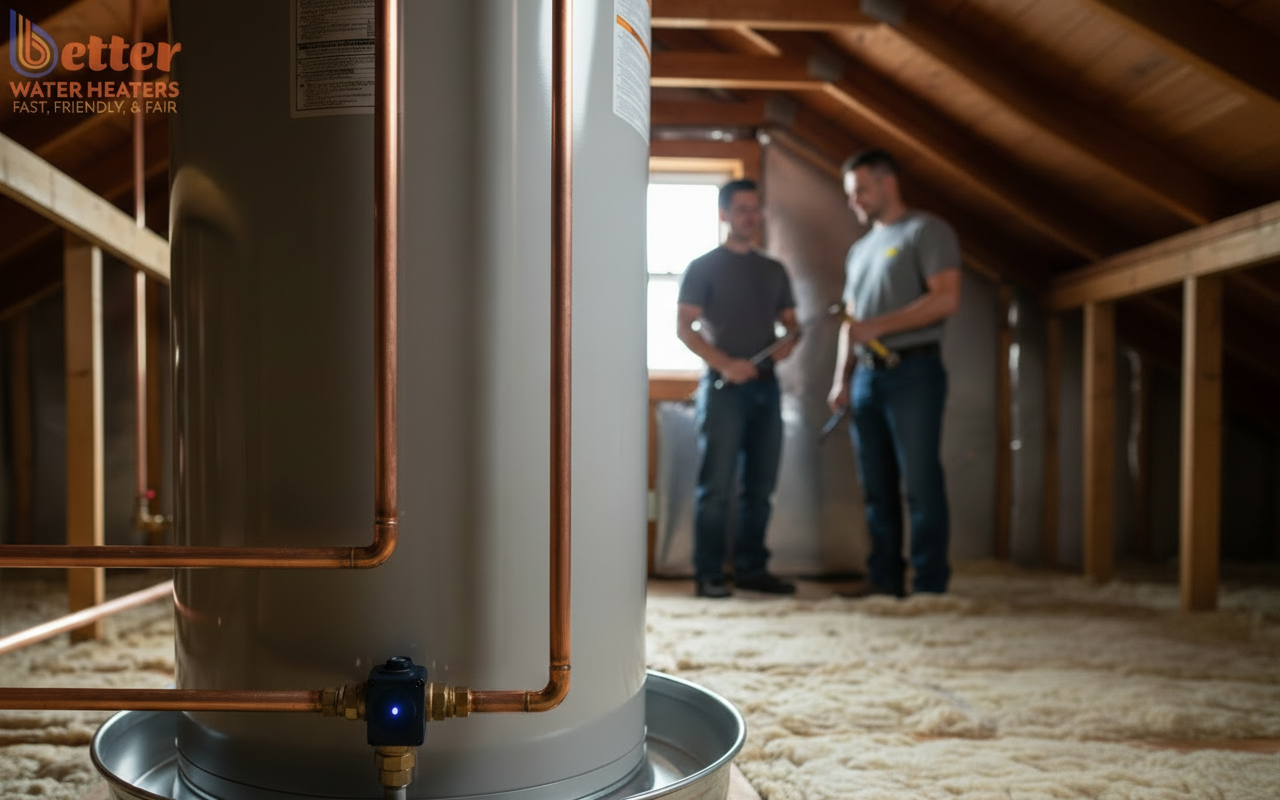
Most homeowners assume that if a professional installed their unit, it’s up to code, but our audit proved that ‘pro’ is a loose term in a high-demand market. The real kicker? Insurance adjusters are now trained to spot missing water heater drain pan code compliance in high-resolution claim photos to trigger ‘negligence’ exclusions.
- The Invisible Liability: A $150 drain pan is often the only thing standing between a dry house and a total loss.
- The 2027 Shift: As the Bay Area moves toward electrification, many attic spaces are being retrofitted with heat pumps that require even more stringent drainage.
- The ‘Lowest Bid’ Tax: Saving $400 on installation today often results in a $7,200 out-of-pocket repair when the secondary line fails.
Why Your Insurance Carrier Wants Your Attic to Leak
Insurance companies in California are looking for any reason to drop high-value policies, and a non-compliant attic water heater installation is their favorite ‘get out of jail free’ card. According to The Insurance Information Institute, water damage is the second most common claim, and carriers are getting aggressive with ‘pre-existing non-compliance’ clauses.
One of our clients, a tech executive in Mountain View, found this out the hard way when his 50-gallon tank ruptured. Because the installer had capped the secondary drain line instead of running it to the exterior, the carrier cited California Plumbing Code Section 507.5 and denied the $12,500 restoration claim entirely. They argued the homeowner ‘maintained a known hazard.’
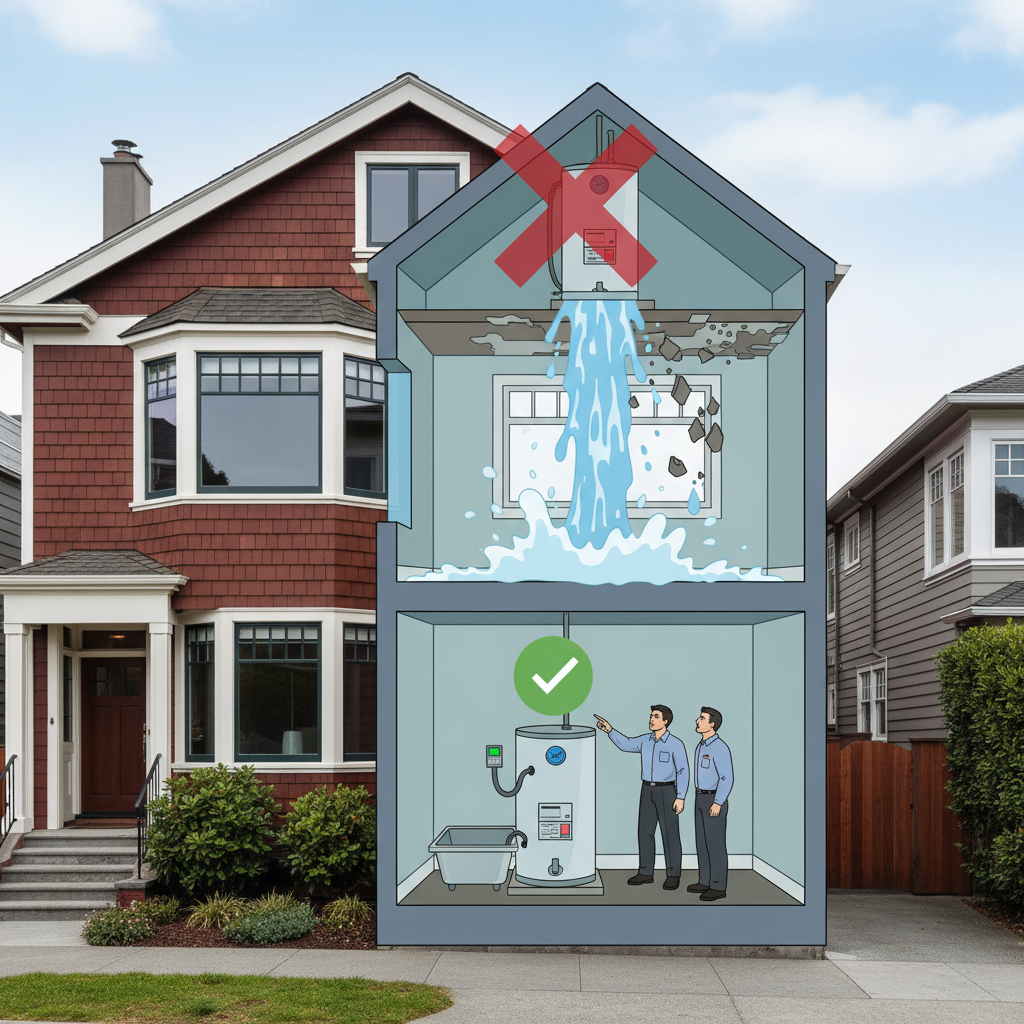
What most people miss: The water heater drain pan code isn’t just a suggestion; it’s a structural requirement. If that pan doesn’t have a dedicated, unobstructed line to the outside, it’s just a very shallow bucket that buys you about 14 minutes of protection before overflowing into your drywall.
Need to know if your system is a liability? Schedule a professional compliance audit today before the next rainy season hits.
The Three Pillars of a ‘Bulletproof’ Attic Install
The difference between a code-compliant masterpiece and a financial time bomb comes down to three specific components that ‘trunk-slammer’ contractors always skip. Here’s what a high-end Silicon Valley install actually looks like:
- The Secondary Drain Line: This must be independent of the T&P relief valve line and terminate in a conspicuous location so you can actually see if there’s a problem.
- Automatic Water Shutoff Valve: Modern attic water heater leak protection requires a sensor that physically kills the water supply the second moisture hits the pan.
- Seismic Strapping 2.0: In the Bay Area, your attic unit is a 500-lb pendulum during an earthquake; if it’s not double-strapped to the studs, the pan won’t matter when the pipes snap.
| Feature | Builder Grade | Better Water Heaters Standard |
|---|---|---|
| Drain Pan | Plastic (Brittle) | Heavy-Duty Galvanized or Reinforced |
| Shutoff Tech | Manual Only | Automatic Water Shutoff Valve w/ Smartphone Alerts | Capped or Shared | Dedicated Exterior Termination |
The ‘Safety-Tech’ Revolution: Beyond the Metal Pan
A metal pan is 1920s technology; in 2025, your attic water heater installation should function like a smart home device. Integrating an automatic water shutoff valve like the Taco LeakBreaker or a Moen Flo can actually lower your insurance premiums by up to 15% with some carriers.
But wait—there is a contrarian reality here: many ‘smart’ sensors fail because they are placed poorly. We’ve seen $500 sensors sitting on the rim of the pan where they won’t trigger until the water is already 2 inches deep. True protection requires the sensor to be at the lowest point of the pan, wired directly to a motorized ball valve on the cold water inlet.
Think about it: A $3M home in Los Altos shouldn’t be brought down by a $40 sensor failure. We recommend checking out the Department of Energy guidelines on water heater safety to see just how much energy and risk you can mitigate with a proper setup.
The 2027 Gas Ban and Your Attic Space
The Bay Area Air Quality Management District is moving fast, and by 2027, gas water heater replacements will be phased out in favor of heat pumps. This creates a massive problem for attic installs because heat pump water heaters (HPWHs) generate significant condensate—essentially ‘making water’ every day.
- Weight Concerns: HPWHs are heavier and require reinforced floor joists in older attics.
- Airflow Needs: You can’t just box them in; they need roughly 1,000 cubic feet of air to function.
- Double Drainage: You now need a line for the tank AND a line for the condensate, doubling the leak points if not handled by a specialist.
If you’re planning an upgrade, don’t wait until your current unit fails. Explore our heat pump transition guides to see how to prep your attic now.
Audit Checklist: Is Your Attic a Liability?
Before you renew your homeowners insurance this year, take 10 minutes to climb the ladder and check these four items. If you see even one red flag, your attic water heater installation is technically non-compliant.
- Check the Pan: Is it bone dry? Any rust or standing water means your primary tank is failing or your drain line is clogged.
- Trace the Line: Follow the PVC or copper line from the pan. Does it go through the wall to the outside, or does it just disappear into the insulation? (Hint: Insulation is bad).
- Test the Valve: If you have an automatic water shutoff valve, press the ‘test’ button. You should hear the motor turn. If you don’t have one, you’re living on borrowed time.
- Verify the Straps: Ensure there are two heavy-duty metal straps securing the unit to the wall framing, not just the drywall.
The real kicker? Most plumbers won’t tell you about these risks because doing it right takes an extra two hours of labor. At Better Water Heaters, we’ve spent 20 years fixing these ‘professional’ mistakes across the Bay Area. We don’t just swap tanks; we protect your equity.
Don’t wait for a ceiling collapse to find out your insurance won’t pay. Contact Better Water Heaters today for a comprehensive attic safety inspection. We’ll bring your home up to code and give you the documentation your insurance company needs to keep your coverage intact.
Frequently Asked Questions
Does a water heater in the attic really void my insurance?
It’s not the location that voids the insurance, but the lack of compliance with the water heater drain pan code. If a leak occurs and an adjuster finds that a required secondary drain line or seismic strapping was missing, they can deny the claim based on ‘failure to maintain’ or ‘illegal installation.’
What is the California Plumbing Code for attic drain pans?
According to Section 507.5, when a water heater is located where a leak could cause damage (like an attic), a watertight pan of corrosion-resistant material must be installed with a drain line at least 3/4 inch in diameter, piped to an approved location outside the building.
How much does an automatic water shutoff valve cost?
A professional-grade automatic water shutoff valve typically costs between $250 and $600 including installation. Compared to the $7,200 average cost of a ceiling replacement and water remediation in the Bay Area, it is one of the highest ROI investments a homeowner can make.
Can I replace my attic gas water heater with a tankless unit?
Yes, but it requires significant modifications. Attic water heater installation for tankless units involves high-capacity gas lines and specialized stainless steel venting. However, because tankless units don’t hold 50 gallons of standing water, they significantly reduce the ‘catastrophic flood’ risk profile of your home.