
📋 Table of Contents
According to the Pew Research Center, nearly 20% of the U.S. population now lives in multi-generational households, a trend that is significantly amplified in the high-cost San Francisco Bay Area. If you have adult children moving back to San Jose or aging parents joining you in a Peninsula home, you’ll quickly find that traditional water heater sizing charts are woefully inadequate for your new reality.
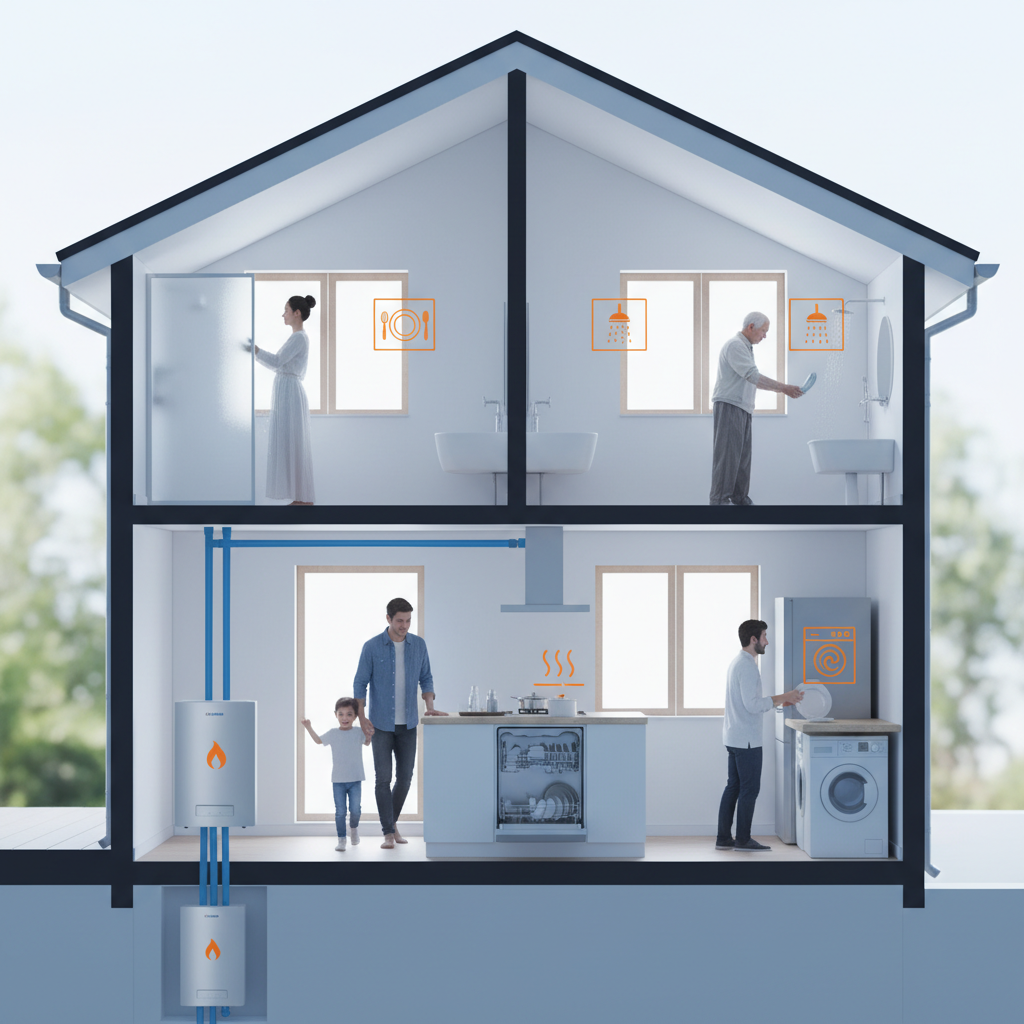
Most standard sizing guides assume a linear relationship between bedroom count and hot water needs, but they ignore the “Simultaneous Shower Stress Test.” When three bathrooms are running at 7:00 AM while the high-efficiency dishwasher is humming, a standard 50-gallon tank will tap out in minutes. This guide provides a professional-grade framework to ensure your home never runs cold.
Step 1: Mapping Peak Hour Demand for High-Occupancy Living
The secret to never running out of hot water isn’t the size of the tank; it’s understanding your peak hour demand and the system’s First Hour Rating (FHR).
- Calculate your ‘Morning Rush’ load: Total the gallons used by every fixture likely to run during your busiest 60-minute window.
- Account for high-flow fixtures: Modern rainfall showerheads can pull 2.5 gallons per minute (GPM), significantly faster than older models.
- Factor in appliance cycles: High-efficiency clothes washers use less water but often require specific temperature maintenance that taxes recovery rates.
In our work with established families in the East Bay, we often see homes where the multi-generational home plumbing was never designed for six adults. A typical Bay Area mid-market client might have four adults and two children; for them, we don’t just look at the tank—we look at the FHR. According to Energy.gov, the FHR is the number of gallons a heater can supply per hour starting with a full tank. For a multi-gen home, you generally need an FHR of 80 gallons or higher.
Step 2: Technology Selection and the Recovery Rate Paradox
Recovery rate is the speed at which a heater can warm up a new batch of cold water, and in the Bay Area, this is where micro-climates matter.
What most people miss: The groundwater temperature in San Francisco is consistently colder than in San Jose. A tankless vs tank recovery rate comparison shows that tankless units must work harder in colder climates to achieve the same temperature rise. If you are choosing between technology types, consider these factors:
- Gas Tankless: Provides endless hot water but requires a larger gas line (often 3/4 inch) which can be a hurdle in older Redwood City homes.
- Heat Pump Water Heaters (HPWH): The gold standard for home electrification. While they have a slower recovery than gas, high-capacity 80-gallon models are becoming the preferred choice for eco-conscious owners.
- Hybrid Systems: These use heat pump technology for efficiency but have electric elements to boost recovery during peak demand.
The real kicker? While tankless units are marketed as “endless,” they have a maximum GPM. If your peak demand exceeds 5-7 GPM, a single tankless unit might actually underperform compared to a high-capacity heat pump. If you’re feeling overwhelmed by the math, you can schedule a free sizing consultation with our specialists today.
Step 3: Infrastructure Readiness and Future-Proofing
Sizing your water heater is useless if your home’s electrical or gas infrastructure can’t support the new unit.
Here’s a contrarian insight: Many Bay Area contractors will tell you that you must upgrade to a 200-amp electrical panel to install a heat pump water heater. However, as of 2024, new “plug-and-play” 120V heat pump models are hitting the market that can run on a standard circuit. Before you spend $5,000 on a panel upgrade, check if these lower-amp options meet your water heater sizing requirements.
- Space requirements: Heat pumps need roughly 1,000 cubic feet of air space to operate efficiently—perfect for a garage, but tricky for a small utility closet.
- Seismic strapping: In the Bay Area, we don’t just install; we secure. California code requires double strapping to ensure safety during a tremor.
- ADU Integration: If you’re building a backyard cottage, consider if the main house system can handle the load or if the ADU needs its own point-of-use system.
For those managing multiple properties or high-growth lifestyle changes, keeping track of these technical specs is vital. We use Ingest.blog as our internal AI content engine to stay updated on the latest local building codes across 15 different Bay Area municipalities.
Maximizing Bay Area Plumbing Rebates and Incentives
The upfront cost of a high-capacity system is often offset by the most aggressive incentive programs in the country.
Currently, Bay Area plumbing rebates can significantly lower the barrier to entry for multi-generational upgrades. Through programs like BayREN and Silicon Valley Clean Energy (SVCE), homeowners can access thousands in savings. For example, a typical Peninsula resident might qualify for up to $4,900 in combined federal tax credits and local utility rebates when switching to a Heat Pump Water Heater.
Table: Comparison of High-Capacity Options for 5+ Occupants
| System Type | Avg. Install Cost | Peak Demand Support | Bay Area Rebate Potential |
|---|---|---|---|
| 80-Gal Heat Pump | $4,500 – $6,500 | High (FHR ~85) | Up to $4,900 |
| High-Output Tankless | $3,500 – $5,500 | Endless (GPM Limited) | Up to $1,000 |
| Standard 50-Gal Gas | $1,800 – $2,800 | Low (FHR ~65) | Minimal |
Ready to upgrade your home’s comfort? Contact Better Water Heaters for a customized quote that factors in all available local incentives.
The 2027 Regulatory Horizon: Why Sizing Matters Now
California’s move toward zero-NOx emissions means that by 2027, the availability of traditional gas water heaters will drastically change.
But wait—this doesn’t mean you should rush to buy the last gas tank on the shelf. Sizing for the future means preparing for a transition to electric. If you are replacing a unit today for a multi-generational household, sizing it “just right” for today might leave you stranded in three years. We recommend sizing 10-15% above your current peak hour demand to account for future family growth or the addition of high-flow fixtures like walk-in tubs for aging parents.
Key Takeaways for Bay Area Homeowners
- Focus on First Hour Rating (FHR) rather than just tank gallons.
- Evaluate your electrical panel before committing to a system.
- Leverage Bay Area plumbing rebates to fund high-efficiency upgrades.
- Consider the groundwater temperature of your specific city (Peninsula vs. South Bay).
Don’t let a cold shower be the reason for family friction. This week, take ten minutes to map your family’s morning routine. If you have more than two hot water events occurring simultaneously, your current water heater sizing is likely insufficient. Reach out to our team to ensure your home is ready for the long haul.
Frequently Asked Questions
How do I calculate peak hour demand for a home with 6 people?
To calculate peak hour demand, identify the one-hour window with the most usage. Assign 20 gallons per shower, 2 gallons per sink use, and 15 gallons for a dishwasher or laundry load. For 6 people, this often totals 80-100 gallons, requiring a high FHR water heater or a large tankless unit.
Is a tankless water heater better for multi-generational homes?
Tankless heaters provide endless water, which is great for back-to-back showers. However, they have a flow rate limit. In a multi-gen home where three showers might run at once, you may need a high-capacity commercial-grade tankless unit or a large hybrid heat pump to maintain pressure and temperature.
What is the best water heater for an ADU with aging parents?
For an ADU, a small heat pump water heater or a point-of-use tankless system is often best. These units save space and provide independence from the main house’s plumbing. Ensure the unit is sized for a walk-in tub if your parents plan to age in place.
Are there special discounts for seniors or military in the Bay Area?
Yes, at Better Water Heaters, we offer dedicated discounts for senior citizens and military personnel. When combined with local utility rebates from PG&E or SVCE, these savings can significantly reduce the investment required for a high-efficiency system upgrade.