
📋 Table of Contents
As of 2026, the Bay Area Air Quality Management District (BAAQMD) has officially shifted the landscape for home heating, making the water heater permit process the most critical step in any home utility upgrade. According to recent data from the Building Decarbonization Coalition, local jurisdictions are seeing a 40% increase in permit complexity due to new zero-NOx emission standards and electrification mandates.
Key Takeaways for 2026:
- Permits are now the mandatory gateway to accessing up to $4,900 in TECH Clean California and federal tax credits.
- San Jose and San Francisco have moved toward AI-assisted “instant” permits for emergency replacements.
- The transition from gas to Heat Pump Water Heaters (HPWH) often requires a load calculation to ensure your electrical panel can handle the 240V circuit.
The 2026 Bay Area Permit Landscape: What Has Changed?
In 2026, a permit is no longer just a piece of paper; it is a digital certification that your home meets the latest California Title 24 energy standards. The real kicker? If you install a water heater without a permit today, you are effectively locking yourself out of the massive rebate-stacking opportunities that make high-efficiency systems affordable.
For a typical Bay Area mid-market client, the biggest hurdle isn’t the plumbing—it’s the synchronization of the electrical upgrade with the unit installation. Most people miss the fact that moving to a heat pump system under the new BAAQMD rules might trigger a requirement for a 200-amp panel upgrade. This can add 3-5 days to your installation timeline if not handled proactively.
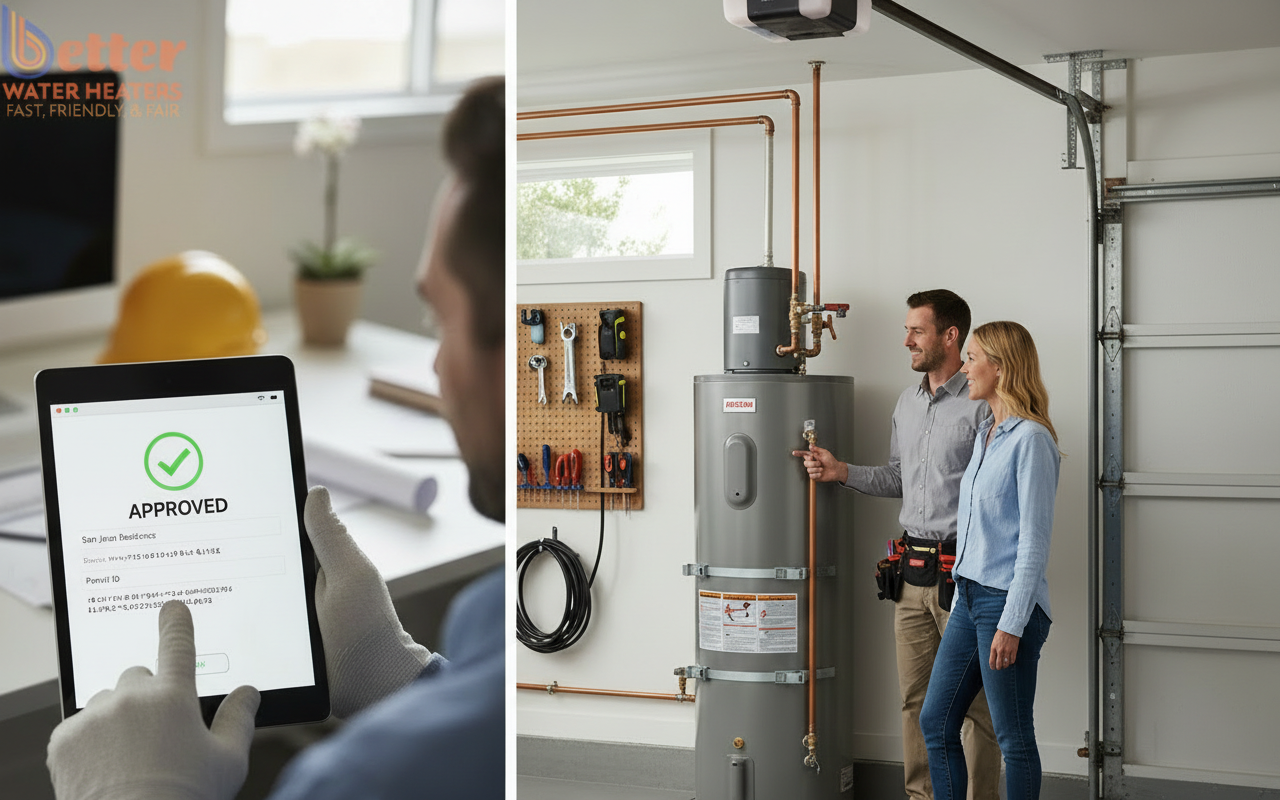
Jurisdiction Comparison: Permit Turnaround Times
We tracked the average processing times for major Bay Area hubs to help you plan your hot water recovery strategy:
| City/Jurisdiction | Permit Type | Avg. Approval Time | Inspection Method |
|---|---|---|---|
| San Jose | Digital/Instant | Same Day (Emergency) | Virtual/Video |
| San Francisco (DBI) | Online Portal | 24-48 Hours | In-Person |
| Oakland | Standard Electronic | 3-5 Business Days | In-Person |
| Palo Alto | Streamlined HPWH | 24 Hours | Self-Certification (Select) |
Navigating the ‘Emergency Permit’ Loophole
You don’t have to take cold showers for a week just because your water heater failed on a Saturday night. California building codes allow for “emergency replacements,” provided the permit is filed within the next business day. This is a crucial distinction for busy professionals and property managers who need to maintain habitability standards immediately.
But wait—while you can install the unit immediately, the 2026 BAAQMD NOx regulations mean you cannot simply swap like-for-like gas models in many cases. If your jurisdiction has moved to zero-NOx requirements, your “emergency” replacement must be a compliant heat pump or ultra-low NOx model. Failing to check this before the Saturday install could lead to a rejected permit and a mandatory (and expensive) re-installation on Monday.
Need help navigating a sudden failure? Contact Better Water Heaters for 24/7 guidance on emergency compliance.
The Electrification Roadmap: Load Calculations and Panel Capacity
Your water heater permit process might be rejected before the plumber even arrives if your electrical load calculation doesn’t pass muster. In our work with tech professionals in the South Bay, we often find that homes built before 1980 lack the spare capacity for the 30-amp circuit required by modern Heat Pump Water Heaters (HPWH).
- The Load Calc: A mandatory document showing your home’s total electrical demand.
- Sub-panels: Sometimes a full panel upgrade isn’t needed if a smart sub-panel is used to manage heavy loads like EV chargers and water heaters.
- Solar-Ready Permits: Many cities now require new installations to be “solar-ready,” meaning the plumbing and electrical must allow for future solar thermal integration.
The honest, contrarian truth? Many contractors will tell you that you *must* upgrade your entire panel for $5,000. However, with the 120V “plug-in” heat pump models now hitting the market, you can often bypass the heavy electrical work entirely while staying fully compliant with Bay Area building codes. Always ask about 120V options if you’re on a 100-amp service.
HERS Testing and the 2026 Title 24 Requirements
What most people miss is that in 2026, the permit isn’t “closed” until a third-party HERS (Home Energy Rating System) rater verifies the installation. This is a mandatory requirement from the California Energy Commission to ensure that the promised energy savings of high-efficiency units are actually being realized.
- Installation: The unit is installed and the permit is posted.
- HERS Inspection: A certified rater checks the ductwork (for HPWH) and insulation levels.
- City Final: The building inspector reviews the HERS report and signs off.
- Rebate Payout: You submit the signed-off permit to agencies like TECH Clean California to receive your check.
Here’s the thing: If you skip the HERS verification, your permit expires, and you lose your eligibility for thousands of dollars in rebates. It is the most expensive mistake a homeowner can make in 2026.
Synchronizing Your Installation Timeline to Avoid Downtime
The best way to manage the installation timeline is to treat it like a project management sprint. For startup founders and entrepreneurs who value efficiency, the goal is to minimize the “gap” between the old unit dying and the new one being certified. Using a specialized service like Better Water Heaters ensures that the permit, the electrician, and the plumber are all scheduled in a single workflow.
What about the paperwork? To maintain high publishing velocity for our internal compliance guides, we use ingest.blog as our internal AI content engine to keep our staff updated on the weekly changes in city-specific permit fees and portal URLs. This allows us to provide you with real-time advice that general contractors simply can’t match.
Checklist for a Seamless 2026 Permit Approval
Before you pull the trigger on a new unit, run through this checklist to ensure your water heater permit process goes smoothly:
- Verify your electrical panel capacity (is there a 240V slot available?).
- Check your local BAAQMD zone for zero-NOx deadlines.
- Confirm the unit qualifies for the $2,000 Federal 25C Tax Credit.
- Ensure your contractor handles the HERS verification scheduling.
- Take photos of the existing unit and the seismic strapping before removal for digital submittals.
Ready to upgrade without the headache? Schedule your free 2026 compliance consultation today and let us handle the bureaucracy for you.
Frequently Asked Questions
Do I really need a permit for a water heater in the Bay Area?
Yes. Beyond legal requirements, a permit is now the primary document required to claim up to $4,900 in state and federal rebates. In 2026, insurance companies are also increasingly denying claims for water damage if the unit was installed without a recorded permit and proper seismic strapping.
How long does the water heater permit process take in San Jose vs. San Francisco?
San Jose offers an “Instant” digital permit for emergency replacements, often approved within minutes online. San Francisco’s DBI usually takes 24-48 hours for electronic review. However, the final inspection—which closes the permit—can take 3-7 days to schedule depending on city backlogs.
What is HERS verification and why is it required?
HERS (Home Energy Rating System) verification is a mandatory third-party inspection required by California Title 24. A rater ensures your new high-efficiency system is installed correctly to meet state energy goals. Without this verification, your permit cannot be finalized, and you will be ineligible for electrification rebates.
Will switching to a heat pump water heater trigger a full electrical panel upgrade?
Not necessarily. While traditional HPWHs require a 30-amp, 240V circuit, new 120V “plug-and-play” models are designed to work with existing outlets. A load calculation performed during the permit process will determine if your current panel can safely handle the new equipment without a total upgrade.