
📋 Table of Contents
In the Bay Area, a water heater failure in a multi-family building isn’t just a maintenance headache; according to industry data from the National Apartment Association, water damage remains one of the leading causes of non-weather-related insurance claims for property owners. Ensuring proper water heater commissioning during installation is the only way to move from reactive repairs to proactive risk management.
Key Takeaways for Property Managers
- Verify thermal expansion settings to prevent premature tank failure.
- Ensure seismic bracing meets the latest California Building Code for high-density housing.
- Document flow rates and mixing valve temperatures to mitigate scalding liability.
- Leverage 2025-2026 electrification rebates to offset up to $4,900 in upgrade costs.
1. Hydraulic Integrity: Verifying Pressure and Thermal Expansion
The most common reason new tanks fail within five years is a failure to account for thermal expansion in closed-loop systems. When water heats up, it expands; if that pressure has nowhere to go, it creates internal stress that weakens the tank’s glass lining.
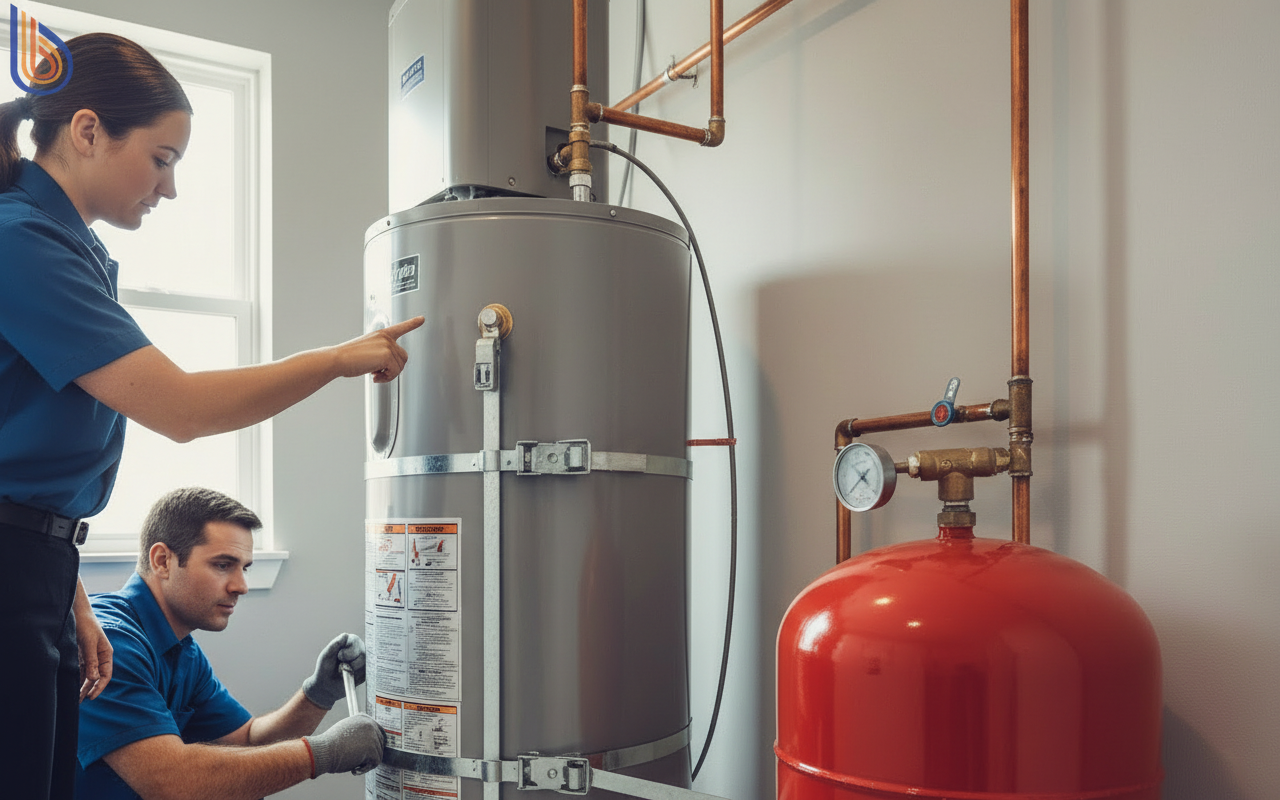
What most people miss is that many Bay Area municipalities have high baseline water pressure, often exceeding 80 PSI. During the water heater commissioning process, a technician must verify that the expansion tank is pre-charged to match the home’s static water pressure. If these numbers don’t align, the expansion tank is essentially a decorative paperweight.
- Measure static incoming water pressure using a calibrated gauge.
- Adjust the thermal expansion tank pre-charge to match the system pressure.
- Test the Temperature and Pressure (T&P) relief valve for proper discharge.
- Check for water hammer arrestors in buildings with fast-acting solenoid valves (like dishwashers).
In our work with mid-market property management firms in San Jose, we’ve found that documenting these baseline pressures at install can reduce “failure to maintain” disputes with insurance adjusters later. If you’re managing multiple units, having a standardized report for every install is non-negotiable for property management plumbing strategy.
2. Seismic Safety: Beyond the Basic Straps
Living near the San Andreas or Hayward faults means your commercial water heater maintenance must prioritize seismic stability over everything else. California Health and Safety Code Section 19211 requires all water heaters to be braced, anchored, or strapped to resist falling during an earthquake.
But wait—standard strapping kits often fail in high-density multi-family environments where heaters are tucked into tight closets or stacked. For property managers, the risk isn’t just the unit falling; it’s the gas line snapping or the water line flooding three floors of tenant improvements. Proper commissioning involves verifying that the straps are located in the upper and lower one-third of the tank and that there is zero “slop” or movement allowed.
- Verify heavy-duty seismic bracing for units over 52 gallons.
- Ensure gas flex lines have adequate “swing” room to prevent snapping.
- Confirm the use of Grade 5 bolts when anchoring to concrete or masonry.
- Check for proper clearance from combustible materials.
The real kicker? After recent tremors in the North Bay, building inspectors are looking closer at the lag bolt depth in wall studs. If your installer just hit the drywall, your building is a liability. Need an expert eye on your portfolio? Schedule a professional site inspection today.
3. Thermal Performance and Title 24 Compliance
California’s Title 24 standards are becoming increasingly strict regarding energy delivery and heat loss. Commissioning isn’t finished until you’ve verified that the thermostatic mixing valve is set to a safe temperature (typically 120°F) while the tank is maintained at a high enough temperature (140°F) to prevent Legionella growth.
Here’s the thing: most property managers ignore the “first-hour rating.” If you’re transitioning to a heat pump water heater to meet San Francisco or San Jose electrification mandates, the recovery time is different than gas. Commissioning ensures the unit is programmed for the correct mode (Hybrid vs. Heat Pump Only) to prevent tenant “no hot water” complaints on Monday morning.
| Feature | Standard Gas Tank | Heat Pump (HPWH) |
|---|---|---|
| Recovery Rate | High (40+ GPH) | Moderate (20-30 GPH) | Requires extra insulation | Highly Compliant |
| Bay Area Rebates | Minimal | Up to $4,900+ |
According to Energy.gov, heat pump models can be two to three times more energy-efficient than conventional electric heaters. For a typical Bay Area mid-market client, switching to these units isn’t just about the environment; it’s about reducing the common-area electrical load and meeting Title 24 compliance California standards.
4. Digital Documentation and Leak Detection Integration
The final step of a modern water heater commissioning process is the digital hand-off. In an era of rising insurance premiums, a paper receipt from a plumber isn’t enough. You need a commissioning report that includes photos of the seismic bracing, the expansion tank pressure reading, and the final temperature setpoint.
What most people miss is the integration of smart leak detection. For high-rise managers, a $200 smart shut-off valve can save $200,000 in flooring and litigation. As part of the commissioning, we verify that these sensors are placed in the most likely path of travel for water and that the auto-shutoff is synced to the building’s Wi-Fi.
- Capture high-resolution photos of all safety components.
- Test the auto-shutoff functionality of smart leak detectors.
- Log the serial and model numbers for warranty registration.
- Provide the tenant with a simple “emergency shut-off” guide.
Transitioning from gas to electric shouldn’t cause tenant disruption. By using a structured commissioning process, you ensure the new system is “Insurance-Ready” from day one. If you’re looking to scale your property content or maintenance documentation, our internal AI content engine, Ingest.blog, helps us keep our clients informed with the latest regulatory updates at high velocity.
The Contrarian View: Why “Code Minimum” is a Risk
I’ll be honest: many contractors will tell you that meeting the local building code is enough. It isn’t. Code is the minimum legal standard to keep a building from falling down or burning; it is not a performance standard. For a property manager, “code minimum” often leads to a system that lasts 8 years instead of 15. Investing an extra hour in the water heater commissioning phase to dial in the water chemistry and pressure settings pays for itself by deferring capital expenditures.
Ready to protect your investment? Contact Better Water Heaters to discuss a portfolio-wide maintenance and commissioning plan that keeps you ahead of 2027 gas regulations.
Frequently Asked Questions
What is the difference between installation and commissioning?
Installation is the physical act of connecting the unit to water and power. Commissioning is the technical process of testing the unit under load, verifying safety settings, and ensuring it meets specific performance and regulatory standards like Title 24. It’s the difference between “it turns on” and “it works perfectly and safely.”
Why is seismic bracing different for multi-family buildings?
In high-density Bay Area housing, the vibration of a water heater during a tremor can be amplified by the building’s structure. Seismic bracing requirements for these units often require double-strapping and specific anchoring into structural members to prevent the tank from becoming a projectile or snapping rigid gas lines.
Can I get rebates for heat pump water heaters in the Bay Area?
Yes, programs like TECH Clean California and local utility incentives from Peninsula Clean Energy or Silicon Valley Clean Energy offer significant heat pump water heater incentives Bay Area residents can use. Some property managers qualify for over $4,000 per unit depending on the building type and location.
How often should property managers perform maintenance?
For commercial water heater maintenance, we recommend a professional inspection every 12 months. This includes flushing sediment, checking the anode rod, and re-verifying the expansion tank pressure. In areas with hard water, like parts of the East Bay, this may need to be done every 6 months.