
📋 Table of Contents
According to the U.S. Department of Energy, water heating accounts for nearly 20% of a building’s energy use, making it the highest-impact target for property managers facing new decarbonization mandates. If you are managing a 20-unit complex in San Jose or a high-density HOA in Redwood City, the multi-unit water heater retrofit is no longer a ‘future’ project—it is a current regulatory necessity.
But here is the reality: most property managers stall because they fear a total electrical service upgrade will cost more than the building is worth. At Better Water Heaters, we have spent 20 years navigating the Bay Area’s unique codes, and we have found that a strategic building infrastructure assessment often reveals hidden capacity that makes electrification far more affordable than the initial bids suggest.
Stage 1: The ‘Hidden Capacity’ Infrastructure Audit
The biggest mistake in a multi-unit water heater retrofit is assuming your current electrical panel is already at its limit based on nameplate ratings alone. Real-world demand is almost always lower than theoretical peak load, which means you likely have “electrical headroom” you didn’t know existed.
- Data Logging Over Estimation: Instead of relying on static calculations, we use IoT-enabled data loggers to track actual building energy usage over a 30-day period.
- Load Management Evaluation: Modern load shedding water heaters can pause heating cycles during peak elevator or HVAC usage, preventing the need for expensive utility-side transformer upgrades.
- Circuit Mapping: We identify underutilized 240V circuits from decommissioned equipment that can be repurposed for commercial heat pump water heater units.
In our work with typical Bay Area mid-market clients, we often find that by implementing smart controls, a building can support a 40% increase in electric load without touching the main service entrance. This is the difference between a $20,000 project and a $100,000 infrastructure nightmare.
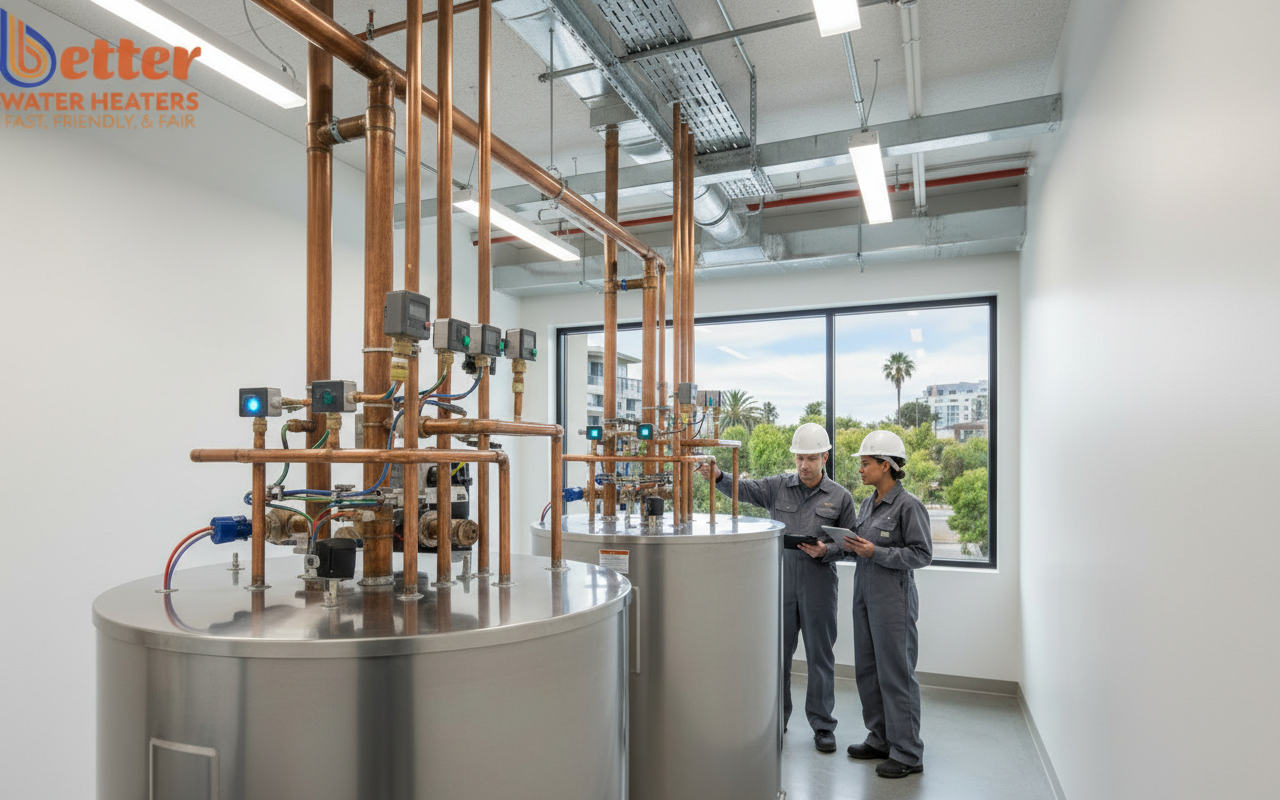
Navigating Bay Area Electrical Codes
Local regulations, such as those from the Bay Area Air Quality Management District, are pushing toward zero-NOx requirements by 2027. This means your property management plumbing strategy must account for Title 24 compliance today to avoid being red-tagged tomorrow.
What most people miss is that California’s building code allows for “Right-Sizing” through diversity factors in multi-family dwellings. You don’t necessarily need to provide peak simultaneous hot water for every unit at 6:00 AM if you have sufficient thermal storage tanks to buffer the demand.
Stage 2: Technology Selection and Right-Sizing
Choosing between centralized storage and point-of-use systems is the pivot point that determines your long-term ROI and tenant satisfaction. A multi-family electrification strategy isn’t one-size-fits-all; it’s a balance of mechanical room footprint and piping heat loss.
| Feature | Centralized Heat Pump | Decentralized (Unit-by-Unit) |
|---|---|---|
| Installation Complexity | High (requires plant space) | Moderate (requires unit access) |
| Energy Efficiency | Highest (shared thermal mass) | High (no loop heat loss) |
| Maintenance | Single point of service | Multiple service points |
| Bay Area Rebates | Up to $4,900+ per unit | Standard individual rebates |
The real kicker? Centralized systems allow you to leverage the IRA Section 179D tax deduction, which rewards building owners for significant reductions in energy intensity. If you’re looking for the most efficient way to scale, explore our heat pump comparison guides to see which brands like Rheem or Nyle fit your building’s footprint.
Need a professional second opinion on your building’s capacity? Schedule a free infrastructure consultation with our Bay Area specialists today.
Stage 3: The Phased Implementation and Incentive Mapping
You do not have to flip a switch and go 100% electric overnight. A phased multi-unit water heater retrofit allows you to manage cash flow while taking advantage of expiring rebates.
- The Hybrid Bridge: Install a heat pump primary heater while keeping your existing gas boiler as a high-limit backup for extreme peak events.
- Stacking Incentives: Combine TECH Clean California rebates with federal tax credits and local utility programs like MCE or Peninsula Clean Energy.
- Tenant-Centric Scheduling: Perform installations in “vertical stacks” to ensure no single tenant is without water for more than four hours.

Here’s an honest, contrarian insight: sometimes, the best retrofit isn’t a full replacement. If your building has a complex recirculating loop, a 100% electric conversion might actually increase your energy bills if the piping isn’t re-insulated. We often recommend a “Plumbing First” approach—insulating the distribution lines before upgrading the source—to ensure the new heat pump isn’t working twice as hard to overcome heat loss.
Maximizing the Inflation Reduction Act (IRA)
As of 2025, the financial landscape for property management plumbing has shifted dramatically. The EPA’s Energy Star program outlines how multi-family properties can qualify for substantial tax credits. For a typical 50-unit building, the combination of federal and local incentives can cover up to 60% of the total project cost.
But wait—don’t forget the permits. In cities like San Francisco or San Jose, the permit process for a centralized commercial heat pump water heater can take weeks. Our team handles the entire submittal process, ensuring your seismic strapping and drainage meet the latest 2024 California Plumbing Code requirements.
Overcoming Tenant Disruption During Retrofits
The fear of tenant complaints is often the biggest hurdle for property managers. However, using a phased approach means you can maintain “business as usual” for 90% of the building while the mechanical room is being upgraded.
- Temporary Bypass Systems: We set up temporary hot water loops to ensure residents have service during the primary swap.
- IoT Monitoring: Post-installation, we use smart leak detection to provide peace of mind to both the owner and the residents.
- Communication Templates: We provide managed properties with clear timelines to share with tenants, reducing friction and perceived inconvenience.
If you’re managing multiple properties, maintaining a high volume of educational touchpoints with your stakeholders is key. For those scaling their own digital presence, our internal AI content engine, Ingest.blog, helps us keep our clients informed with the latest regulatory updates at speed.
The Financial Reality of Doing Nothing
The cost of waiting is rising. Between the 2027 gas water heater bans and the increasing price of natural gas in the Bay Area, sticking with legacy systems is becoming a liability. A building infrastructure assessment today protects your asset value for the next decade.
What most property managers miss is the “Resale Value Bump.” Buildings with fully electrified, high-efficiency systems are commanding higher valuations from institutional buyers who are focused on ESG (Environmental, Social, and Governance) metrics. Your water heater isn’t just a utility; it’s a piece of your building’s financial performance.
Ready to future-proof your property? Don’t wait for a catastrophic tank failure to start your transition. Contact Better Water Heaters today for a comprehensive 3-stage assessment of your multi-unit property. We’ll help you find the rebates, navigate the codes, and keep your tenants happy.
Frequently Asked Questions
How do I know if my building needs an electrical service upgrade for a heat pump?
A professional building infrastructure assessment using 30-day data logging is the only way to be certain. Many older Bay Area buildings have significant ‘hidden capacity’ because their original electrical designs were highly conservative. We often find that smart load-sharing controllers can eliminate the need for a utility-side upgrade entirely.
What is the typical ROI for a multi-unit water heater retrofit?
While costs vary, most properties see a full return on investment within 4 to 7 years. This is achieved by stacking IRA tax credits, local Bay Area rebates (often exceeding $4,000 per unit), and the significant reduction in monthly energy bills provided by high-efficiency heat pump technology compared to traditional gas boilers.
Will my tenants be without hot water during the installation?
No. Using our 3-stage framework, we implement temporary bypass systems or phased installs that ensure hot water remains available. We typically schedule the final switch-over during low-usage mid-day hours, resulting in less than 4 hours of planned downtime, which is communicated to residents well in advance.
Does the 2027 gas water heater ban apply to my existing building?
As of now, the BAAQMD regulations primarily target the sale and installation of new equipment. This means when your current gas system fails after 2027, you will likely be required to replace it with a zero-NOx (electric) alternative. Planning your multi-family electrification strategy now allows you to avoid emergency costs when the regulations take full effect.