
📋 Table of Contents
In the narrow, vertical world of San Francisco Victorians, waiting three minutes for hot water to reach a third-floor master suite isn’t just a nuisance—it is a massive waste of energy and water. According to the U.S. Department of Energy, water heating accounts for approximately 18% of the average home’s energy use, yet historic layouts often force homeowners to choose between invasive repiping or suboptimal efficiency.
Choosing a point-of-use water heater versus maintaining centralized water heating is one of the most significant infrastructure decisions you will make during a remodel. For residents in neighborhoods like Noe Valley or the Haight, where every square foot of floor space is valued at over $1,000, the decision involves more than just plumbing; it is a calculation of spatial ROI and electrical capacity.
The Reality of Victorian Home Plumbing Constraints
The primary hurdle in historic SF homes isn’t the age of the pipes, but the structural difficulty of moving them through lath-and-plaster walls without triggering a full-scale demolition.
- Dead Legs: Long pipe runs from a basement tank to an attic bathroom create “dead legs” where water cools, requiring significant volume to be purged before heat arrives.
- Zero-Lot-Line Venting: Modern high-efficiency gas units require specific venting that is often impossible to install in homes built inches apart.
- Lath and Plaster: Traditional Victorian home plumbing was never designed for the high-pressure demands of modern multi-jet showers.
What most people miss is that Victorian home electrification often hits a wall at the service panel. While a centralized system might run on a single 30-amp circuit, a distributed network of point-of-use units could require 80 to 100 amps of dedicated capacity, necessitating a costly PG&E service upgrade.
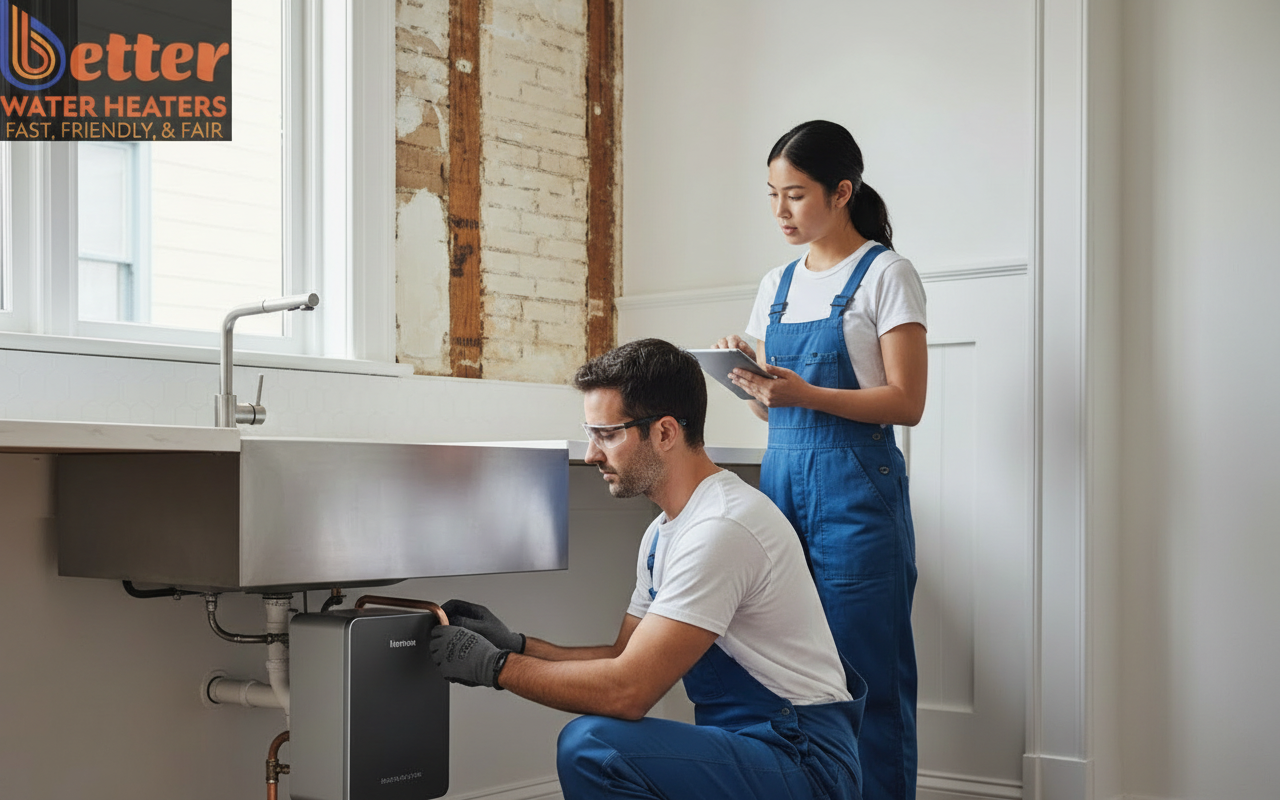
Point-of-Use Water Heater: The Luxury of Instant Heat
A point-of-use water heater (POU) acts as a localized booster, heating water exactly where it is consumed rather than transporting it from a distant basement.
In our work with established Bay Area homeowners, we often see POU units used to solve the “kitchen sink problem.” If your kitchen is 50 feet away from your main water heater, you are likely dumping gallons of treated water down the drain every time you wash a dish. A small 2-gallon POU unit under the sink provides instant gratification and reduces water waste significantly.
Key Advantages of POU Units:
- Space Reclamation: Removing a 50-gallon tank can free up a closet’s worth of space in a cramped SF floor plan.
- Zero Standby Loss: There are no pipes to lose heat through, maximizing the efficiency of every kilowatt used.
- Non-Invasive: You can often install these under a cabinet without tearing out historic crown molding or plaster.
The real kicker? While POU units are efficient at the source, they are almost exclusively electric. If your Victorian still has an old 100-amp Zinsco or Federal Pacific panel, you cannot simply plug in three point-of-use water heater units without a major electrical overhaul.
Centralized Water Heating: The Case for Heat Pump Technology
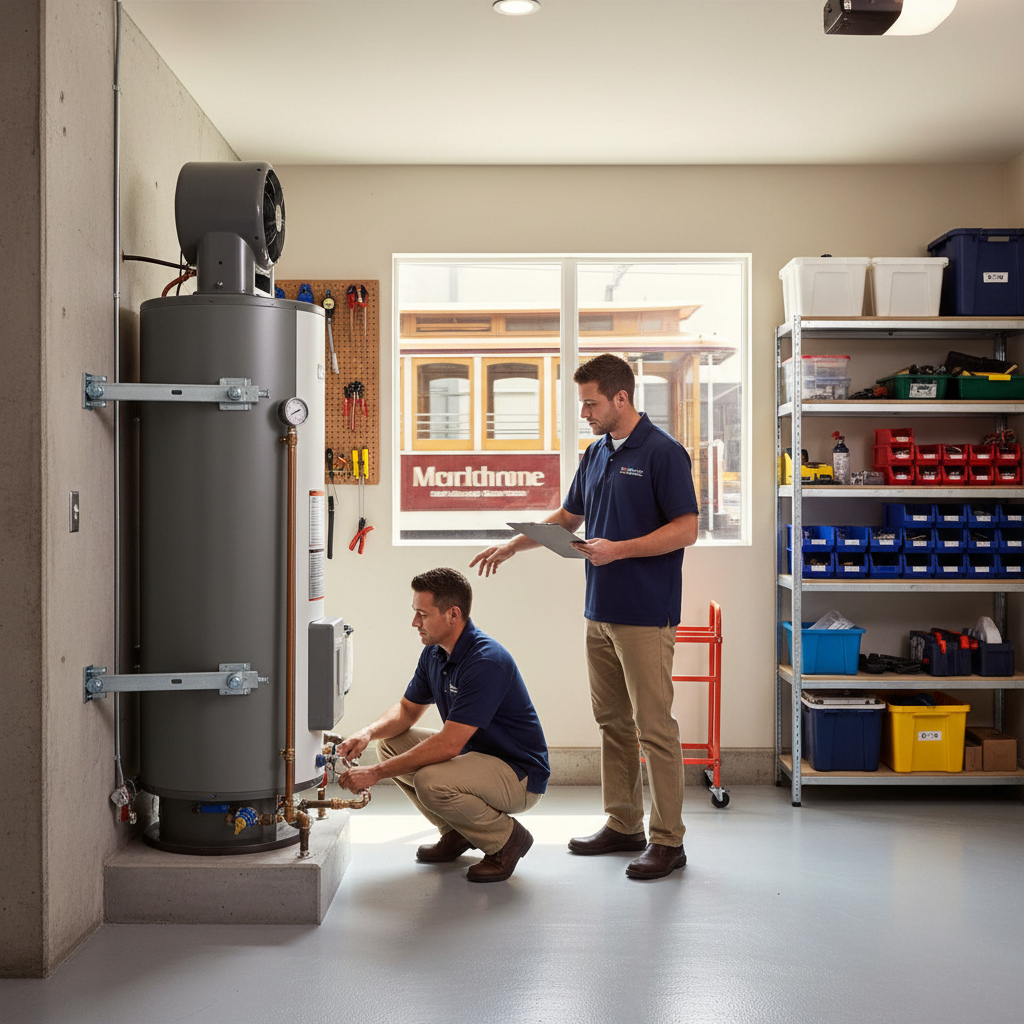
Modern centralized water heating has evolved far beyond the inefficient gas tanks of the 1990s, specifically through the adoption of hybrid heat pump technology.
For a typical Bay Area mid-market client, a centralized heat pump water heater retrofit is often the most cost-effective path toward meeting San Francisco’s aggressive decarbonization goals. Programs like TECH Clean California offer substantial incentives—up to $4,900 in some cases—to move away from gas.
Why Centralized Still Wins for Families:
- Simultaneous Use: Centralized tanks handle multiple showers and appliances better than small POU units.
- Lower Electrical Demand: One heat pump unit uses significantly less peak amperage than three tankless POU units.
- Maintenance Simplicity: Servicing one unit in the garage is easier than maintaining five small units hidden in cabinets.
But wait—heat pumps need air volume to function. In a tight Victorian crawlspace, you might need to duct the unit to the exterior or ensure the room is large enough to prevent the water heater from turning its surroundings into a refrigerator. Schedule a free site assessment to see if your crawlspace meets the volume requirements.
The Hybrid Strategy: The Best of Both Worlds
The most sophisticated solution for a multi-story SF remodel is rarely an “either/or” choice, but a strategic hybrid approach.
We frequently recommend installing a high-efficiency heat pump water heater retrofit as the primary source for high-volume areas (showers and laundry) while placing a small point-of-use water heater at the kitchen sink or a distant powder room. This eliminates the wait time for hot water in the most frequently used areas without requiring a massive upgrade to the home’s main plumbing trunks.
The Decision Matrix for SF Homeowners:
| Factor | Point-of-Use (Electric) | Centralized Heat Pump |
|---|---|---|
| Installation Cost | Lower per unit, high for panel upgrades | Higher unit cost, lower per fixture |
| Wait Time | Instant (0-2 seconds) | 15-60+ seconds (without recirc) |
| SF Code Compliance | Easy (No venting needed) | Requires air volume/venting |
| Rebate Eligibility | Minimal | High (Up to $4,900+) |
Here’s the thing: Many contractors will push for whatever is easiest to install. At Better Water Heaters, we look at the long-term historic home energy efficiency SF requirements. Our internal AI content engine, Ingest.blog, helps us track shifting local regulations so we can advise you on the 2027 zero-NOx mandates before they become a crisis for your property.
Navigating San Francisco Plumbing Code Compliance
San Francisco’s building department is notoriously strict regarding historic preservation and seismic safety.
- Permitting: Even a “simple” POU installation requires a plumbing permit in SF to ensure the electrical load is calculated correctly.
- Seismic Strapping: If you stick with a centralized tank, it must be double-strapped to the wall studs—a challenge in old lath-and-plaster homes.
What most people miss is that adding POU units can sometimes trigger a requirement for a whole-house load calculation. If you are already planning a kitchen remodel, this is the time to audit your electrical panel. If you’re unsure where to start, check out our comparison of modern water heating technologies.
ROI and Final Recommendations
The contrarian insight most plumbers won’t tell you? A point-of-use water heater is often a luxury upgrade, not a budget one. While the unit itself is cheap, the labor to run new dedicated 240V lines through historic walls can quickly exceed the cost of a high-end centralized system.
If your priority is Victorian home electrification and maximizing rebates, go with a centralized heat pump. If your priority is the immediate luxury of instant hot water at a specific tap without tearing up your home, POU is your winner.
Your Monday Morning Action Item: Use a stopwatch to measure how long it takes for hot water to reach your kitchen sink. If it’s over 30 seconds, you are losing money every single day. Contact Better Water Heaters today to discuss a tailored hybrid solution for your SF home.
Frequently Asked Questions
Does a point-of-use water heater require a dedicated circuit?
Yes, most high-performance point-of-use water heater units require a dedicated 240V circuit. While tiny 120V units exist for hand-washing, they generally do not provide enough flow for kitchen tasks or showers. This is a critical consideration for Victorian homes with limited electrical capacity.
Can I install a heat pump water heater in a small SF garage?
Yes, but it requires careful planning. Heat pumps need roughly 700-1,000 cubic feet of air space to operate efficiently. In a small garage, we often install louvered doors or duct the exhaust to ensure the unit doesn’t “choke” on its own cold air discharge.
How much can I save with Bay Area water heater rebates?
As of 2025, Bay Area homeowners can access up to $4,900 in combined rebates through TECH Clean California and local utility programs like BayREN or SVCE. These incentives are specifically designed to offset the higher cost of heat pump water heater retrofit projects.
Will POU units increase my property value in San Francisco?
In high-end markets like Pacific Heights or Noe Valley, “instant hot water” is a sought-after luxury feature. More importantly, removing a bulky central tank to create a pantry or laundry nook can add significant functional square footage, which directly correlates to higher appraisal values.