Water heater article archive
Palo Alto Heat Pump Noise Ordinances: The $3,200 Quiet Lie
Historical article, not newly reviewed advice. Verify current requirements, incentives and model guidance with the relevant authority or manufacturer before relying on them. Equipment and service needs require an assessment.
📋 Table of Contents
One Palo Alto homeowner recently pocketed a $3,000 rebate for a high-efficiency heat pump, only to be slapped with a $5,000 mitigation order three weeks later because their neighbor couldn't sleep. The heat pump noise ordinances in the Bay Area are the hidden 'kill switch' for electrification projects that most contractors are too scared—or too ignorant—to mention.
Here’s the cold truth: a unit that sounds like a soft hum in a massive Texas backyard sounds like a jet engine in a 5-foot-wide Palo Alto side-yard. When you trap a compressor between two stucco walls, you aren't just heating water; you're building an acoustic combustion chamber. Most 'pro' installers are chasing the TECH Clean California incentives without checking the decibel math, leaving you to deal with the City of Palo Alto’s code enforcement officers.
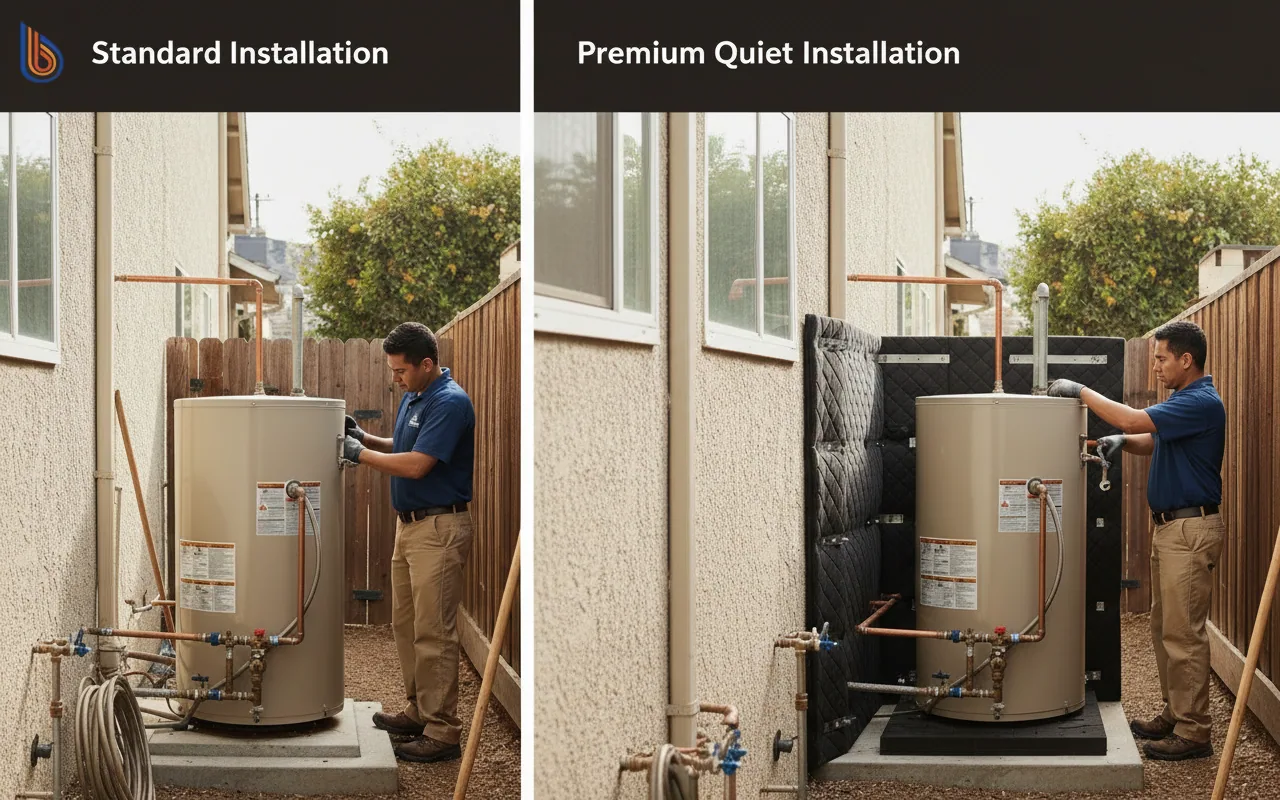
The Echo Chamber Effect: Why Palo Alto Building Codes Matter
The real kicker? A standard 55-decibel (dB) rating on a spec sheet is measured in a laboratory, not in a narrow alleyway where sound bounces off hard surfaces indefinitely.
- The 5-Foot Trap: Most Palo Alto homes have side-yard setbacks that barely meet the minimum, causing sound waves to amplify by up to 10-15dB via reflection.
- Nighttime Limits: Local Palo Alto building codes often restrict noise to 45-50dB at the property line during late hours—a threshold many heat pumps cross the second the compressor kicks in.
- The Vibration Factor: It’s rarely just the air; it’s the structural resonance vibrating through your neighbor’s bedroom wall.
What most people miss is that sound is logarithmic. A 3dB increase actually represents a doubling of sound energy. When your contractor says, "It's only a few decibels louder than a dishwasher," they are technically lying about the physical impact on your environment. According to the U.S. Department of Energy, placement is just as critical as the technology itself.
The $3,200 Trap: Rebates vs. Compliance Costs
One of our clients in Old Palo Alto thought they were being savvy by stacking federal tax credits with local rebates to cover their $4,500 installation. They ended up spending an additional $3,200 on acoustic fencing and vibration isolation pads just to stop the daily calls from the HOA.
The real surprise? Many high-volume installers ignore heat pump noise ordinances because they want the quick turnaround. They’ll bolt a Sanden or Rheem directly to a plastic pad on the dirt, which acts like a drum skin. If your installer isn't talking about seismic strapping and acoustic decoupling, they aren't doing a Bay Area install; they're doing a liability install.
| Feature | Standard Installation | Better Water Heaters Standard |
|---|---|---|
| Mounting | Direct Bolt | Dual-Layer Vibration Dampening | Placement | Shortest Pipe Run | Acoustic Path Analysis | Compliance | "Should be fine" | Palo Alto Noise Code Verification | Rebate Help | Hands-off | Full Documentation Support |
Need to know if your site is compliant? Schedule a professional sound-path audit today before the city knocks on your door.
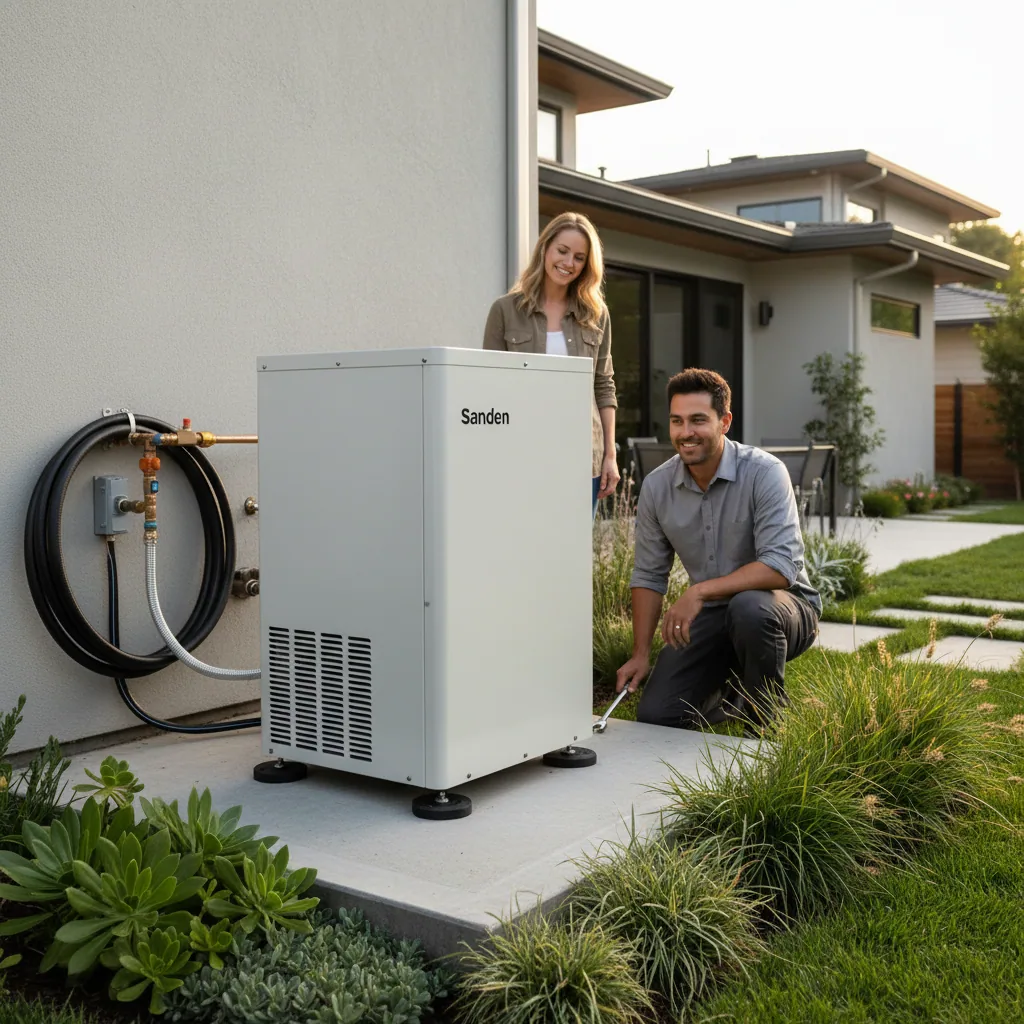
Quietest Water Heater Brands: Sanden vs. Rheem vs. AO Smith
Choosing the quietest water heater brands isn't just about brand loyalty; it's about the specific compressor architecture used for California’s climate.
- Sanden SanCO2: The gold standard for silence. Because the compressor is a separate outdoor unit designed with high-end Japanese engineering, it operates at roughly 37dB—quieter than a library.
- Rheem ProTerra: A solid mid-range choice, but it requires specific acoustic enclosures for water heaters if placed near windows.
- AO Smith Voltex: Great efficiency, but the top-ducted fan can create a 'drone' that carries across property lines if not angled correctly.
Contrarian insight: Sometimes the 'most efficient' unit on paper is the worst choice for a Palo Alto home. If a unit is 4% more efficient but 10dB louder, the cost of potential litigation and neighbor mediation far outweighs the $12 a year you'll save on PG&E. We often recommend the Sanden system for tight lots because it eliminates the 'neighbor headache' entirely.
Strategic Placement: The Good Neighbor Policy
Strategic placement is the difference between a successful green upgrade and a legal nightmare. You cannot simply swap a gas tank for a heat pump in the same footprint without considering the air discharge path.
- Orientation Matters: Never point the fan exhaust directly at a neighbor's window or a fence; it creates a localized pressure zone that increases noise.
- Mass-Loaded Vinyl: Using acoustic enclosures for water heaters lined with mass-loaded vinyl can drop perceived noise by 50%.
- The 45-Degree Rule: Angling the unit can help disperse sound waves rather than letting them bounce directly between parallel walls.
But wait—before you build a box around it, remember that these units need massive amounts of airflow to work. Suffocate the unit to quiet it down, and you’ll burn out the compressor in two years. This is why professional water heater specialists are non-negotiable in high-density areas like San Jose and Palo Alto.
Palo Alto Permit Pitfalls: Navigating Title 24
The City of Palo Alto has some of the strictest enforcement of California Title 24 and local noise statutes in the country. If your permit doesn't explicitly account for the equipment’s sound power level, you are essentially flying blind.
What most people miss is that the city can require a post-installation sound test if a complaint is filed. According to City of Palo Alto Municipal Code, if you exceed the ambient noise level by a certain margin, you are in violation regardless of whether you have a permit. We’ve seen homeowners forced to move units to the other side of the house—a $4,000 mistake that could have been avoided with a 15-minute consultation.
Don't risk a code violation. Contact Better Water Heaters to ensure your installation is quiet, compliant, and rebate-ready.
FAQs About Heat Pump Noise and Regulations
How loud is a heat pump water heater compared to a normal AC?
Most modern heat pump water heaters operate between 45 and 55 decibels. This is roughly equivalent to a quiet dishwasher or a modern refrigerator. However, unlike an AC, which sits on a large pad, the HPWH compressor is often indoors or in a narrow side-yard, which can make the resonance feel much louder to neighbors.
Do I really need a permit for a water heater in Palo Alto?
Yes. Palo Alto requires permits for all water heater replacements to ensure compliance with seismic strapping, electrical safety, and increasingly, noise ordinances. Failure to pull a permit can result in fines and issues during home resale. We handle the entire permit process for our clients to ensure 100% compliance.
What are vibration isolation pads and do they work?
Vibration isolation pads are specialized rubber or cork composites placed under the unit to absorb kinetic energy. They are incredibly effective at preventing 'structure-borne' noise—the humming sound that travels through your floorboards or your neighbor's walls. They are a low-cost way to avoid high-cost complaints.
Can I build a fence around my heat pump to block the noise?
You can, but it must be designed for airflow. Heat pumps work by pulling heat from the air; if you restrict that airflow with a solid fence, the efficiency plummets and the unit may fail. We recommend acoustic louvers or strategic landscaping that breaks up sound waves without blocking air intake.
The Final Word: Silence is an Investment
In the Bay Area, your reputation with your neighbors is worth more than a $3,000 rebate. Don't let a cut-rate contractor turn your home into a local noise nuisance. True expertise means understanding that 'green' energy shouldn't come with a 'red' noise violation. If you're ready to upgrade to a system that's as quiet as it is efficient, let's talk about a solution that keeps the peace and the hot water flowing.