
📋 Table of Contents
In the Bay Area, where every square foot of real estate is valued at a premium, wasting 15 square feet on a poorly planned utility closet is a $15,000 mistake. According to data from the California Energy Commission, water heating accounts for nearly 25% of a typical home’s energy use, making ADU water heater requirements a critical pivot point for both your budget and your floor plan.
Key Takeaways for Homeowners
- A mechanical footprint audit can reclaim significant living space in garage-to-ADU conversions.
- California Title 24 regulations heavily favor high-efficiency heat pump technology for new secondary dwellings.
- Shared water systems are often cheaper upfront but can complicate utility submetering and future property sales.
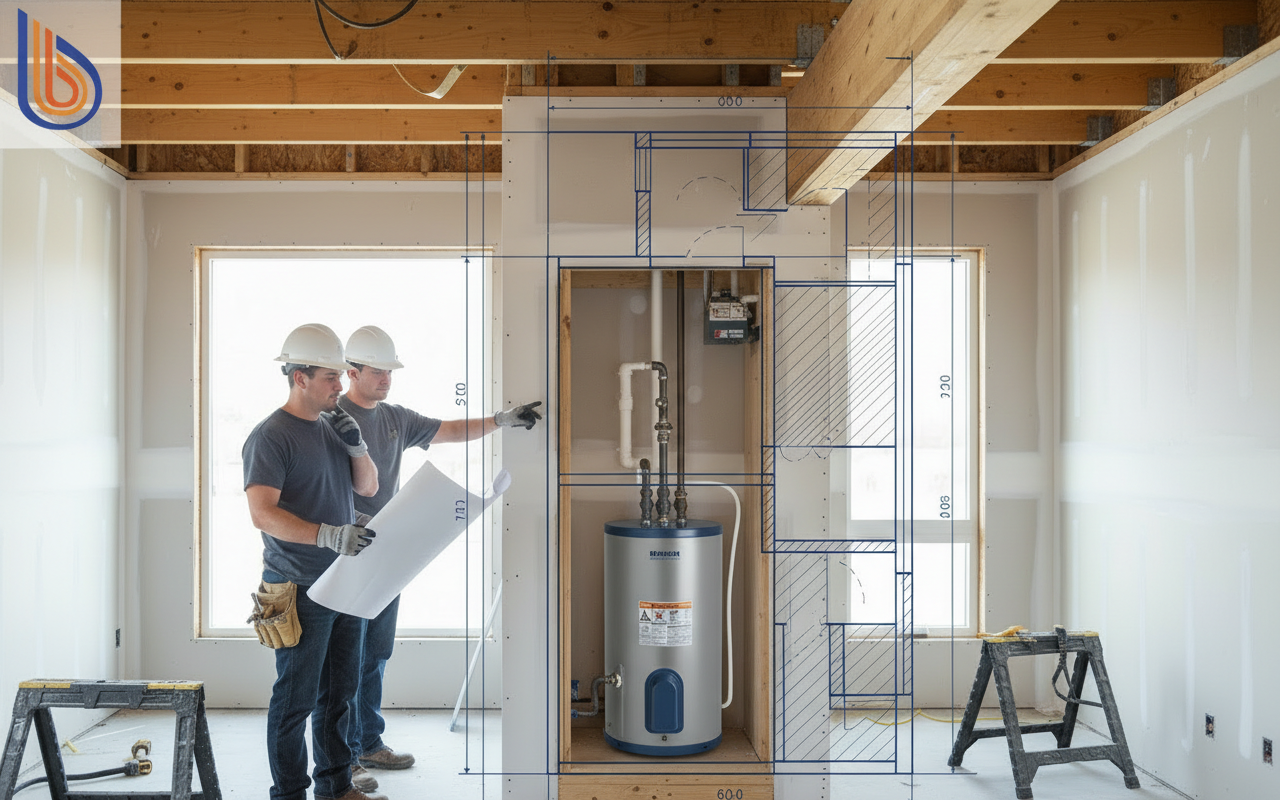
The 3-step mechanical footprint audit is a framework we developed to help homeowners navigate the complex intersection of Bay Area ADU plumbing codes and spatial efficiency. Whether you are a startup founder building a backyard office or a multi-unit landlord, understanding your mechanical footprint is the difference between a seamless build and a “change order” nightmare.
Step 1: Assessing Load and Shared Water Systems
The biggest decision you’ll face is whether to branch off the main house or install a dedicated unit. Most people miss the fact that while shared water systems save on equipment costs, they often require upgrading the main house unit to a high-capacity tankless system to handle the simultaneous shower loads of two separate households.
In our work with established homeowners in San Jose and Palo Alto, we’ve seen that branching off an existing 50-gallon tank rarely works for a full ADU conversion. Here is why the audit starts with a fixture count:
- Fixture Units: Calculate the total load (showers, sinks, dishwashers) for both the primary residence and the ADU.
- Distance: If the ADU is more than 30 feet from the main water heater, the “wait for hot water” becomes an energy-wasting dealbreaker.
- Submetering: If you plan to rent the unit, a shared system makes it nearly impossible to bill the tenant for their specific energy usage.
But wait—there’s a contrarian take here. While most contractors push for two separate systems, if your ADU is a junior conversion (JADU) within the existing building envelope, a single high-output tankless water heater is often the most footprint-efficient move you can make.
Step 2: Evaluating the Heat Pump Water Heater Footprint
As of 2024, California’s push for electrification means that ADU water heater requirements are increasingly pointing toward Heat Pump Water Heaters (HPWH). The real kicker? These units require significantly more physical space and airflow than the gas units they replace.
A typical 50-gallon heat pump unit needs approximately 1,000 cubic feet of ambient air to operate efficiently. For a 400-square-foot ADU, that’s a massive requirement. Your audit must account for:
- Cubic Footage: Does the mechanical closet have louvered doors or ducting to an adjacent garage space?
- Clearance: You need at least 6 to 12 inches of tankless water heater clearance or HPWH buffer space for maintenance.
- Condensate Drainage: Unlike gas tanks, heat pumps produce water (condensate) that must be routed to a floor drain or exterior landscape.
Need help navigating these spatial constraints? Schedule your free footprint consultation with our Bay Area experts today.
Step 3: Future-Proofing for 2027 Regulations
The Bay Area Air Quality Management District (BAAQMD) has signaled a phase-out of NOx-emitting gas appliances starting in 2027. An audit today prevents a forced, expensive retrofit three years from now. This is where ADU mechanical code compliance meets long-term ROI.
A typical Bay Area mid-market client often overlooks the electrical panel capacity. A heat pump water heater requires a dedicated 30-amp, 240-volt circuit. If your existing panel is maxed out, your “simple” ADU plumbing project just turned into a $5,000 electrical service upgrade.
| System Type | Footprint Size | Efficiency (UEF) | Bay Area Rebates |
|---|---|---|---|
| Standard Gas Tank | 9 sq. ft. | 0.65 | None |
| Exterior Tankless | 2 sq. ft. | 0.95 | Up to $900 |
| Internal Heat Pump | 12+ sq. ft. | 3.50+ | Up to $4,900 |

The “Hidden Square Footage” Hack
What if you could move the water heater outside? For many Bay Area ADU plumbing projects, mounting a tankless unit on the exterior wall or using a “zero-clearance” exterior-rated heat pump can reclaim an entire closet’s worth of space. In a small dwelling, that space becomes a pantry, a stacked washer/dryer, or much-needed storage.
Here’s the thing: while exterior mounting is a space-saver, it requires specific ADU water heater requirements regarding property line setbacks. In cities like Berkeley or San Francisco, you cannot have mechanical equipment encroaching on the side-yard setback. This is why a professional audit is non-negotiable before you pour concrete.
To keep our internal workflows at peak efficiency, we utilize Ingest.blog to stay updated on the latest municipal code changes across all nine Bay Area counties.
Maximizing ROI with Federal and Local Incentives
The audit isn’t just about space; it’s about the money. Under the Inflation Reduction Act, homeowners can access significant tax credits for installing heat pump technology. When combined with local TECH Clean California rebates, the net cost of a high-end system can often drop below that of a traditional gas install.
- Federal Tax Credit: Up to 30% of the project cost (capped at $2,000/year).
- Local Rebates: Programs like Peninsula Clean Energy or SVCE offer additional thousands for switching from gas to electric.
- Operational Savings: Heat pumps are up to 4x more efficient than gas, protecting you and your tenants from fluctuating PG&E gas prices.
Ready to maximize your ADU’s potential? Explore our ADU water heater solutions and see how we handle the permits and rebates for you.
Frequently Asked Questions
Do I need a separate water heater for my ADU?
While not strictly required by California state law, separate ADU water heater requirements are often dictated by the distance from the main house and total fixture count. If the ADU is a detached structure, a dedicated system is almost always required to ensure consistent pressure and temperature without massive energy loss through underground pipes.
How much space does a heat pump water heater really need?
A heat pump water heater footprint is larger than a traditional tank because it needs air to breathe. You generally need a 10’x10’x10′ volume of space, or a closet with louvered doors that allow for 1,000 cubic feet of airflow. If space is tight, we often recommend ducting the intake and exhaust to the outdoors or an attic.
Can I use a tankless electric water heater for an ADU?
In the Bay Area, electric tankless units are rarely recommended for full ADUs. They require a massive electrical draw (often 80-120 amps), which usually necessitates a total home electrical panel upgrade. Heat pumps are the far more efficient and cost-effective choice for all-electric ADU conversions.
What are the seismic requirements for ADU water heaters?
All Bay Area ADU plumbing must comply with California’s strict seismic codes. This includes double-strapping the tank to the wall studs (one in the upper third, one in the lower third) and installing flexible water and gas connectors to prevent ruptures during an earthquake.
The Monday Morning Action Plan
Don’t wait until the drywall is up to think about your mechanical footprint. This week, take a tape measure to your proposed ADU site and mark out a 3’x3′ square for a water heater. If that feels like it’s eating your floor plan, it’s time to call in a specialist. A professional footprint audit today can save you from a $5,000 “oops” moment during your final inspection. Contact Better Water Heaters to ensure your ADU is efficient, compliant, and comfortable.