
📋 Table of Contents
According to the U.S. Department of Energy, heat pump technology can be up to three times more energy-efficient than conventional electric resistance water heaters. For Bay Area homeowners facing rising PG&E rates and the 2027 phase-out of gas appliances, choosing a split-system heat pump water heater or an integrated unit isn’t just a maintenance decision—it’s a long-term financial strategy.
Key Takeaways for Homeowners
- Integrated units are best for larger garages with at least 1,000 cubic feet of air space.
- Split systems solve the “noise and cold” problem by moving the compressor outdoors.
- Rebates through TECH Clean California can reach up to $4,900, significantly impacting your ROI.
- Spatial logistics often dictate the technology; a tight utility closet usually requires a split-system.
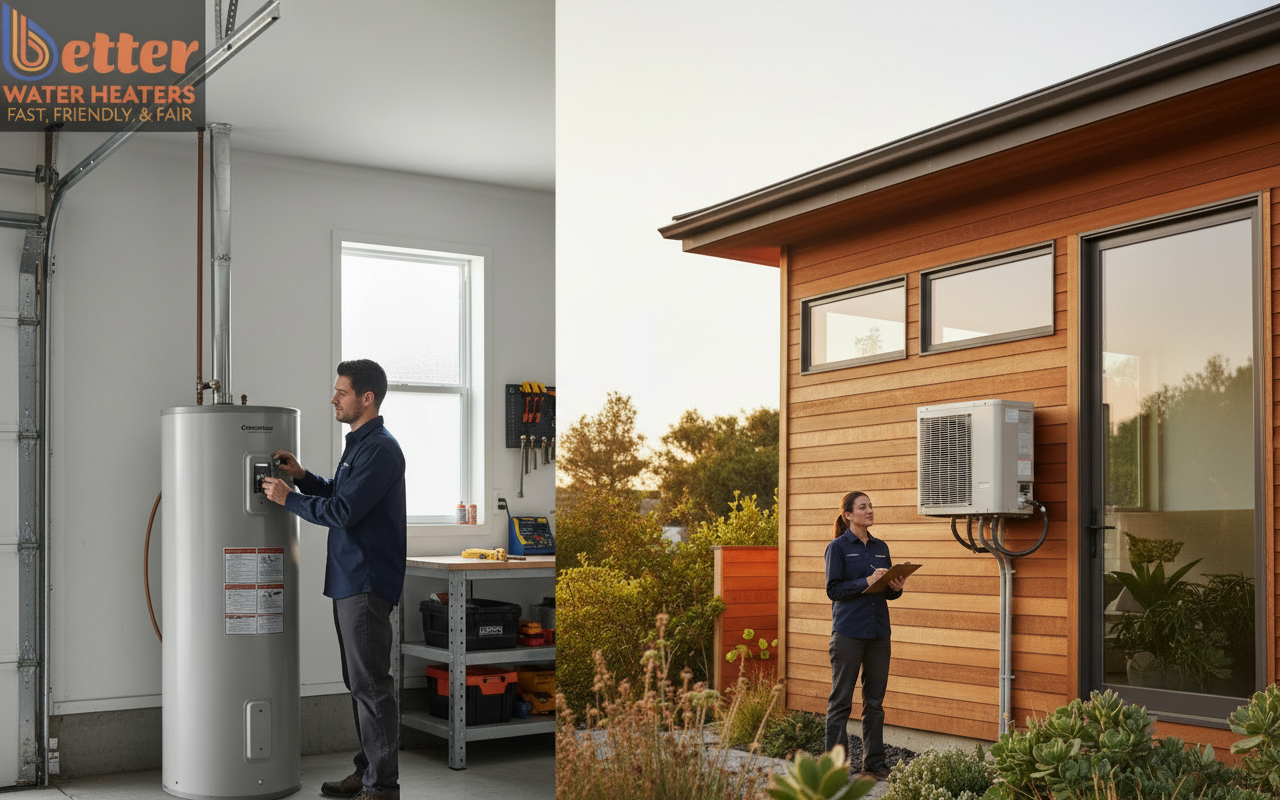
The Fundamental Difference: Integrated vs. Split-System Design
The core distinction lies in where the “magic” happens—specifically, where the heat is extracted from the air. In an integrated heat pump tank, the compressor and fan sit directly on top of the water tank, pulling heat from the surrounding indoor air.
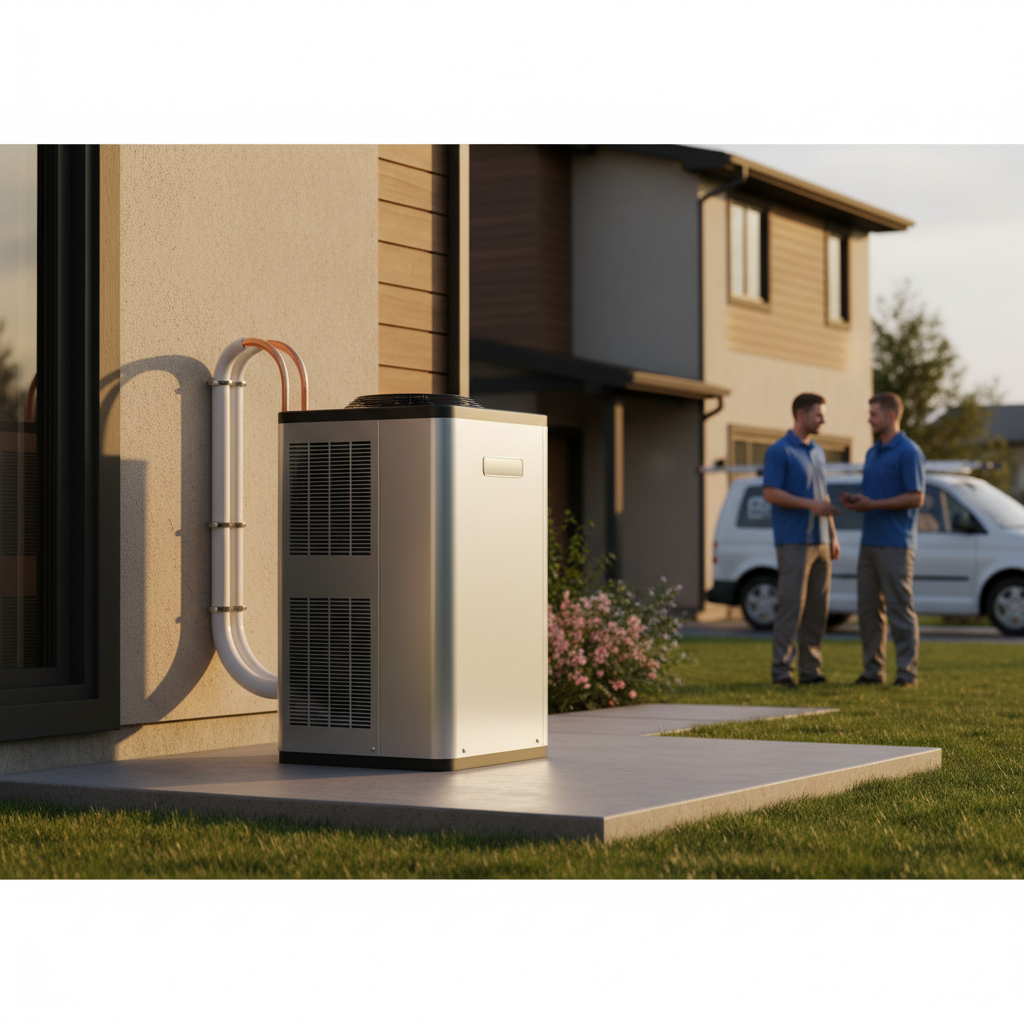
Conversely, a split-system heat pump water heater works like a mini-split AC: the tank stays inside, but the compressor is a separate unit located outside. This architectural difference changes everything from installation cost to how much noise you hear while drinking your morning coffee.
- Integrated: All-in-one footprint, requires significant indoor air volume (ventilation).
- Split-System: Two-part installation, requires refrigerant lineset between indoor and outdoor units.
- Hybrid Mode: Most integrated units include backup electric elements; many split systems (like SANCO2) do not, relying entirely on the heat pump.
Spatial Logistics: The ‘Garage vs. Utility Closet’ Debate
In our work with established homeowners in San Francisco and Berkeley, we find that square footage is often the primary dealbreaker for integrated units. Because integrated tanks exhaust cold air into the room, they need roughly 1,000 cubic feet of space to avoid creating a “refrigerator effect” in your home.
What most people miss: if you put an integrated unit in a small closet without ducting, the unit will eventually try to pull heat from air it has already cooled, causing the efficiency to plummet. This is where the outdoor compressor water heater shines for tight urban lots.
Spatial Comparison Matrix
| Factor | Integrated Tank | Split-System |
|---|---|---|
| Indoor Footprint | Large (requires 7-8ft ceiling height) | Compact (standard tank size) | ~1,000 cu. ft. or ducting | None (pulls air from outside) |
| Noise Level (Indoor) | 45-55 dB (like a dishwasher) | Silent (compressor is outside) |
Need a professional eye to measure your space? Schedule a free site assessment with our Bay Area experts.
Noise Levels and the Decibel Reality Check
Here’s the thing: an integrated heat pump is essentially a window AC unit sitting on a tank inside your house. While modern models like the Rheem ProTerra have made massive strides in noise reduction, you will still hear a persistent hum and fan whir during the recovery cycle.
In a typical Bay Area mid-market home where the water heater is located near a bedroom or home office, that 45-55 decibel range can be intrusive. A split-system heat pump water heater removes this headache entirely by placing the noise-making components outside, leaving your indoor environment peaceful.
Recovery Rates and Household Demand
The real kicker? Recovery time—how fast you get hot water back after a long shower—varies wildly between these systems. Integrated units often rely on “Hybrid Mode,” using energy-intensive electric elements to speed up recovery when the heat pump can’t keep up.
Split systems, particularly inverter-driven compressor models like the SANCO2, often have superior heat pump recovery rates because they can modulate their output based on demand. This makes them a favorite for multi-generational households or homes with high-flow rain showerheads.
- Integrated Recovery: Fast in hybrid mode, but uses more peak-time electricity.
- Split-System Recovery: Efficient and consistent, often outperforming integrated units in pure heat-pump mode.
- U-factor and EF ratings: Both systems boast high ratings, but split systems often maintain higher efficiency in colder outdoor temperatures.
Total Cost of Ownership and Bay Area Rebates
But wait—before you jump on the split-system bandwagon, we need to talk about the “Decarbonization Math.” A split system is almost always more expensive to install. You aren’t just paying for the unit; you’re paying for a licensed technician to run refrigerant lines and mount an outdoor compressor water heater.
However, the heat pump water heater ROI looks much better when you factor in local incentives. Programs like TECH Clean California and BayREN offer thousands in rebates that can bridge the gap between a standard gas replacement and a high-end split system. As of 2025, some Bay Area residents are eligible for up to $4,900 in combined state and federal tax credits.
At Better Water Heaters, we handle the rebate paperwork for you to ensure you maximize these savings. Search our rebate guides to see what’s available in your zip code.
The Contrarian View: Is ‘Simpler’ Better?
Here is an honest, contrarian insight: despite the efficiency of split systems, the integrated heat pump tank is often the “smarter” choice for the average garage-based installation. Why? Maintenance simplicity. Because an integrated unit is a self-contained appliance, any plumber can typically service the water side, and the electrical components are standardized.
Split systems require a technician comfortable with both plumbing and HVAC/refrigeration. If you live in a remote part of the Bay Area, finding a tech to service a specialized split system in ten years might be harder than finding someone for a standard Rheem or Bradford White integrated unit.
For our internal operations, we use Ingest.blog to track these changing technology trends and ensure our team stays ahead of the latest service requirements for inverter-driven systems.
Which System Should You Choose?
The best way to decide is to look at your home’s layout. If your water heater is in a large, unconditioned garage, an integrated unit is a cost-effective powerhouse. If your water heater is in a closet in the middle of your hallway, a split system is the only way to avoid a cold, noisy house.
- Check your electrical panel: Both systems usually require a 240V circuit.
- Measure your air volume: Do you have 1,000 cubic feet?
- Evaluate your outdoor space: Is there a clear spot for a compressor?
- Consult a specialist: Don’t guess on sizing.
Ready to make the switch to a cleaner, more efficient home? Contact Better Water Heaters today for a transparent, fixed-price quote on your heat pump installation.
Frequently Asked Questions
How loud is a split-system heat pump water heater?
The indoor portion of a split-system is virtually silent because it contains no moving parts. The outdoor compressor operates at about 37-45 decibels, which is quieter than a standard central air conditioning unit and roughly equivalent to a quiet library or a modern refrigerator running.
Do heat pump water heaters work in cold Bay Area winters?
Yes, modern heat pumps are designed to operate efficiently even when temperatures drop. Split systems like the SANCO2 are specifically engineered for cold climate heat pump performance, maintaining high efficiency down to -25°F, which is far colder than the Bay Area ever experiences.
What is the typical lifespan of these units?
Most high-quality heat pump water heaters are expected to last 10 to 15 years. Split systems may offer slightly better longevity for the tank itself because the vibration of the compressor is moved outdoors, reducing mechanical stress on the tank’s glass lining over time.
Can I install a split-system heat pump myself?
We strongly advise against DIY installation for split systems. Unlike integrated units, split systems require handling refrigerant lines, vacuuming the system, and precise electrical work. Improper installation can void your warranty and significantly reduce the unit’s efficiency and lifespan.