
📋 Table of Contents
According to the Department of Energy, the average household wastes up to 12,000 gallons of water annually just waiting for it to get hot. In a vertical San Francisco Victorian or a sprawling hillside estate in Los Gatos, that wait time isn’t just a nuisance—it’s a significant drain on your utility bill and local water resources.
Installing a hot water recirculation pump is the gold standard for achieving instant hot water systems, but most homeowners (and many general contractors) get the sizing wrong. They treat a three-story home like a single-level ranch, leading to premature pump failure or the dreaded ‘cold water sandwich’ effect. This guide breaks down the professional framework we use at Better Water Heaters to ensure your system is efficient, quiet, and compliant with California’s strict energy codes.
Step 0: The Water Quality Audit (The ‘Silent Killer’ of Pumps)
Before you even look at a pump’s flow rate, you must understand that Bay Area water isn’t uniform; regions like the Peninsula often deal with higher mineral content that can scale a pump’s impeller in months.
- Hard Water Impact: Mineral deposits increase internal friction, forcing the pump to work harder and consume more energy.
- Velocity Scouring: Over-sizing a pump in a home with copper pipes can lead to pinhole leaks due to excessive water velocity.
- Filtration First: We often recommend a whole-home descaler alongside a hot water recirculation pump to protect your investment.
Step 1: Calculate Vertical Head and Friction Loss
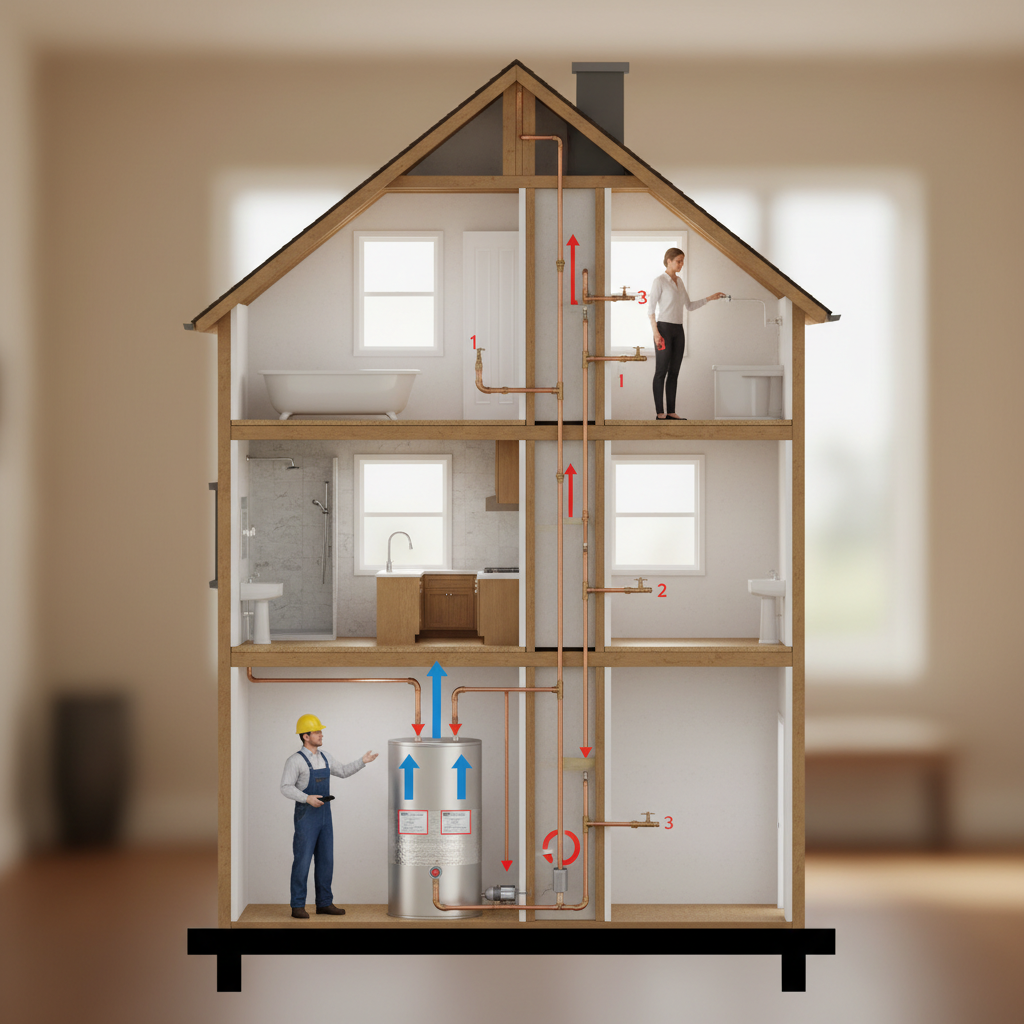
The real kicker is that gravity doesn’t care about your floor plan; it only cares about vertical lift.
In a typical Bay Area mid-market home, specifically those narrow multi-story builds, the pump has to overcome ‘head pressure.’ This is the resistance created by lifting water three stories up and the friction caused by every 90-degree elbow in your plumbing. Most DIY guides suggest a small 1/25 HP pump, but for a vertical layout, that’s often insufficient to maintain Bay Area plumbing efficiency.
- Vertical Rise: Measure the distance from your water heater (usually in the garage or basement) to the highest fixture.
- The ‘Painted Lady’ Factor: Older San Francisco homes often have restrictive 1/2-inch galvanized or copper lines that require higher head-pressure pumps compared to modern 3/4-inch PEX systems.
- Return Line Sizing: If you don’t have a dedicated return line, you’ll need a bypass valve system, which introduces its own set of flow resistance variables.
Need a professional eye on your vertical layout? Schedule a free site evaluation with our experts today.
Step 2: Balance Luxury with Title 24 Energy Standards
Instant hot water is a luxury, but California law requires that luxury to be smart.
Under California Title 24, new installations of instant hot water systems must utilize ‘on-demand’ or ‘sensing’ technology. Gone are the days of pumps running 24/7, which was essentially like leaving a 75-watt lightbulb on in a closet forever. Modern smart hot water recirculators learn your habits or use motion sensors to prime the lines only when needed.
| System Type | Energy Usage | Wait Time | Best For |
|---|---|---|---|
| Continuous Run | Very High | 0 Seconds | Obsolete/Non-Compliant |
| Timer-Based | Medium | 0-5 Seconds | Predictable Schedules |
| Smart/Learning | Low | 2-10 Seconds | Modern Bay Area Homes |
| On-Demand (Button) | Very Low | 15-30 Seconds | Maximum Conservation |
What most people miss is that a pump that is too large doesn’t just waste electricity; it creates noise. In high-density residential zones like North Beach or Downtown San Jose, a hum in the pipes at 6:00 AM is a recipe for a neighbor dispute. We prefer high-efficiency ECM (Electronically Commutated Motor) pumps like those from Grundfos or Taco for their near-silent operation.
Step 3: Integrate with Your Specific Heater Technology
The best way to ruin a brand-new heat pump water heater (HPWH) is to pair it with an improperly configured recirculation system.
As of 2024, many Bay Area homeowners are transitioning to electric heat pumps to meet upcoming BAAQMD regulations. However, HPWHs have lower recovery rates than gas. If your hot water recirculation pump runs too frequently, it can exhaust the tank’s hot water buffer, leading to a ‘cold water sandwich’ where the first few gallons are hot, the next few are cold, and then it finally warms up again.
- Thermal Expansion Tanks: These are mandatory in most Bay Area jurisdictions and must be sized to handle the additional volume of a recirculating loop.
- Dedicated Return Lines: Whenever possible, we advocate for a dedicated hot water return line sizing strategy that keeps the ‘cross-talk’ between cold and hot lines to zero.
- Check Valves: Ensure your pump includes a high-quality check valve to prevent ‘back-feeding’ cold water into your hot lines when the pump is off.
Here’s the thing: most ‘pro’ installers just slap on whatever pump is on the truck. In our work with tech professionals in Palo Alto and Mountain View, we find that a data-driven approach to sizing—accounting for flow velocity and pipe material—saves the homeowner hundreds in potential pipe repairs down the road.
Ready to stop wasting water? Explore our recirculation system options or call us at (408) 250-6672 for a custom quote.
The Contrarian View: Why You Might NOT Want a Pump
It sounds strange for a specialist to say, but sometimes a recirculation pump isn’t the answer. If your home is a single-story ranch with a centrally located water heater, the ‘wait time’ is likely under 15 seconds. In this scenario, the energy cost of the pump and the heat loss through the pipes (even if insulated) often outweighs the water savings. We always recommend a ‘bucket test’ first: measure how much water you actually lose before it gets hot. If it’s less than half a gallon, stick to a standard setup and save your money for a high-efficiency heater upgrade.
FAQs About Hot Water Recirculation in the Bay Area
How much does it cost to run a recirculation pump in San Jose?
With PG&E’s current tiered pricing, a standard 24/7 pump can cost $15-$20 per month. However, a Title 24 compliant smart hot water recirculator typically costs less than $2 per month because it only operates during peak usage windows. The water savings often offset this cost entirely.
Do I need a permit for a hot water recirculation pump installation?
If you are adding a pump to an existing system without modifying the main water lines, some cities consider it a minor repair. However, if you are installing a dedicated return line or a new electrical outlet, a permit is required in most Bay Area jurisdictions to ensure Bay Area plumbing code compliance.
Will a recirculation pump work with my tankless water heater?
Yes, but you must use a pump specifically designed for tankless systems. Tankless heaters require a minimum flow rate to ignite the burners. If the pump’s flow is too low, the heater won’t turn on; if it’s too high, it can wear out the heat exchanger. We recommend brands like Rinnai or Navien that have internal pumps built-in.
Can I install a recirculation pump myself?
While ‘under-sink’ kits are available at big-box stores, they often lead to lukewarm water in your cold taps. For multi-story homes with complex vertical head requirements, professional sizing is critical to prevent pipe cavitation and ensure the pump doesn’t burn out prematurely.
The Bottom Line: Don’t guess on your pump size. Take five minutes this week to measure the ‘wait time’ at your furthest shower. If it’s over 30 seconds, you’re a prime candidate for a professionally sized hot water recirculation pump. At Better Water Heaters, we’ve spent 20 years perfecting these systems for the unique architecture of the Bay Area. Contact us today to bring instant luxury and efficiency to your home.