
📋 Table of Contents
- The Decibel Deception: Why ‘Quiet’ Labels Fail Marin County Noise Ordinances
- The $3,600 Soundproofing Tax: Hidden Costs of Heat Pump Noise Mitigation
- Marin’s Electrification Paradox: State Mandates vs. Local Bylaws
- Vibration Isolation: The Overlooked Step That Prevents Fines
- Brands to Avoid (And Which Ones Actually Pass Inspection)
- FAQs
Your HOA doesn’t care about California’s electrification mandates or your carbon footprint; they care about the 2:00 AM hum vibrating through your neighbor’s bedroom wall. In wealthy enclaves like Tiburon and Mill Valley, homeowners are discovering that a $4,000 ‘ultra-quiet’ heat pump can trigger a $3,600 compliance nightmare the moment the Architectural Review Committee (ARC) pulls out a sound meter.
The HOA water heater compliance landscape in Marin County is a legal minefield where state law and local peace-and-quiet collide. While California SB 379 pushes for rapid heat pump adoption, Marin’s stringent noise ordinances often cap property line noise at 45-55 dBA—a level many ‘quiet’ models exceed the second they ramp up to full power on a chilly morning.
The Decibel Deception: Why ‘Quiet’ Labels Fail Marin County Noise Ordinances
Most manufacturers measure decibel ratings in a laboratory setting that bears zero resemblance to a narrow side-yard in Sausalito. Here is the reality: a unit rated at 55 dBA might jump to 65 dBA when reflecting off a stucco wall and a wooden fence, immediately violating Marin County noise ordinances.
- Ambient Noise Floor: In quiet Marin neighborhoods, the background noise at night is often as low as 30-35 dBA, making even a ‘silent’ heat pump sound like a jet engine.
- The Multiplier Effect: Placing a unit in a recessed alcove or narrow breezeway can amplify sound by 3 to 6 decibels due to reverberation.
- Frequency Matters: Low-frequency vibrations travel through structural foundations, leading to ‘structure-borne’ noise complaints that air-decibel readings don’t even capture.
What most people miss: The ‘quiet mode’ on many popular heat pumps often reduces heating efficiency by 40%, meaning your water takes twice as long to heat just to keep the neighbors happy. If you’re struggling with a noisy unit or planning an install, contact our Marin specialists before the fines start mounting.
The $3,600 Soundproofing Tax: Hidden Costs of Heat Pump Noise Mitigation
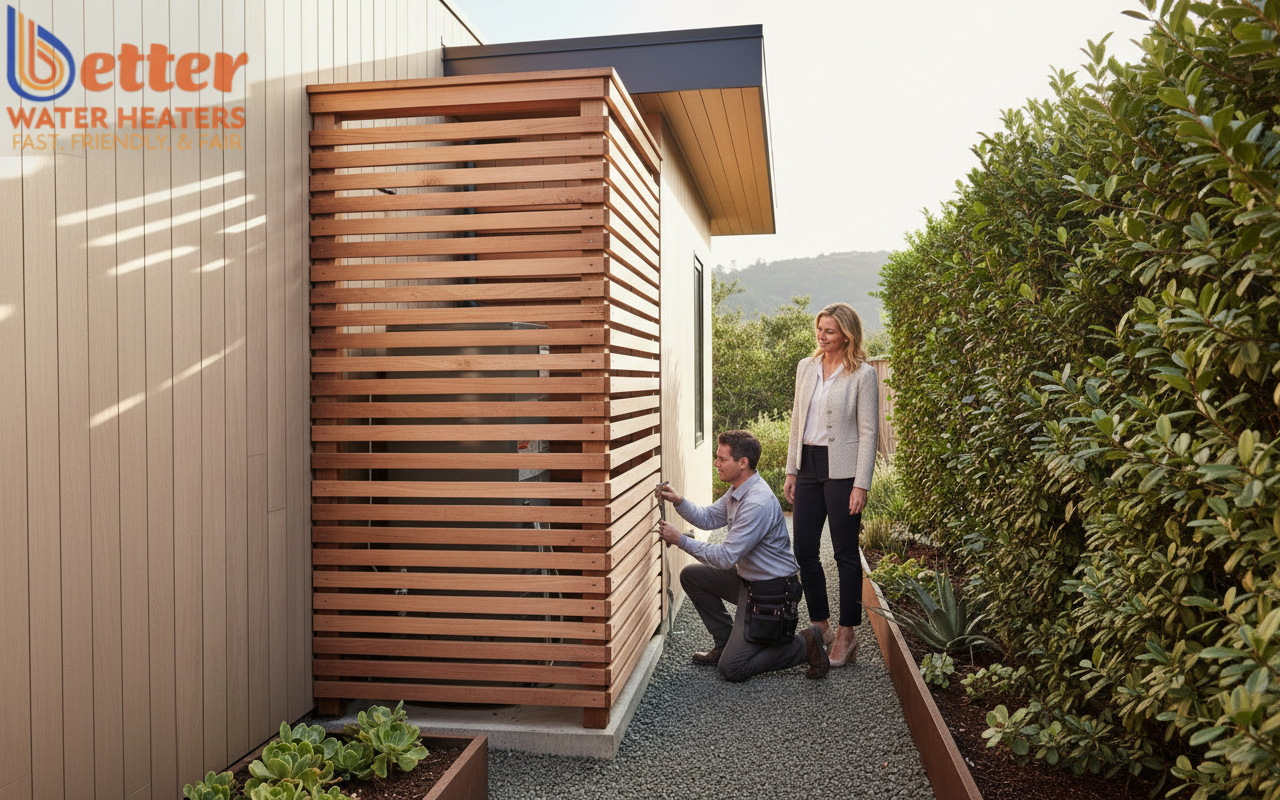
Retrofitting a non-compliant system is nearly three times more expensive than doing it right the first time. One homeowner in Belvedere recently spent $4,200 on an ‘ultra-quiet’ Tier 1 heat pump, only to be hit with a $500-per-day HOA fine after a neighbor complained about the compressor kick-in at dawn.
The real kicker? To achieve HOA water heater compliance, she had to spend an additional $3,600 on:
- Acoustic Sound Enclosures: Custom-engineered baffles that allow airflow while trapping sound ($1,800 – $2,500).
- Vibration Isolation Pads: Specialized industrial-grade rubber mounts to stop floor-trembling hums ($400).
- Strategic Relocation: Re-routing plumbing and electrical to move the unit 10 feet further from the property line ($1,200+).
But wait—even these fixes can be rejected if the sound enclosure doesn’t meet the HOA’s aesthetic guidelines. You end up in a circular hell of acoustic engineering and architectural approval.
Marin’s Electrification Paradox: State Mandates vs. Local Bylaws
California is aggressively pushing CEC Title 24 water heater standards to phase out gas, but HOAs are the final gatekeepers. While state law (like Civil Code 4751) limits an HOA’s ability to prohibit high-efficiency appliances, it does not give you a free pass on noise or aesthetics.
| Requirement Type | State Mandate (CA) | Typical Marin HOA Rule | The Conflict |
|---|---|---|---|
| Noise Limits | Vague / Health-based | 45-55 dBA at property line | Most HPWHs hit 55+ dBA |
| Placement | Encourages exterior | Must be screened/hidden | Airflow needs vs. Visuals |
| Permitting | Streamlined (SB 379) | ARC Review (30-60 days) | Installation delays |
As of 2024, the California Energy Commission is tightening efficiency rules, but they don’t provide a shield against a neighbor’s lawsuit over a humming compressor. We’ve seen homeowners forced to pull out brand-new units because their contractor didn’t understand the specific heat pump decibel ratings required for a zero-lot-line property.
Vibration Isolation: The Overlooked Step That Prevents Fines
High-end contractors often ignore the fact that noise isn’t just air; it’s movement. A common mistake in Ross and Kentfield is bolting a heat pump directly to a garage wall that shares a stud with a bedroom. The compressor’s vibration turns the entire wall into a speaker diaphragm.
The best way to ensure HOA water heater compliance is a three-pronged approach:
- Mass-Loaded Vinyl (MLV): Lining the interior of the closet or enclosure to deaden sound waves.
- Spring Isolators: Using actual mechanical springs for heavy units rather than just rubber pads.
- Sound Attenuation Blankets: Wrapping the compressor itself in a custom-fit acoustic jacket.
Need a system that won’t get you in trouble? Search our heat pump guides for models that actually meet local standards.
Brands to Avoid (And Which Ones Actually Pass Inspection)
Here is a contrarian insight: The most famous ‘big box’ brands are often the loudest. While they meet federal efficiency standards, they use cheaper, single-stage compressors that are either ‘Full Blast’ or ‘Off.’ In contrast, premium brands like Rinnai or specialized heat pump models feature inverter-driven compressors that ramp up slowly and quietly.
One of our clients, a homeowner in a $5M Tiburon property, was initially sold a standard contractor-grade unit. Within a week, the HOA sent a cease-and-desist. We replaced it with a unit featuring a top-discharge fan (which directs sound upward rather than toward the neighbor) and integrated heat pump noise mitigation tech. The inspection passed with 4 dBA to spare.
Before you buy, check the Energy Star database for noise ratings, but remember to add a 5-decibel ‘real world’ buffer for Marin’s tight spaces.
Key Takeaways for Marin Homeowners
- Don’t trust the box: A 55 dBA rating on the packaging will likely be 60+ dBA once installed against a wall.
- Budget for the ‘Tax’: Always set aside $2,000 – $3,500 for potential sound shielding if your unit is within 15 feet of a neighbor.
- Get it in writing: Require your installer to guarantee the install will meet local Marin County noise ordinances.
- ARC First: Never install a heat pump in Marin without prior Architectural Review Committee approval—even if it’s an emergency replacement.
Ready to upgrade without the headache? Schedule your free Marin compliance audit today. We handle the permits, the sound checks, and the HOA paperwork so you don’t have to.
Frequently Asked Questions
What are the typical noise limits for Marin County HOAs?
Most Marin HOAs follow city-specific ordinances that limit noise to 45-55 dBA at the property line during nighttime hours (10 PM to 7 AM). Some luxury HOAs in areas like Belvedere have even stricter requirements, sometimes requiring the unit to be virtually inaudible from the street or neighboring windows.
Can an HOA legally block me from installing a heat pump water heater?
Under California Civil Code 4751, an HOA cannot prohibit high-efficiency water heaters. However, they can impose “reasonable restrictions” regarding aesthetics and noise. If your unit violates local noise ordinances, they can fine you or force you to install heat pump noise mitigation solutions at your own expense.
Is a sound blanket enough to satisfy a noise complaint?
Usually, no. A sound blanket typically reduces noise by 3-5 dBA. If your unit is 15 decibels over the limit, you will need a combination of a blanket, vibration isolation, and potentially a full acoustic enclosure. These combined efforts are what we call the ‘compliance tax’ for high-density Marin neighborhoods.
Are tankless water heaters quieter than heat pumps?
Yes, significantly. Tankless units don’t have large compressors or fans. However, they don’t qualify for the same massive electrification rebates (up to $4,900+) as heat pumps. For many Marin residents, the challenge is balancing the high rebates of a heat pump with the strict noise requirements of their HOA.
Don’t let a ‘quiet’ unit turn into a loud legal battle. The transition to clean energy shouldn’t cost you your peace of mind or thousands in avoidable fines. Get an expert who knows Marin’s specific hurdles before you pull the trigger on an install.