Water heater article archive
Heat Pump Water Heater Clearance: San Francisco Solutions
Historical article, not newly reviewed advice. Verify current requirements, incentives and model guidance with the relevant authority or manufacturer before relying on them. Equipment and service needs require an assessment.
📋 Table of Contents
- Understanding Heat Pump Water Heater Clearance Requirements
- The 120V Revolution: A Secret Weapon for SF Utility Closets
- Strategic Ducting for Small Space Water Heater Installation
- Navigating San Francisco Utility Closet Regulations and Permits
- Case Study: The 'Pantry Conversion' in a Pacific Heights Condo
- Maximizing Your Investment: Bay Area Rebates and ROI
- FAQs
Navigating heat pump water heater clearance requirements in a classic San Francisco Victorian or a compact Mission District condo can feel like a high-stakes puzzle. As California pushes toward electrification under SB 1414, many homeowners are discovering that their legacy gas water heaters sit in 'hidden closets' that don't immediately meet the spatial demands of modern heat pump technology.
Key Takeaways for SF Homeowners:
• 120V 'Plug-and-Play' models eliminate the need for costly electrical panel upgrades.
• Strategic ducting can solve airflow issues in closets as small as 40 square feet.
• Combined rebates from BayREN and TECH Clean California can exceed $4,900.
• Professional condensate management is critical for mid-floor apartment installs.
Understanding Heat Pump Water Heater Clearance Requirements
Unlike traditional gas tanks that only require minimal space for combustion air, heat pump water heaters (HPWHs) operate by pulling heat from the surrounding air. This process requires a specific volume of air—typically 700 to 1,000 cubic feet—to function efficiently without cooling the room into a 'refrigerator effect.'
- Cubic Footage: Most manufacturers require a minimum room size unless the space is louvered or ducted.
- Airflow Paths: There must be at least 5 to 7 inches of clearance on all sides for intake and exhaust.
- Maintenance Access: San Francisco plumbing codes require clear access to the sacrificial anode rod and electrical panels.
Consequently, installing these units in a standard 3x3 utility closet requires more than just a direct swap. According to Energy.gov, proper placement is the single most important factor in HPWH efficiency and longevity.
The 120V Revolution: A Secret Weapon for SF Utility Closets
One of the biggest hurdles in San Francisco's older housing stock is the electrical panel. Many homes still operate on 100-amp or even 60-amp service, making a traditional 240V heat pump installation an expensive proposition involving thousands in panel upgrades.
Fortunately, the new generation of 120-volt heat pump water heaters has changed the game. These 'plug-and-play' models can often run on a dedicated 15-amp circuit, which is much easier to pull through lath-and-plaster walls.
- Shared Circuits: Some models are designed to share a circuit with other low-draw appliances.
- Integrated Mixing Valves: These allow the tank to keep water at a higher temperature, effectively increasing the 'first-hour rating' without a larger footprint.
- Cost Savings: By avoiding a panel upgrade, homeowners save an average of $2,500 to $4,000 in labor and permit fees.
If you are unsure if your electrical system can handle a transition, our team at Better Water Heaters specializes in evaluating SF electrical capacity for modern appliances. Schedule a professional site assessment today to see if a 120V system is right for your home.
Strategic Ducting for Small Space Water Heater Installation
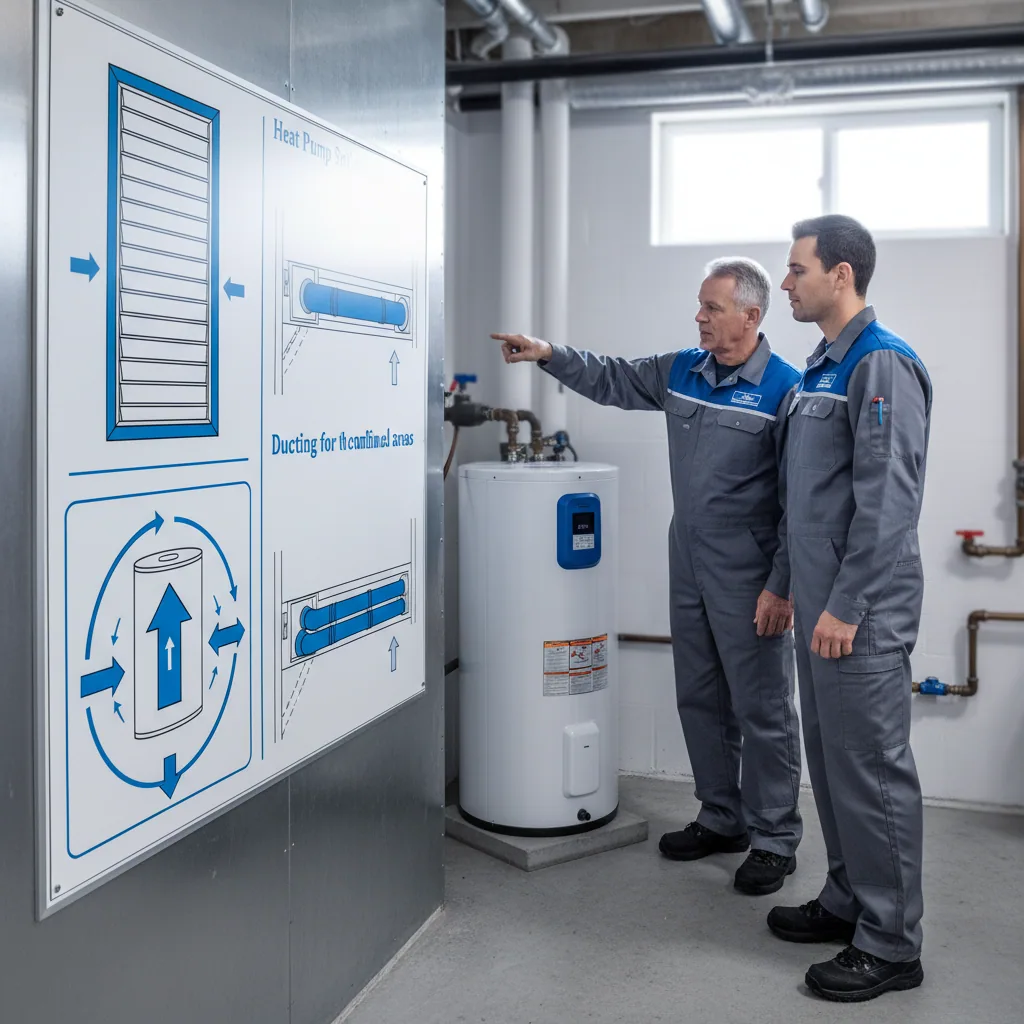
When heat pump water heater clearance cannot be met naturally by the room's volume, we turn to strategic ducting. This involves attaching insulated flexible or rigid ducts to the intake and exhaust ports of the water heater to pull air from—or push air to—a larger adjacent space or the outdoors.
- Intake Ducting: Pulling relatively warm air from an attic or a hallway to maximize efficiency.
- Exhaust Ducting: Directing the cold discharge air outside or into a crawlspace to prevent the utility closet from freezing.
- Louvered Doors: Replacing solid closet doors with high-airflow louvers to meet the 'unconfined space' definition under San Francisco utility closet regulations.
Transitioning to a ducted system effectively turns your cramped closet into a ventilation asset. This is particularly useful in the Mission District or Noe Valley, where every square foot of living space is premium real estate. By ducting the exhaust, you ensure the unit doesn't compete with your home's heating system during the foggy San Francisco summers.
| Feature | Standard HPWH (240V) | Plug-and-Play HPWH (120V) |
|---|---|---|
| Electrical Req. | 30A / 240V Dedicated | 15A / 120V Dedicated | Panel Upgrade? | Usually Required | Rarely Required | Typical Rebate | $1,000 - $4,900 | Up to $3,500 | Ideal Space | Garage / Large Basement | Closets / Pantries |
Navigating San Francisco Utility Closet Regulations and Permits
San Francisco has some of the strictest building codes in the country, especially regarding seismic safety and electrical conversions. When installing a heat pump in a tight space, you must account for the San Francisco plumbing code electric conversion standards.
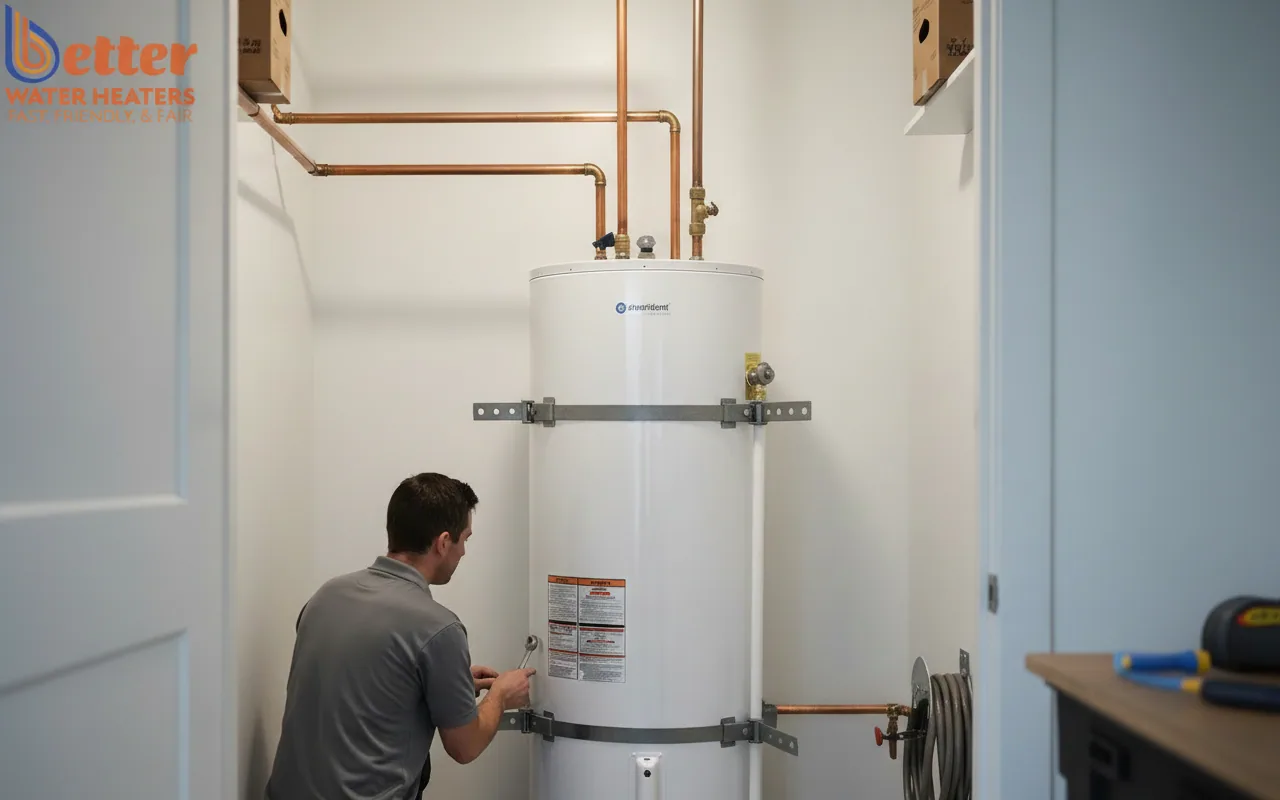
- Seismic Strapping: Units must be secured with heavy-duty straps in the upper and lower thirds of the tank to withstand Bay Area tremors.
- Condensate Drainage: HPWHs produce moisture as they dehumidify the air. In a 'hidden closet,' this requires a condensate pump to move water to a nearby drain or laundry standpipe.
- Noise Mitigation: Since heat pumps use compressors (similar to a refrigerator), we often recommend vibration isolation pads for units installed near bedrooms.
Furthermore, the BayREN program offers significant incentives, but only if the installation meets specific efficiency and code requirements. At Better Water Heaters, we handle the entire permit process and rebate application for you, ensuring you maximize your ROI. Contact us for a free estimate on your code-compliant installation.
Case Study: The 'Pantry Conversion' in a Pacific Heights Condo
Recently, a client in Pacific Heights wanted to replace an aging gas unit located in a 3x4 pantry. The heat pump water heater clearance was non-existent. Our solution involved a 120V Rheem ProTerra unit with a top-ducted exhaust system.
By venting the cold exhaust air into the ceiling joists and out through an existing wall vent, we maintained the pantry's temperature while providing the unit with the airflow it needed. The homeowner utilized both TECH Clean California and BayREN rebates, covering nearly 60% of the total project cost. This approach not only saved space but also eliminated the risk of carbon monoxide leaks inherent in the old gas system.
Maximizing Your Investment: Bay Area Rebates and ROI
While the upfront cost of a heat pump is higher than a gas tank, the long-term savings in the Bay Area are substantial. With PG&E rates continuing to climb, shifting to a high-efficiency electric model can reduce your water heating costs by up to 70%.
- TECH Clean California: Offers up to $3,100 for gas-to-HPWH conversions.
- BayREN: Provides an additional $1,000 for qualifying residents.
- Federal Tax Credits (25C): Allows for a 30% tax credit up to $2,000.
When you factor in these incentives, the 'payback period' for a San Francisco home is often less than five years. For property managers, this is a strategic move to future-proof buildings ahead of the 2027 gas appliance phase-out goals set by the Bay Area Air Quality Management District.
FAQs: Heat Pump Installation in Small Spaces
Can I install a heat pump water heater in a closet without a vent?
Technically, no. Without a louvered door or ducting, the unit will exhaust cold air into the small space, eventually causing it to shut down or lose efficiency. To meet heat pump water heater clearance standards, you must provide a path for air exchange, typically through a louvered door with at least 240 square inches of open area.
How loud are heat pump water heaters in small SF apartments?
Most modern units emit about 45-55 decibels, roughly the sound of a modern dishwasher. In tight San Francisco spaces, we use vibration-dampening mounts and insulated ducting to ensure the compressor noise doesn't disturb your living environment. If the closet is adjacent to a bedroom, additional soundproofing may be recommended.
Are 120V heat pumps as efficient as 240V models?
Yes, they are remarkably efficient. While they may have a slightly slower recovery time (how fast they reheat water after a long shower), their energy factor (EF) remains high. For most 1-4 person San Francisco households, a 120V unit provides ample hot water while avoiding the need for a massive electrical overhaul.
Do I need a permit for a small space water heater installation in SF?
Yes, the San Francisco Department of Building Inspection (DBI) requires a permit for all water heater replacements. This ensures the unit is properly strapped for earthquakes and that the electrical conversion meets current safety codes. Better Water Heaters manages this entire process to ensure your installation is 100% legal and safe.
Ready to reclaim your utility space and slash your energy bills? Our specialists are experts at solving the most complex heat pump water heater clearance challenges in the Bay Area. Click here to schedule your free consultation or call us to speak with a local expert about your San Francisco home today.