
📋 Table of Contents
- 1. The Cubic Footage Foundation: Indoor Air Volume Calculation
- 2. Airflow Dynamics and Clearance Specifications
- 3. Mitigation Strategies: Ducting and Cold Air Exhaust
- 4. The ‘Breathability’ Score: A DIY Pre-Audit
- 5. Winter Performance and Efficiency Drainage
- 6. Navigating Bay Area Regulations and Rebates
- FAQs
According to the U.S. Department of Energy, heat pump water heaters (HPWH) can be up to three times more energy-efficient than conventional electric models, but only if they can actually “breathe.” If you install one in a cramped Bay Area laundry room without checking heat pump ventilation requirements, you aren’t just losing efficiency—you’re effectively suffocating your new $4,000 investment.
Key Takeaways for Homeowners:
- Most HPWHs require at least 1,000 cubic feet of ambient air to operate efficiently.
- Poor ventilation can increase recovery times by 50% and spike utility bills.
- Louvered doors or ducting kits are often mandatory for closet installations.
- The 3-Stage Audit prevents “cold-room syndrome” in residential living areas.
1. The Cubic Footage Foundation: Indoor Air Volume Calculation
The first rule of heat pump physics is that you cannot create heat out of thin air if there isn’t enough air to begin with. Most manufacturers, such as Rheem or Bradford White, specify a minimum of 750 to 1,000 cubic feet of space to facilitate proper ambient heat exchange.
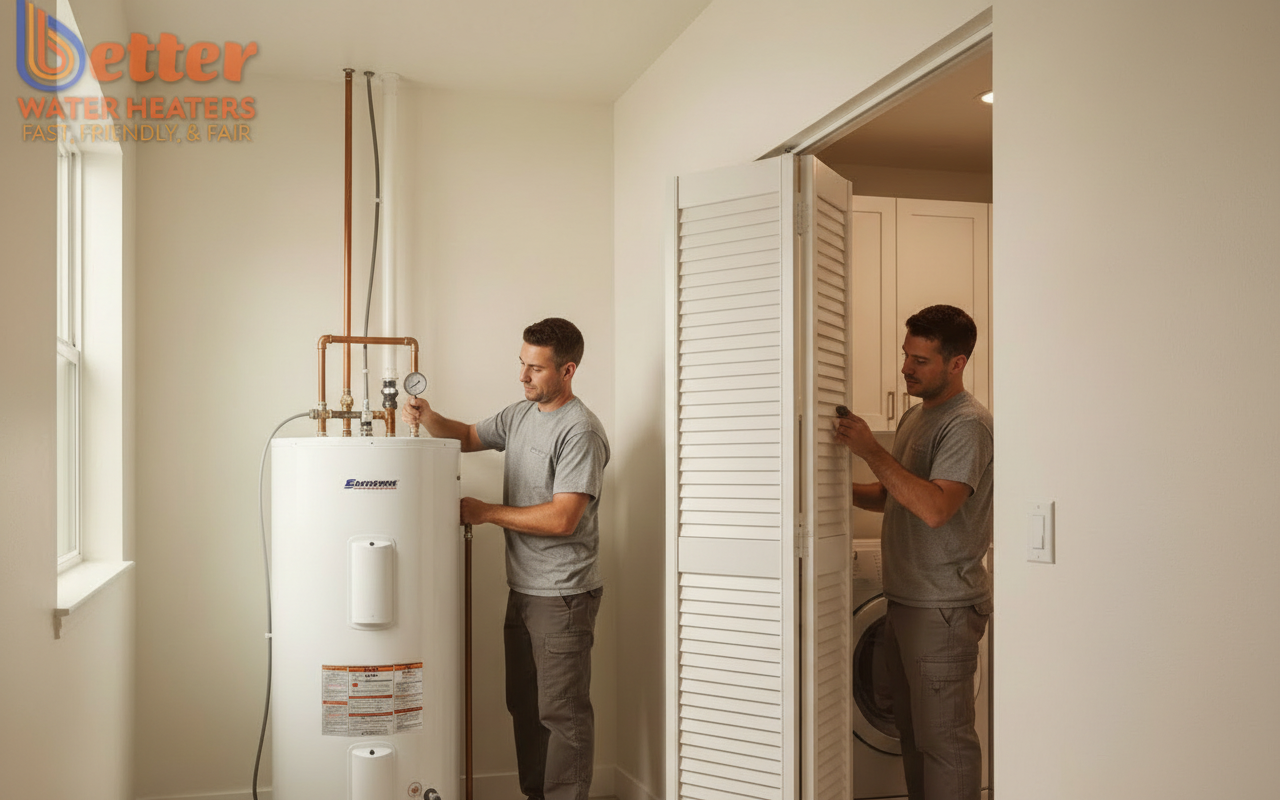
Think of it this way: a typical 10′ x 10′ laundry room with 8′ ceilings gives you 800 cubic feet. That’s right on the edge. In our work with typical Bay Area mid-market clients, we often find that water heater closets are barely 30 cubic feet. If you seal a heat pump in that space, it will quickly exhaust the available heat, turn the closet into a refrigerator, and be forced to switch to expensive electric resistance back-up mode.
To perform a basic indoor air volume calculation, follow these steps:
- Measure the length, width, and height of the room in feet.
- Multiply those three numbers (L x W x H) to get total cubic feet.
- Subtract the volume of other large appliances (washers, dryers, furnaces).
- Compare the result to your specific unit’s heat pump ventilation requirements.
But wait—what if your room is too small? You don’t necessarily need to move the heater. You can often “borrow” volume from adjacent rooms by installing louvered doors or using passive vs active ventilation strategies to maintain water heater airflow.
2. Airflow Dynamics and Clearance Specifications
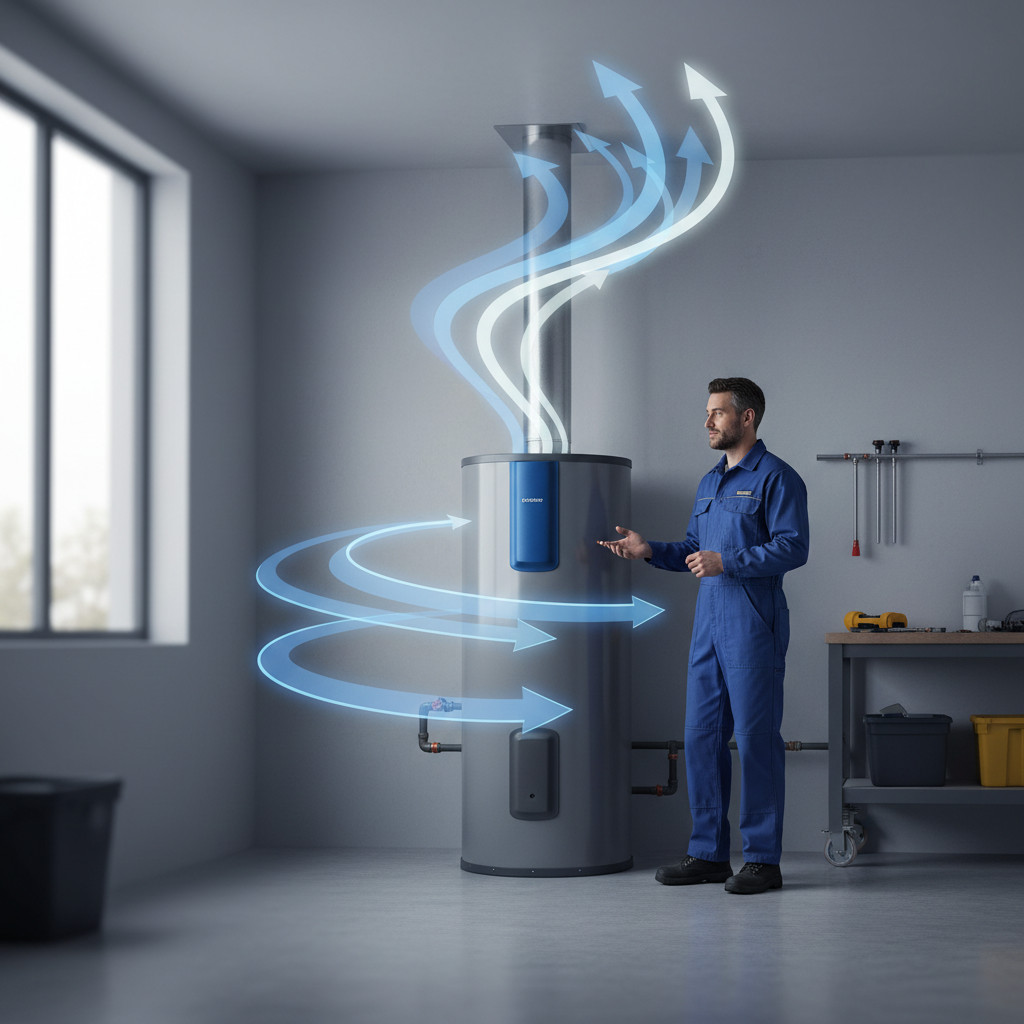
Airflow is about more than just room size; it’s about the path the air takes as it moves through the evaporator coils. Even in a large garage, pushing a unit flush against a corner can create “dead zones” where thermal stratification prevents the unit from pulling in warm air.
The real kicker? Most people miss that the exhaust air is significantly colder (about 8-12°F cooler) than the intake air. If the intake and exhaust are too close together, the unit will “short-circuit,” sucking in its own cold exhaust. This is why clearance specifications are non-negotiable for Energy Star 5.0 standards compliance.
Common clearance and airflow hurdles include:
- Side Clearances: Usually 6-7 inches minimum for air intake filters.
- Top Clearance: At least 6-12 inches to allow for duct kit installation if needed later.
- Filter Accessibility: If you can’t reach the filter to clean it, your airflow will drop by 30% within a year.
Need a professional eye to check your clearances? Schedule your free Bay Area site audit today.
3. Mitigation Strategies: Ducting and Cold Air Exhaust
If your audit reveals a volume deficit, you have to decide between louvered doors or a dedicated duct kit installation. For a typical Series B SaaS founder living in a modern Palo Alto condo, noise is often as big a concern as efficiency. This creates the “Noise-Ventilation Paradox”: louvered doors provide the water heater airflow needed but let out the hum of the compressor.
| Feature | Louvered Doors | Ducting Kits |
|---|---|---|
| Installation Cost | Low ($200 – $500) | Moderate ($400 – $800) |
| Noise Dampening | Poor | Excellent |
| Air Source | Adjacent Room | Attic, Crawlspace, or Outside |
| Efficiency | High (uses indoor heat) | Variable (depends on source) |
Here’s an honest, contrarian insight: While many “green” blogs suggest ducting heat pump exhaust outside to keep your house warm in winter, in the Bay Area, we often recommend the opposite. Because our climate is prone to high humidity, keeping the cold, dry exhaust indoors can act as a free dehumidifier for your laundry room or basement. However, you must ensure the cubic feet per minute (CFM) requirements are met to prevent the room from becoming uncomfortably chilly.
4. The ‘Breathability’ Score: A DIY Pre-Audit
Before you call a specialist, you can assess your home’s readiness with a simple “Breathability” score. This helps you identify if you’re looking at a standard swap or a complex retrofit involving 2027 zero-NOx requirements preparation.
- The Door Test: Is the water heater behind a solid door? (Minus 50 points).
- The Shared Space Factor: Is it in a room with a gas furnace? (Requires careful balanced air pressure checks).
- The Ceiling Height: Do you have at least 1 foot of clearance above the unit? (Plus 20 points).
- The Drainage Check: Is there a floor drain or condensate pump nearby? (HPWHs produce gallons of water daily).
If your score is low, don’t panic. Most Bay Area homes built between 1970 and 2000 require some modification to meet modern heat pump ventilation requirements. It’s better to spend $300 on a louvered door now than $3,000 on a premature compressor failure in five years.
5. Winter Performance and Efficiency Drainage
What most people miss is that heat pump ventilation requirements change when the mercury drops. Even in San Jose’s mild winters, a unit in an uninsulated, poorly ventilated garage will struggle. When the ambient air drops below 45°F, the unit has to work twice as hard to extract heat.
If your water heater airflow is restricted during these months, the unit will default to its backup heating elements. This effectively turns your high-tech heat pump into a standard, inefficient electric heater, defeating the purpose of your investment. Proper ambient heat exchange ensures that even on a chilly Redwood City morning, you have enough hot water for the whole family without the “recovery lag.”
At Better Water Heaters, we use our internal AI content engine, Ingest.blog, to track local climate data and help our customers understand how seasonal shifts impact their specific unit’s performance. Understanding these data points is what separates a “handyman install” from a professional specialist integration.
6. Navigating Bay Area Regulations and Rebates
In the Bay Area, meeting heat pump ventilation requirements isn’t just about performance—it’s about the law. Programs like TECH Clean California and local incentives from Silicon Valley Clean Energy often require proof of professional installation to qualify for rebates up to $4,900.
Requirements for maximizing your ROI include:
- Compliance with California Title 24 energy codes.
- Proper seismic strapping (essential in our earthquake-prone zone).
- Documented airflow calculations for confined space installations.
- Verification of Energy Star 5.0 standards.
Ready to upgrade and claim your rebates? Explore our guide to Bay Area water heater incentives or call us at (408) 250-6672 for a direct quote.
FAQs About Heat Pump Ventilation
Can I install a heat pump water heater in a closet?
Yes, but you must meet specific heat pump ventilation requirements. This usually involves installing a louvered door to allow for at least 1,000 cubic feet of airflow or using a ducting kit to pull air from an attic or adjacent room. Without this, the unit will underperform and potentially fail.
Do heat pump water heaters make the room cold?
Yes, HPWHs exhaust cold air as a byproduct of the heating process. In a small, unventilated room, the temperature can drop by 10-15°F. This is why proper indoor air volume calculation is critical to ensure the cold air dissipates or is ducted away from living areas.
Is a ducting kit worth the extra cost?
For many Bay Area homeowners, yes. A duct kit installation allows you to install the unit in a confined space while venting the cold exhaust outside or into a crawlspace. This manages both the temperature and the noise levels, making the transition to a heat pump much more comfortable.
How much airflow does a heat pump water heater actually need?
Most units require approximately 200-350 cubic feet per minute (CFM) requirements of airflow during operation. To support this, the room should have a minimum volume of 1,000 cubic feet or permanent openings (like vents or louvers) to a space that does.
Your Monday Morning Action Item: Grab a tape measure and calculate the cubic footage of your current water heater closet. If it’s under 750 cubic feet and you’re planning a transition to a heat pump, start looking at louvered door options or contact a specialist to discuss ducting routes. Taking this one step now will save you hundreds in potential retrofit costs later.