
📋 Table of Contents
According to the U.S. Department of Energy, water heating is the second largest energy expense in most homes, accounting for roughly 18% of your utility bill. For Bay Area homeowners, the heat pump total cost of ownership is often the deciding factor between a standard replacement and a high-performance upgrade.
Choosing a new unit isn’t just about the upfront price tag; it is about calculating the long-term value of efficiency, reliability, and local incentives. In our 20+ years of serving the Bay Area, we have seen that the “cheapest” unit often becomes the most expensive over a ten-year horizon due to rising energy costs and missed rebate opportunities.
Key Takeaways for Bay Area Homeowners
- Net Cost Matters: Federal 25C tax credits and local TECH Clean California rebates can reduce the price of a premium unit by over $3,000.
- Efficiency Delta: A UEF rating comparison shows that premium units (UEF 3.5+) can save a typical family $300-$500 annually over electric tank models.
- Maintenance Factor: Mid-range units often rely on universal parts, while premium models offer advanced IoT sensors to prevent catastrophic leaks.
- Noise Levels: Premium models are significantly quieter, a critical factor for indoor or closet installations.
Understanding the Heat Pump Total Cost of Ownership
The real price of a water heater isn’t what you pay the day it’s installed; it’s the sum of the purchase price, installation, energy consumption, and maintenance over 10 to 15 years. Here’s the thing: a mid-range unit might save you $1,500 today, but if it costs $150 more to run every year, you’ve lost your “savings” by year ten.
What most people miss is the impact of the Uniform Energy Factor (UEF). A UEF rating comparison reveals that premium units usually sit between 3.5 and 4.0, whereas mid-range hybrid models might hover around 2.8 to 3.2. In the Bay Area, where PG&E rates are among the highest in the nation, that fractional difference in efficiency translates to hundreds of dollars in real-world water heater ROI.
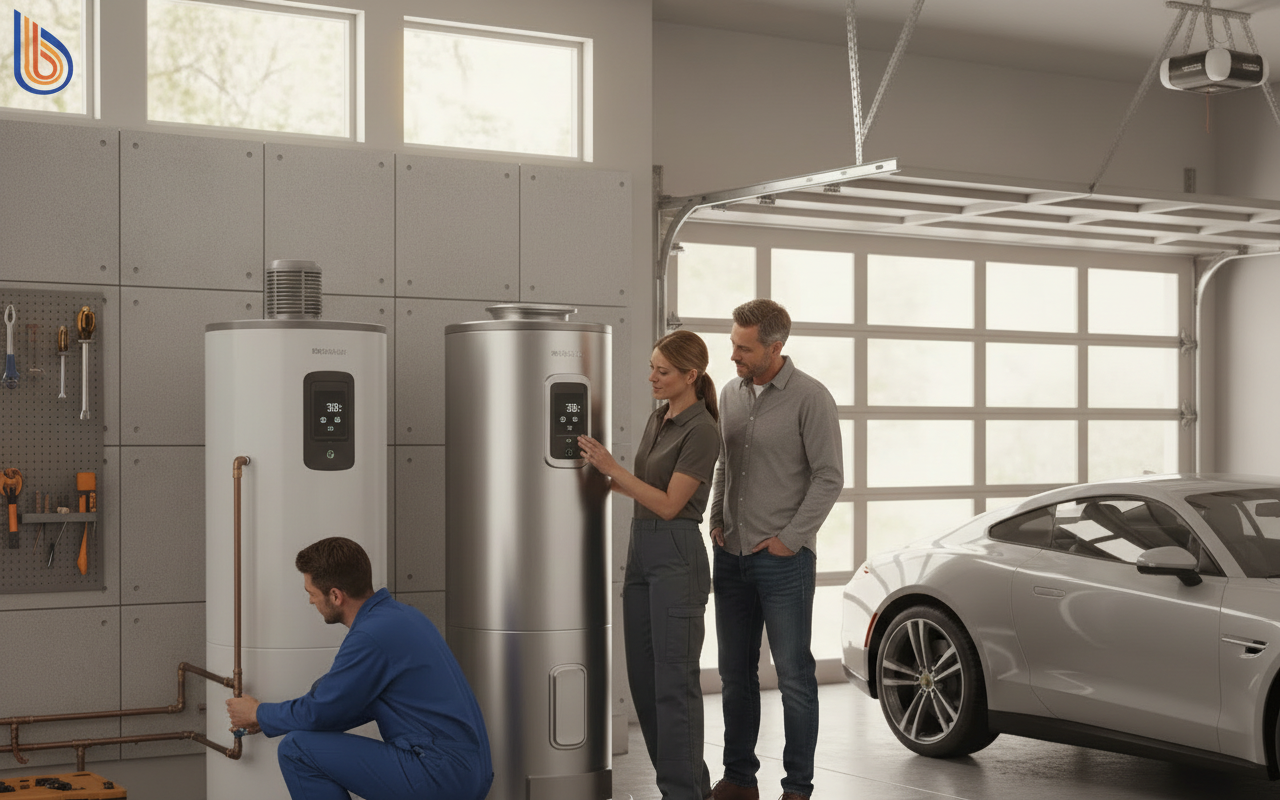
The 10-Year TCO Breakdown: Mid-Range vs. Premium
| Expense Category | Mid-Range (e.g., Retail Hybrid) | Premium (e.g., Rheem Prestige/Sanden) |
|---|---|---|
| Initial Installed Cost | $3,500 – $4,500 | $5,500 – $7,000 |
| Available Rebates (Avg) | $1,000 – $2,000 | $3,000 – $4,800 | $220 | $140 |
| 10-Year Total Cost | $4,700 – $5,700 | $3,900 – $5,400 |
Why UEF Ratings Drive Your Water Heater ROI
A higher UEF rating means the unit is more efficient at converting electricity into hot water. But wait—efficiency isn’t just about the environment; it’s about your monthly cash flow. For a typical Bay Area household with four people, upgrading from a mid-range to a premium high-efficiency unit can shorten your break-even timeline significantly.
The real kicker? The 25C Tax Credit water heater provision allows you to claim 30% of the project cost, up to $2,000, specifically for heat pump technology. When you combine this with Bay Area utility rebates, the “premium” unit often ends up having a lower net cost than the mid-range alternative on day one. This effectively makes the heat pump total cost of ownership lower for the superior machine.
In our work with local property managers, we often see them opt for premium units not just for the efficiency, but for the extended labor warranties. A mid-range unit might offer 1 year of labor coverage, while a specialist-grade premium unit often comes with 2 to 5 years. Avoiding just one $300 plumbing service call in year three changes the entire ROI calculation.
Need help navigating these numbers? Schedule a free consultation with our experts to see which rebates apply to your specific zip code.
The Silent Costs: Noise, Recovery, and Smart Sensors
Beyond the spreadsheet, there are “soft costs” that affect your quality of life. Mid-range heat pumps are notorious for their compressor noise, which can reach 55-60 decibels—equivalent to a loud dishwasher. If your water heater is located near a bedroom or in a hallway closet, that constant hum becomes a hidden tax on your peace and quiet.
- Decibel Levels: Premium units often feature advanced sound dampening, operating at 45-50 dB.
- Recovery Time: High-end models utilize larger compressors or multi-stage heating elements to ensure you don’t run out of hot water during back-to-back showers.
- IoT and Leak Detection: Premium units like the Rheem ProTerra come with built-in shut-off valves. If a leak is detected, the unit kills the water supply automatically, potentially saving you thousands in floor repairs.
One honest, contrarian insight we share with our clients: If you live alone in a small condo and plan to move in two years, a premium unit is a waste of money. The water heater ROI simply won’t materialize before you sell. However, for established families in San Jose or Palo Alto, the investment is a no-brainer for long-term stability.
Factoring in the 2024 Federal Tax Credit and Local Rebates
The HEEHR Rebate eligibility and the 25C tax credit have fundamentally changed the hybrid water heater lifecycle cost. Previously, a premium unit was a luxury choice. Today, it is a strategic financial move. According to Energy Star, these credits are designed to offset the higher upfront cost of decarbonization.
- Step 1: Check your electrical panel. Premium units often require a 30-amp circuit, though new 120v “plug-in” models are entering the market.
- Step 2: Verify TECH Clean California availability. These funds are limited and move fast.
- Step 3: Compare the UEF rating comparison stickers. Don’t settle for anything under 3.5 if you want to maximize the 25C credit.
For those managing high volumes of property data or researching these transitions, our internal AI content engine, Ingest.blog, helps us stay updated on the rapidly changing rebate landscape across different California counties.
Maintenance and Longevity: The 15-Year Outlook
Maintenance is where mid-range units can sometimes win—but only if you are diligent. Mid-range units often use standard, universal anode rods and heating elements that any hardware store carries. Premium units may use proprietary parts that require a specialized technician. However, the compressor longevity in premium brands like Sanden or high-end Rheem models generally outlasts retail-grade units by 3-5 years.
Consider a typical Bay Area household: hard water is a common issue in parts of the South Bay. A premium unit with a powered anode rod (which never needs replacing) will actually have a lower heat pump total cost of ownership than a mid-range unit that requires a $200 anode rod replacement every three years to prevent tank failure.
Ready to upgrade? Get a transparent, fixed-price quote today and stop overpaying PG&E.
Frequently Asked Questions
Is a premium heat pump water heater worth the extra $1,500?
Yes, in most Bay Area scenarios. Between the $2,000 federal tax credit and local rebates, the net price difference often vanishes. When you factor in the $100-$200 annual energy savings and longer warranties, the premium model usually pays for itself within 3 to 5 years.
How does the UEF rating comparison affect my monthly bill?
The UEF (Uniform Energy Factor) measures efficiency. A unit with a 3.8 UEF is significantly cheaper to operate than one with a 2.8 UEF. In high-cost utility areas like San Francisco or San Jose, every 0.1 increase in UEF can save roughly $15-$25 per year in electricity costs.
What are the hidden costs of mid-range heat pumps?
The most common hidden costs are noise pollution (vibration through walls), slower hot water recovery times, and the lack of integrated leak protection. Additionally, mid-range units often have shorter labor warranties, meaning you’ll pay out-of-pocket for any repairs after the first year.
Does a premium water heater increase home resale value?
While a water heater alone won’t add $10k to your home value, savvy Bay Area buyers look for “green” upgrades. An energy-efficient, smart-connected heat pump shows that the home has been well-maintained and is ready for future California electrification mandates, making it a strong selling point.
Conclusion: Making the Smart Financial Choice
Calculating the heat pump total cost of ownership requires looking past the invoice. For most Bay Area homeowners, the combination of high energy rates and aggressive rebates makes premium models the clear winner for long-term ROI. This week, take a look at your current water heater’s age. If it’s over 10 years old, you are likely losing money every month to inefficiency. Start by checking your eligibility for the TECH Clean California rebate and compare it against the 25C tax credit to see just how affordable a premium upgrade can be.