
📋 Table of Contents
According to the U.S. Department of Energy, a heat pump retrofit can reduce water heating costs by up to 70% compared to standard electric models, yet the layout of a 50-year-old Bay Area home often fights this transition at every turn. While new construction allows architects to design around the specific needs of a Heat Pump Water Heater (HPWH), retrofitting an established home is often a surgical operation involving electrical panels, condensate lines, and acoustic planning.
Key Takeaways for Bay Area Homeowners
- Infrastructure First: The unit cost is often eclipsed by the “hidden” costs of electrical upgrades and structural modifications.
- The 120V Breakthrough: New plug-in models can bypass the need for expensive 240V rewiring in older homes.
- Space is Money: Ambient air requirements mean you can’t just tuck a heat pump into a tiny closet without proper ducting.
- Rebate Maximization: Bay Area residents can access up to $4,900 in incentives to offset these infrastructure hurdles.
1. The Infrastructure Gap: Why Retrofits Cost More Than New Builds
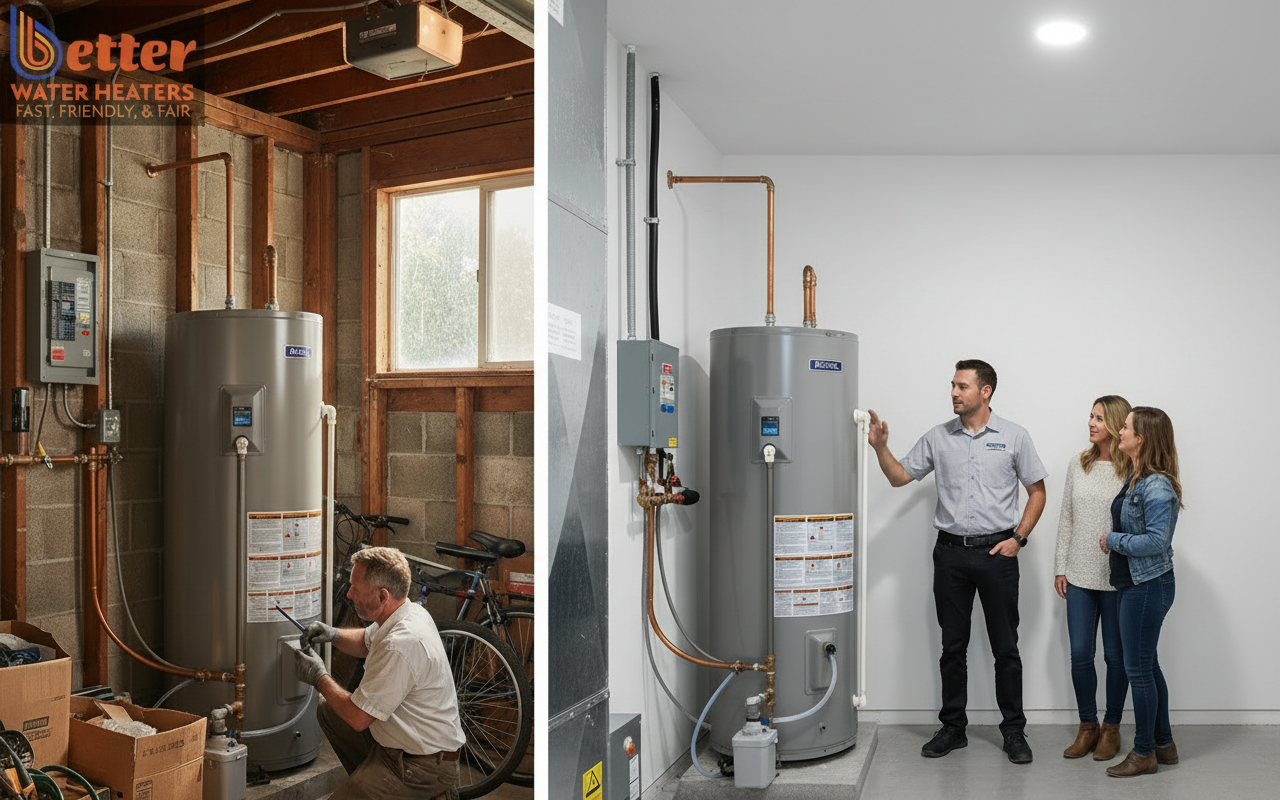
The real kicker is that in new construction, the “cost” of siting a heat pump is essentially zero because the blueprints account for drainage and power from day one. In a heat pump retrofit, you are often fighting decades of legacy plumbing and electrical decisions that weren’t designed for high-efficiency tech.
In our work with established Bay Area homeowners, we frequently see the “Electrical Panel Tax.” Most older homes in San Jose or Redwood City operate on 100-amp or 125-amp panels. Adding a 240V heat pump often pushes the system over capacity, triggering a full electrical panel upgrade that can add $3,000 to $5,000 to the project before a single pipe is fitted.
- New Construction: 200-amp panels are standard; 240V circuits are pulled during the framing stage.
- Retrofit: May require trenching for new utility service or creative load-shedding solutions.
- The Solution: The emergence of the 120V heat pump water heater allows homeowners to use a standard wall outlet, potentially saving thousands in electrical labor.
2. Ambient Air Volume and the ‘Space Tax’
Siting a heat pump requires a specific volume of air—usually 750 to 1,000 cubic feet—to extract heat effectively, a requirement that often clashes with the cramped utility closets of mid-century homes. If you place a HPWH in a confined space without ducting, it will quickly chill the air around it, causing the Coefficient of Performance (COP) to plummet as the unit struggles to find heat.
What most people miss is the “Lollipop Effect” found in new construction. Architects centralize the HPWH to minimize pipe runs, yielding 20% higher efficiency. In a retrofit, you are often stuck with the existing footprint, which might be a cold garage or a tight basement. This necessitates either louvered doors or expensive intake/exhaust ducting to tap into warmer air sources.
Need help navigating your home’s layout? Schedule a free site assessment with our specialists to find your optimal siting location.
3. Condensate Management: The Hidden Drainage Challenge
Unlike gas heaters, heat pumps act like dehumidifiers, producing several gallons of water daily through condensate drainage. In a new build, a floor drain is roughed in exactly where it needs to be. In a Bay Area home renovation, we often find water heaters located in the middle of a slab-on-grade garage with no drain in sight.
Here are the three ways we solve this in retrofits:
- Gravity Drains: Only possible if the unit is near an exterior wall or existing plumbing stack.
- Condensate Pumps: Small, motorized pumps that push water up and out to a laundry sink or exterior landscape.
- Strategic Siting: Moving the unit to a location where drainage already exists, though this may increase plumbing labor.
4. Acoustic Engineering: Solving the Decibel Dilemma
The best way to ensure you hate your new energy-efficient appliance is to bolt it to a shared wall with a bedroom without considering the decibel rating. Heat pumps contain compressors and fans; while modern units like Rheem or Bradford White are quieter than ever, they still produce a rhythmic hum that can telegraph through wood framing.
The contrast is stark: new construction uses specialized vibration isolation pads and sound-dampened mechanical rooms. In a retrofit, we often recommend “decoupling” the unit from the floor using rubber mats or siting it in a garage rather than an indoor closet. For a deeper dive into noise levels, check out our maintenance and noise guide.
5. The Cost-to-Benefit Matrix: Retrofit vs. New Construction
Here is how the numbers actually shake out when you account for the infrastructure variables we’ve discussed.
| Factor | New Construction | Standard Retrofit (240V) | 120V “Plug-in” Retrofit |
|---|---|---|---|
| Electrical Cost | Included in build | $1,500 – $5,000 | $0 – $500 |
| Drainage Setup | $0 (Roughed in) | $300 – $800 | $300 – $800 |
| Labor Premium | Standard | High (Surgical) | Moderate |
| Efficiency (COP) | High (Optimized) | Variable | Moderate/High |
But wait—don’t let the retrofit labor premium scare you off. Programs like BayREN and TECH Clean California offer massive incentives that specifically target these infrastructure hurdles. By combining federal tax credits with local rebates, many of our clients cover nearly 80% of the total installation cost.
6. Future-Proofing: Thermal Batteries and Grid Resilience
One contrarian insight we share with our clients: don’t just site your water heater for today; site it for the 2030 grid. Modern HPWHs can act as “thermal batteries.” By over-heating the water during the day when solar production is high (and electricity is cheap), and load shedding during peak evening hours, you turn a passive appliance into an active financial asset.
In new construction, this is handled via smart home integration. In a retrofit, we look for siting that allows for easy access to your Wi-Fi router and enough space to add a mixing valve, which lets you store water at 140°F while delivering a safe 120°F to your taps, effectively increasing your “tank capacity” without a larger footprint.
Ready to maximize your home’s efficiency? Get a custom quote and see how much you can save with current Bay Area rebates.
FAQs About Heat Pump Siting
Can I put a heat pump water heater in a small closet?
Yes, but it requires specific modifications. You must either install louvered doors to allow for ambient air volume requirements or use a ducting kit to pull air from an attic or crawlspace. Without these, the unit will underperform and potentially increase your energy bills.
Does a heat pump water heater work in a cold Bay Area garage?
Absolutely. The Bay Area’s temperate climate is ideal for heat pumps. Even in the middle of a 40°F winter night, modern units have a high enough COP to extract heat efficiently. However, in unconditioned spaces, we ensure proper pipe insulation to prevent heat loss.
Is the 120V heat pump water heater worth it?
For many heat pump retrofit projects, the 120V model is a game-changer. It avoids the $2,000+ cost of a dedicated 240V circuit and panel upgrades. While the recovery time is slightly slower, it is perfectly adequate for most 2-4 person households in the Bay Area.
Will a heat pump water heater make my house too cold?
The cooling effect is roughly equivalent to a small window air conditioner. If the unit is in a garage or basement, you won’t notice it. If it’s inside the home, that “exhaust air” can actually be a benefit in the summer, though it might require ducting in the winter.
The shift to heat pump technology is the most significant change in home infrastructure in decades. Whether you are building fresh or upgrading a heritage home, success lies in the details of the site. Start your week by checking your electrical panel—knowing your amperage is the first step toward a successful heat pump retrofit.