
📋 Table of Contents
While the U.S. Department of Energy confirms that heat pump water heaters are up to three times more efficient than standard electric models, many Bay Area homeowners are surprised by the operational hum of an indoor unit. When transitioning from a silent gas tank to a hybrid electric model, the primary challenge isn’t the heat—it’s the acoustics.
Key Takeaways for Homeowners
- Sound Power vs. Pressure: Manufacturers report Sound Power (LwA), but your ears perceive Sound Pressure; understanding the difference is vital for closet installations.
- Vibration is the Real Culprit: Most “noise” complaints are actually structural vibrations traveling through wood-frame floors.
- Strategic Decoupling: Using mass-loaded vinyl and isolation pads can reduce perceived noise by up to 50%.
- Local Compliance: Bay Area municipal codes are increasingly strict regarding decibel levels in multi-family retrofits.
Understanding Heat Pump Noise Levels and Decibel Ratings
The first mistake most people make is looking at a single decibel number on a spec sheet and assuming it represents the reality of their hallway closet. Here’s the thing: sound behaves differently in a laboratory than it does in a cramped San Jose utility room with drywall reflections.
What most people miss is the distinction between Sound Power Level (LwA) and Sound Pressure Level (LpA). Sound Power is the total acoustic energy emitted by the unit, while Sound Pressure is what you actually hear at a specific distance. For a typical indoor heat pump installation, a unit rated at 55 dB(A) sound power might result in a much higher perceived noise level if the room is small and lacks sound-absorbing materials.
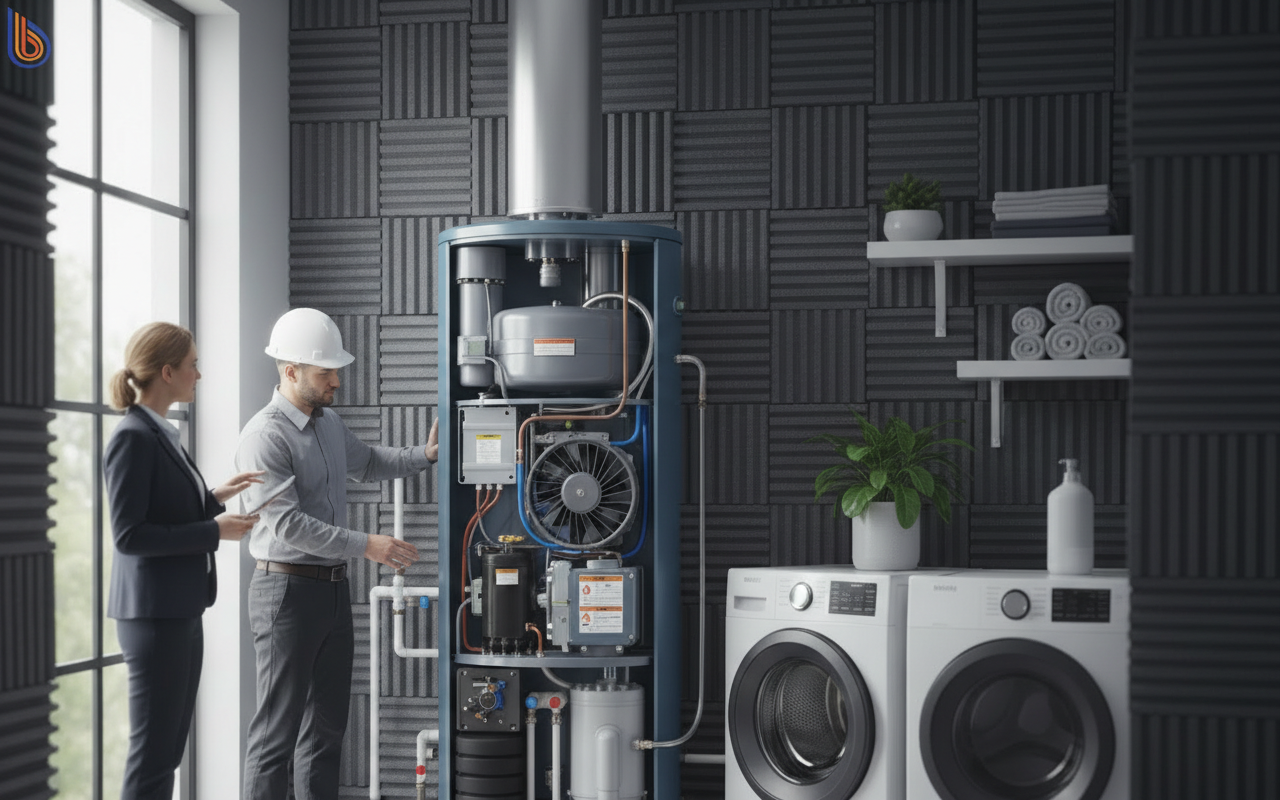
In our work with technical professionals and Series B startup founders in Palo Alto, we’ve found that high-frequency fan noise is rarely the issue; it’s the low-frequency hum of the compressor that penetrates bedroom walls. Modern hybrid models use inverter compressor modulation to vary speeds, which can create shifting resonant frequencies that are harder to ignore than a constant drone.
- Ambient Noise Floor: A typical quiet home has a floor of 30-35 dB; a heat pump adds 15-20 dB to that environment.
- Frequency Spectrum: Low-frequency sounds (under 250 Hz) require physical mass, not just foam, to stop.
- Inverter Technology: Look for units that ramp up slowly to avoid the “clunk” of a hard-start compressor.
The Silent Utility Audit: Why Vibration Isolation Matters
An honest, contrarian insight we share with every client: the best soundproofing isn’t a thicker door; it’s a better base. If you bolt a heat pump directly to a wood-joist floor, you’ve essentially turned your entire floor into a giant speaker diaphragm.
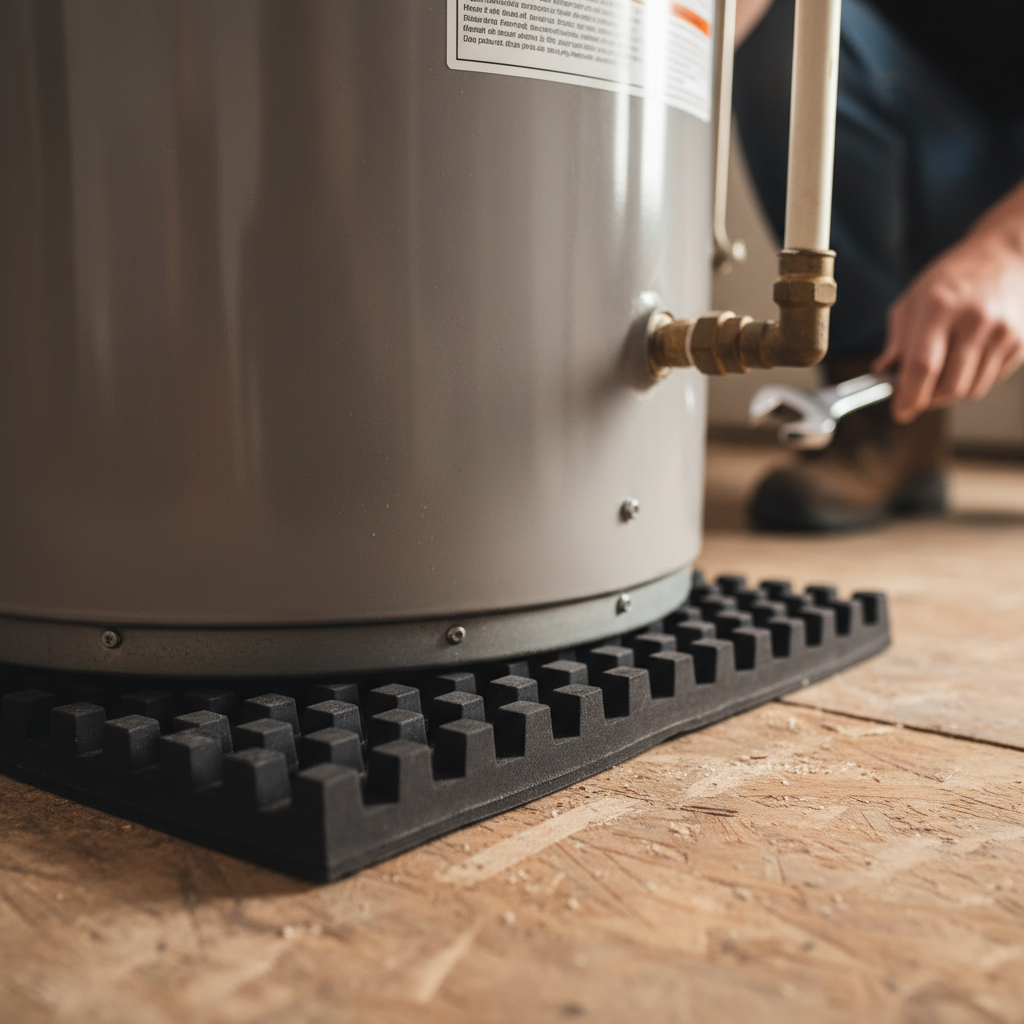
Water heater vibration isolation is the practice of mechanically decoupling the unit from the building’s structure. For a typical Bay Area mid-market client living in a 1970s wood-frame home, this is the single most important step in the installation process. Without it, the mechanical energy of the compressor travels through the studs and can be heard three rooms away.
Consider this comparison of common floor substrates and their impact on noise transmission:
| Floor Type | Transmission Risk | Recommended Mitigation |
|---|---|---|
| Concrete Slab (Garage) | Low | Standard Rubber Pads |
| Wood Joist (2nd Floor) | Critical | Spring Isolators or High-Density Neoprene |
| Crawlspace / Subfloor | Medium | Mass-Loaded Vinyl + Vibration Pads |
Need help determining if your floor can handle a hybrid unit? Schedule your free acoustic assessment with our specialist team today.
Advanced Strategies for Indoor Heat Pump Installation
The real kicker in noise mitigation is managing the air. Since heat pumps move massive amounts of air to extract heat, fan turbulence can create a “whooshing” sound that bothers sensitive sleepers.
When performing an indoor heat pump installation in a noise-sensitive area like a closet near a home office, we utilize architectural integration. This includes ducting the exhaust air to a secondary location or using acoustic plenums. By slowing down the air velocity before it exits the closet, we significantly reduce the high-frequency hiss associated with hybrid models.
- Acoustic Enclosures: Lining closets with 1lb per square foot Mass-Loaded Vinyl (MLV) blocks the transmission of sound through the drywall.
- Seismic Strapping Decoupling: In California, seismic strapping is mandatory. Use rubber grommets between the strap and the tank to prevent vibration from jumping into the wall studs.
- Pipe Isolation: Use flexible connectors for water lines. Copper pipes act as acoustic conduits, carrying compressor hum throughout the plumbing of the house.
Addressing the Psychology of Sound: Low-Frequency Hum
But wait—why do some people find 50 dB unbearable while others don’t notice it? The psychology of sound suggests that intermittent, low-frequency hums trigger more stress than consistent white noise. This is why we focus heavily on water heater vibration isolation.
For our clients who are sensitive to noise, we recommend “Night Mode” optimization. Many modern units from brands like Rheem or AOSmith allow for smart scheduling through their marketing automation platforms—err, I mean, their smart home apps. You can program the unit to perform its heavy heating cycles during the day when the house is loud, and remain in a low-power, silent state during sleeping hours.
What most people miss: The “Hybrid” setting is often quieter than the “Heat Pump Only” setting because the unit can supplement with electric elements rather than running the compressor at maximum RPM during peak demand.
Bay Area Regulations and Municipal Noise Compliance
As we move toward the 2027 zero-NOx requirements, local governments in cities like Palo Alto and San Jose are tightening noise ordinances. If you are a landlord or property manager, ensuring your heat pump noise levels stay within legal limits is no longer optional—it’s a liability issue.
We use high-fidelity measurement tools to ensure every installation meets the specific decibel limits of your ZIP code. This is particularly important for multi-family residential retrofits where units are stacked. In these scenarios, we often recommend decoupling the entire mechanical platform from the subfloor to prevent litigation from downstairs neighbors.
Ready to upgrade without the headache? Contact Better Water Heaters to discuss a custom noise-mitigation plan for your home.
The Vibration Control Checklist for Professional Installation
Before you sign off on a new installation, ensure your contractor has followed this technical framework. If they haven’t mentioned vibration pads, they aren’t thinking about your long-term comfort.
- Base Isolation: Are there 2-inch thick anti-vibration pads under the tank?
- Flex Connections: Are the water and condensate lines flexible or hard-piped?
- Wall Clearance: Is the unit at least 2 inches away from any wall to prevent “drumming” effects?
- Airflow Paths: Is the intake and exhaust clear, or is the fan struggling (and getting louder) due to static pressure?
At Better Water Heaters, we treat every installation like a precision engineering project. We don’t just swap tanks; we integrate technology into your living space. If you’re looking for a partner who understands the nuance of decibel ratings and structural resonance, we’re here to help.
Frequently Asked Questions
How loud is a heat pump water heater compared to a refrigerator?
A modern heat pump water heater typically operates between 45 and 55 dB(A), which is slightly louder than a high-end refrigerator (usually 35-45 dB). However, the water heater produces a lower-frequency vibration that can feel more intrusive if not properly isolated from the floor using vibration pads.
Can I install a heat pump water heater in a bedroom closet?
Yes, but it requires significant noise mitigation. You must use acoustic decoupling techniques, such as mass-loaded vinyl on the walls and thick vibration isolation pads. We also recommend ducting the air intake and exhaust to a different room or attic space to minimize fan noise near sleeping areas.
Do heat pump water heaters get louder as they age?
If maintenance is neglected, yes. Sediment buildup can cause the compressor to work harder, and loose panels can begin to rattle. Regular annual maintenance ensures that components remain tight and the fan assembly stays balanced, keeping heat pump noise levels consistent with the day of installation.
Will vibration isolation pads affect the stability of the water heater?
When installed correctly with seismic strapping, high-density vibration pads actually improve the safety of the unit. They provide a stable, level base while absorbing the micro-vibrations that can eventually loosen plumbing connections over time. In the Bay Area, we always ensure pads are compatible with California seismic codes.
Ready to experience the efficiency of a heat pump without the noise? Call Better Water Heaters at (408) 250-6672 or book your consultation online. We specialize in silent, high-performance installations across the entire Bay Area.