
📋 Table of Contents
According to Energy.gov, a heat pump water heater can be two to three times more energy-efficient than a conventional electric model, but only if the installation environment supports its unique physics. In our 20+ years of experience, a heat pump efficiency audit is the single most important step a Bay Area homeowner can take to prevent a multi-thousand dollar installation failure.
The real kicker? Most homeowners focus on the unit’s price tag while ignoring the environment it lives in. If you place a high-efficiency unit in a cramped, unventilated closet, your Coefficient of Performance (COP) will tank, and your energy bills will actually rise as the unit struggles to pull heat from stagnant air. This guide breaks down the four critical pillars you must evaluate before the truck arrives at your driveway.
Pillar 1: Space and Airflow Optimization
Your heat pump water heater is essentially a refrigerator working in reverse; it needs to breathe to maintain optimal water heater performance.
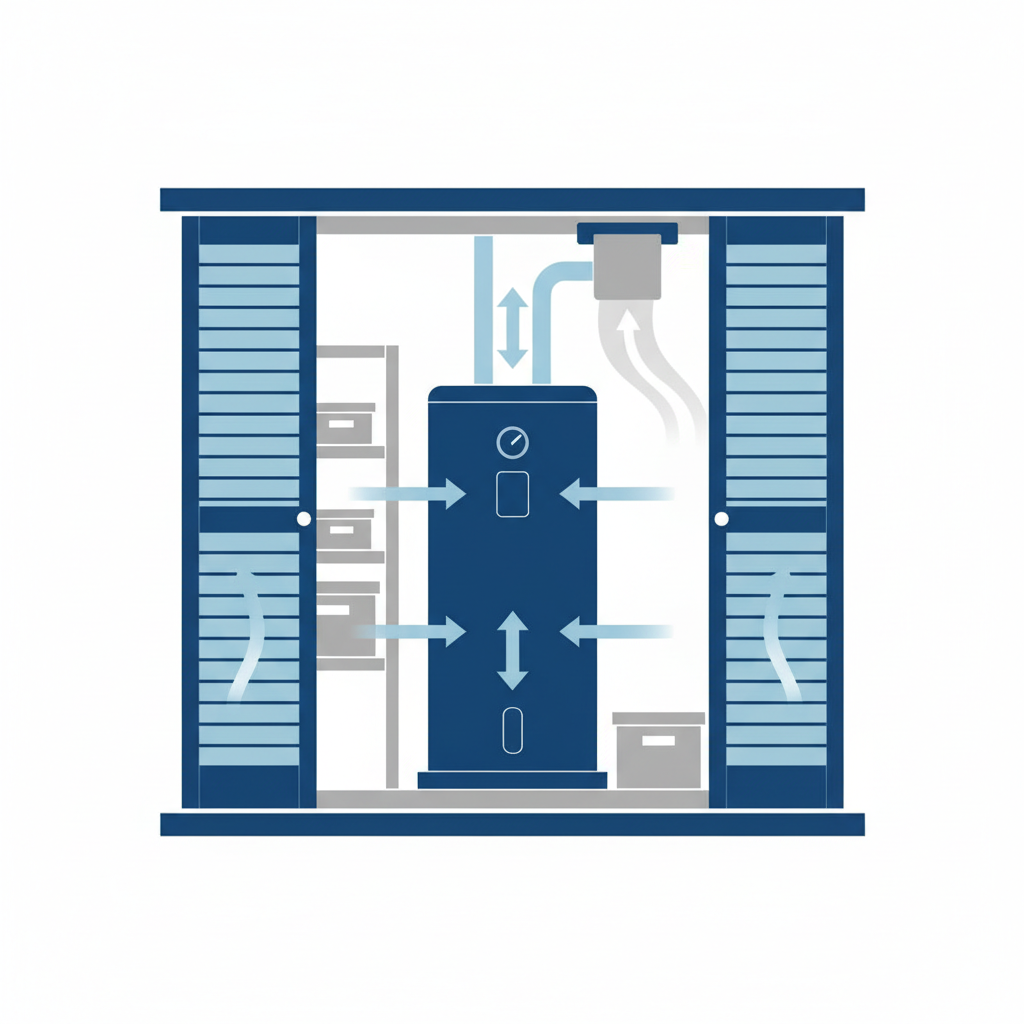
- The 1,000 Cubic Feet Rule: Most units require approximately 750 to 1,000 cubic feet of surrounding air space to operate without exhausting their heat source.
- Louvered Doors: If you are installing in a closet, a louvered door is not just an aesthetic choice—it is a functional necessity for airflow.
- Clearance Requirements: Ensure at least 6 to 12 inches of clearance on all sides to allow for easy filter cleaning and component access.
What most people miss is that the volume of the room directly impacts the HPWH recovery rate. In a typical Bay Area mid-market home, we often see units installed in garages where the ambient air temperature stays consistent, providing a stable energy source for the heat pump. However, if your utility room is smaller than 10′ x 10′, you may need to consider ducting the exhaust air outside to prevent the room from becoming a walk-in freezer.
Pillar 2: Electrical Panel Capacity and Readiness
An honest, contrarian insight: You might not actually need a 200-amp panel upgrade, despite what some high-pressure sales reps claim.
Before committing to an install, a professional heat pump efficiency audit must include a electrical panel load calculation for heat pumps. Many modern hybrid units can run on a 30-amp, 240V circuit, and some newer “plug-in” models even operate on standard 120V outlets. However, if your home still runs on an original 60-amp or 100-amp Federal Pacific or Zinsco panel, you are looking at a mandatory upgrade for safety and code compliance.
- Circuit Dedication: The water heater must be on its own dedicated circuit to prevent tripping breakers during peak recovery.
- Smart Load Balancing: For homes with tight electrical margins, consider a smart circuit breaker or a load-shedding device that prioritizes appliances.
- 2024 Tax Credit Prep: To claim the 25C tax credit, your electrical upgrades must be documented as part of the heat pump installation project.
Need a professional eye on your panel? Schedule a technical site assessment with our team to avoid mid-project surprises.
Pillar 3: Ambient Temperature and Climate Zoning
The efficiency of your system is tied directly to the ambient air temperature requirements of the specific model you choose.
While the Bay Area has a moderate climate, micro-climates matter. A unit in a drafty garage in Daly City will perform differently than one in a sun-soaked utility room in San Jose. A heat pump efficiency audit evaluates these zones to ensure the unit doesn’t rely too heavily on its backup electric resistance elements, which are far less efficient.
| Installation Zone | Typical Efficiency (COP) | Considerations |
|---|---|---|
| Attached Garage | 3.2 – 3.7 | Best balance of space and temp. |
| Interior Closet | 2.5 – 3.0 | Requires venting/louvered doors. |
| Unconditioned Basement | 3.0 – 3.4 | Provides dehumidification benefits. |
Here’s the thing: If your installation site regularly drops below 40°F, your heat pump will switch to “Electric Mode.” This is why we analyze your Bay Area home energy profile to select a unit with a lower operating temperature threshold, ensuring you stay in high-efficiency mode year-round.
Pillar 4: Condensate and Noise Management
The most overlooked pillar of a heat pump efficiency audit is the long-term management of the unit’s physical output: water and sound.
Because these units act as dehumidifiers, they produce several gallons of condensate daily. In our work with local property managers, we’ve seen foundation damage caused by improper drainage. You need a dedicated condensate pump or a gravity drain that leads to a proper termination point. Furthermore, because these units contain a compressor, they generate a hum similar to a window AC unit. If the unit is located near a bedroom, vibration isolation pads are a non-negotiable addition to your checklist.
- Condensate Routing: Ensure the drain line won’t freeze or clog, which could trigger a safety shut-off.
- Decibel Mapping: Plan for a 45-55 dB sound profile; avoid shared walls with quiet spaces if possible.
- Vibration Pads: High-density rubber pads can reduce floor-transmitted noise by up to 15%.
But wait—don’t forget about the Heat pump water heater tax credits 2024. Under the Inflation Reduction Act, you can claim 30% of the project cost, up to $2,000, but only if the unit meets specific UEF (Uniform Energy Factor) ratings. Our internal AI content engine, Ingest.blog, helps us stay updated on these shifting federal benchmarks so we can pass that data directly to you.
The ‘Red Light / Green Light’ Readiness Checklist
Before you call for an install, use this quick diagnostic to see if your home is truly ready for a high-efficiency upgrade.
- Green Light: You have a garage or large utility room with at least 1,000 cubic feet of air and a 200-amp electrical panel.
- Yellow Light: You have a small closet but are willing to install louvered doors and potentially duct the exhaust. Your panel is 100-amps and may need a sub-panel.
- Red Light: You have a tiny, unventilated interior closet with no drain access and a 60-amp fuse box. You need remediation before a heat pump is viable.
Ready to maximize your savings? Explore our guide to Bay Area rebates to see how you can stack local incentives with federal tax credits.
Key Takeaways for Homeowners
- Audit First: Never buy a unit without a heat pump efficiency audit to verify airflow and electrical capacity.
- Tax Credit Strategy: Ensure your model is 25C compliant to capture the $2,000 federal credit in 2024.
- Noise Matters: Use vibration isolation if installing near living quarters.
- Local Expertise: Bay Area regulations are shifting; work with specialists who understand the 2027 zero-NOx requirements.
Frequently Asked Questions
How much space does a heat pump water heater really need?
Most manufacturers recommend at least 750 to 1,000 cubic feet of air space. For a standard 8-foot ceiling, this translates to roughly a 10′ x 12′ room. If your space is smaller, you must use louvered doors or an air duct kit to ensure the unit can pull enough heat from the surrounding environment to operate efficiently.
Will a heat pump water heater work in a cold Bay Area garage?
Yes, they are highly effective in our climate. Most modern units operate efficiently down to 40°F. Since Bay Area nights rarely stay below that for long, the unit will maintain a high COP. In the rare event of a freeze, the hybrid system will temporarily switch to standard electric resistance heating to ensure you still have hot water.
Can I claim the 2024 tax credit for both the unit and electrical work?
According to the IRS, the 25C credit covers 30% of the total project cost, including labor and necessary electrical upgrades like a new circuit or panel, up to a maximum of $2,000 per year for heat pump water heaters. Always keep your itemized receipts and the manufacturer’s certification statement for tax filing.
How loud are these units compared to a standard tank?
Standard tanks are silent, while heat pumps produce about 45-55 decibels of sound—similar to a modern dishwasher. While not “loud,” the constant hum can be noticeable if the unit is installed in a hallway closet near a bedroom. We recommend installing them in garages or using sound-dampening materials during installation.
Don’t leave your energy savings to chance. Contact Better Water Heaters today at our contact page for a professional consultation and ensure your home is ready for the future of hot water.