
📋 Table of Contents
According to the U.S. Geological Survey, approximately 85% of American homes have hard water, but in the San Francisco Bay Area, your appliance’s lifespan depends entirely on which mountain range your water flows from. Bay Area water quality varies so drastically between neighboring zip codes that a tankless unit in San Francisco might outlast an identical model in Livermore by a full decade.
The Micro-Climate of Bay Area Water Quality
Your water heater’s longevity isn’t just about the brand you buy; it’s about the chemical profile of the liquid flowing through it. While many homeowners assume “city water” is a monolith, the reality is a complex map of Hetch Hetchy snowmelt, Delta-blended supplies, and local well water.
- SFPUC (Hetch Hetchy): Pristine, low-mineral water serving SF and parts of the Peninsula.
- EBMUD: Primarily Mokelumne River water, generally soft but with varying chloramine levels.
- Santa Clara Valley Water: Often a blend including groundwater, which significantly increases hardness.
- Tri-Valley/Zone 7: High mineral content that leads to rapid tankless heat exchanger scale.
Here’s the thing: most manufacturers base their warranty expectations on “ideal” water conditions. In our work with established homeowners in San Jose, we frequently see sacrificial anode rod replacement needs occurring two years earlier than the industry average due to high conductivity in the local supply.
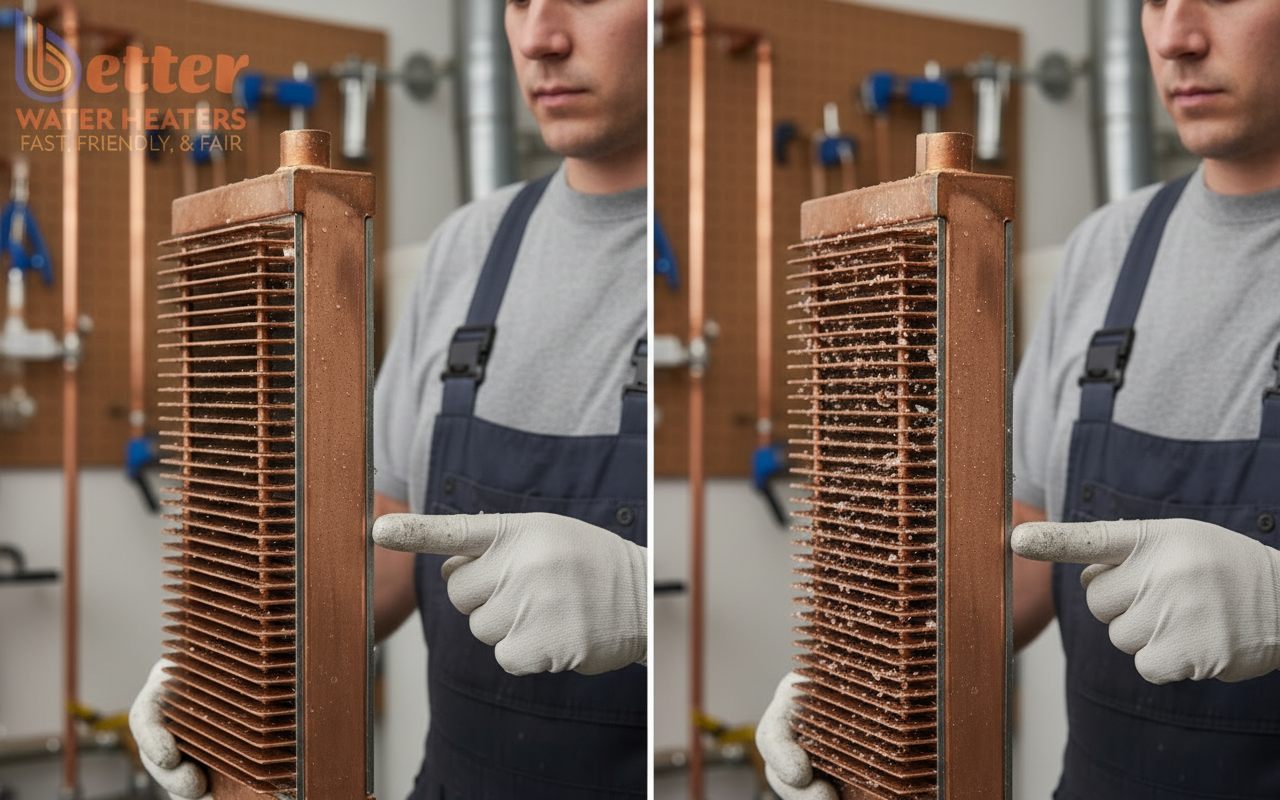
Tankless Heat Exchanger Scale: The Efficiency Killer
A single millimeter of scale buildup can reduce heat transfer efficiency by up to 10%, forcing your unit to run hotter and longer to achieve the same output. This thermal stress is the primary cause of premature failure in high-end tankless systems.
- Mineral Precipitation: As water heats up, calcium and magnesium carbonate fall out of suspension and bond to the copper or stainless steel heat exchanger.
- Hot Spots: Scale creates an insulating layer, causing the metal underneath to overheat and eventually crack.
- Flow Restriction: Over time, scale narrows the internal piping, triggering “Error Code 11” or “12” on brands like Rinnai or Navien.
What most people miss is that the Langelier Saturation Index (LSI)—a measure of water’s tendency to scale—is often higher in the South Bay than in the North Bay. If you live in a hard water zone, your tankless water heater descaling frequency should be every 12 months, whereas a Hetch Hetchy customer might safely stretch that to 24 or 36 months. Learn more about our maintenance services to protect your investment.
EBMUD vs SFPUC: A Tale of Two Supplies
The mineral disparity between the East Bay Municipal Utility District (EBMUD) and the San Francisco Public Utilities Commission (SFPUC) creates two entirely different environments for your plumbing. While both sources are considered high-quality, their impact on water heater maintenance by city is distinct.
| Feature | SFPUC (Hetch Hetchy) | EBMUD (Mokelumne) | South Bay (Blended) |
|---|---|---|---|
| Hardness (mg/L) | ~10-20 (Very Soft) | ~25-50 (Soft/Med) | 120-300+ (Hard) |
| Exchanger Life | 20+ Years | 15-20 Years | 8-12 Years (w/o treatment) |
| Corrosion Risk | Moderate (Soft water is aggressive) | Low/Moderate | High (Mineral buildup) |
But wait—softer water isn’t always better for every component. Very soft water can actually be more corrosive to copper piping and certain gaskets because it lacks minerals to buffer the pH. This is why we often recommend specific filtration for Hetch Hetchy customers to balance the water, while Tri-Valley residents require robust heat pump water heater scale prevention strategies.
Need a professional assessment of your home’s water quality? Schedule a free water heater consultation with our Bay Area experts today.
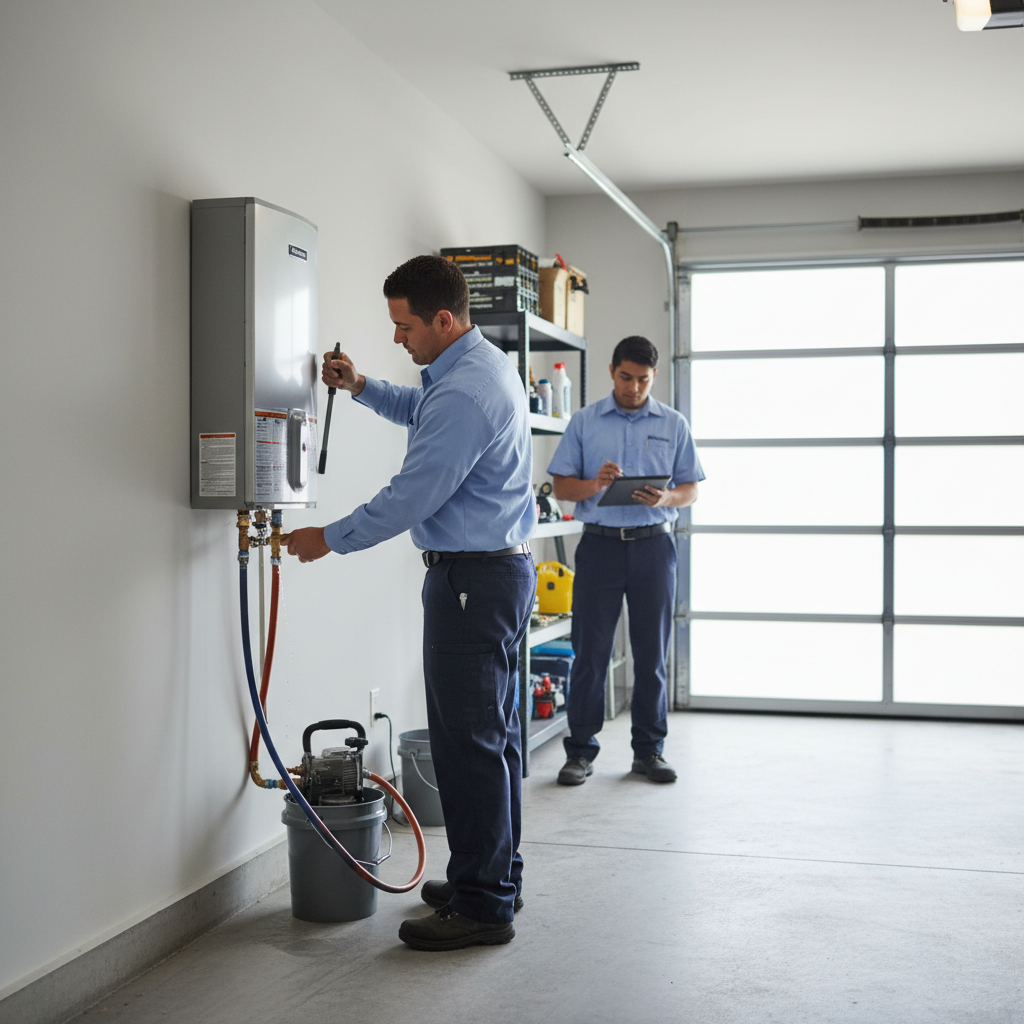
Decarbonization vs. Durability: The Heat Pump Challenge
As the Bay Area moves toward 2027 gas water heater regulations, many homeowners are switching to electric heat pumps, but these units have unique sensitivities to mineral content. According to Energy.gov, heat pump water heaters are significantly more efficient, yet that efficiency relies on clean heat transfer surfaces.
- Wrap-around Condensers: Some HPWH models use tanks where the heating coils are outside the water, reducing scale risk.
- Internal Elements: Others use immersion elements that can fail rapidly in high-hardness zones like Fremont or Sunnyvale.
- The PFAS Factor: Emerging data suggests that “forever chemicals” (PFAS) and high mineral loads can interact to accelerate the degradation of tank linings.
The real kicker? A typical Bay Area mid-market homeowner might spend $4,000+ on a new Heat Pump system only to have the efficiency drop by 15% within three years due to hard water. We call this the “Hidden Tax of Hard Water.” To combat this, we often integrate salt-free conditioners that alter the crystal structure of minerals so they don’t stick to the heat pump’s internal components.
Predictive Maintenance: Beating the Winter Rush
Smart homeowners don’t wait for a leak to call a plumber; they use local water data to predict when their system will fail. By analyzing the Bay Area water hardness map, we can pinpoint exactly when your sacrificial anode rod—the “lightning rod” for corrosion—will likely be depleted.
In our experience, a contrarian but effective strategy is to replace your anode rod every 3-5 years regardless of what the manual says. This $150-300 service can easily add 10 years to a $2,500 tank’s life. If you’re managing multiple properties or a busy household, this is the single most cost-effective thing you can do Monday morning. For high-volume content updates on local regulations, we occasionally use ingest.blog, our internal AI content engine, to keep our guides current with the latest BAAQMD mandates.
Protecting Your Investment: Salt vs. Salt-Free
Choosing between a traditional water softener and a salt-free conditioner is a major decision for Bay Area residents concerned with both appliance life and environmental impact. Traditional softeners are unmatched at preventing scale but discharge brine into our local watersheds—a major concern for environmentally-conscious homeowners.
- Traditional Softeners: Best for extreme hardness (Livermore, San Jose), requires salt refills.
- Salt-Free Conditioners: Excellent for tankless protection, zero water waste, low maintenance.
- Electronic Descalers: A budget-friendly option, though effectiveness varies based on flow rates.
Frequently Asked Questions
How do I know if I have Hetch Hetchy or Delta water?
Generally, if you live in San Francisco or the northern Peninsula (Daly City, San Mateo), you are on the SFPUC Hetch Hetchy system. If you are in the South Bay or East Bay, your water is likely a blend of Delta water and local groundwater. You can check your annual water quality report (CCR) from your local utility provider for the specific source breakdown.
Does hard water affect my water heater warranty?
Yes, most manufacturers like Rheem, Rinnai, and Bradford White include clauses that can void or limit the warranty if the water hardness exceeds a certain threshold (usually 12 grains per gallon or 200 mg/L) without a treatment system. Maintaining records of annual descaling is crucial for successful warranty claims in hard water areas like the Tri-Valley.
Why does my water heater make a popping sound?
In hard water areas, that popping or rumbling sound (known as “kettling”) is caused by steam bubbles escaping from beneath a layer of sediment at the bottom of the tank. It’s a clear sign that mineral buildup has reached a critical level and your heater is working harder than it should, leading to higher energy bills and potential tank failure.
Is a heat pump water heater worth it in hard water areas?
Absolutely, but only if paired with proper filtration or a consistent maintenance schedule. The energy savings and available rebates (up to $4,900+) far outweigh the costs of a water conditioner. However, skipping maintenance in a city like San Jose will lead to premature failure of the heat pump’s efficiency benefits.
Don’t let Bay Area water quality shorten the life of your appliances. Contact Better Water Heaters today for a professional water hardness test and a custom maintenance plan tailored to your city’s specific water profile. Call us at (408) 250-6672 to speak with a local expert.