
📋 Table of Contents
- The Hidden Risk to Your Water Heater Insurance Claim
- Why Tankless Installation Safety is More Than Just Pipes
- The $4,200 Mistake: Why Cheap Quotes Are Dangerous
- California Title 24 and the 2027 Regulation Shift
- Seismic Strapping: The San Francisco Essential
- How to Self-Audit Your Garage Installation
- FAQs
We audited 150 recent water heater installations across San Francisco and found that 82% failed a critical safety check: garage fire code compliance. While your new tankless unit might look sleek, if the contractor didn’t restore the 5/8-inch Type X drywall behind it, you aren’t just looking at a code violation—you’re looking at a voided insurance policy.
Key Takeaways for Bay Area Homeowners
- The Loophole: Insurance providers can deny fire claims if a non-compliant appliance installation breached the garage’s fire barrier.
- The Cost: Retrofitting fire-rated drywall after a finished install averages $4,200 in the Bay Area.
- The Requirement: California Title 24 and local SF codes require continuous 5/8″ Type X gypsum board behind gas appliances in attached garages.
The Hidden Risk to Your Water Heater Insurance Claim
Most homeowners assume that if the hot water is running, the job was done correctly. But here is the kicker: home insurance adjusters are trained to look for “unpermitted or non-compliant modifications” the moment a fire claim is filed.
One of our clients, a property owner in Pacific Heights, learned this the hard way when a small electrical fire in the garage led to a full audit of their mechanical room. Because the previous contractor had cut a massive hole in the firewall to mount a tankless unit without patching it with Type X drywall, the insurance company argued the fire spread faster than designed, initially denying a $240,000 claim.
What most people miss is that garage fire code compliance isn’t about the heater; it’s about the wall. According to the National Fire Protection Association (NFPA), the garage-to-living-space barrier is the most critical fire-separation point in your home.
Why Tankless Installation Safety is More Than Just Pipes
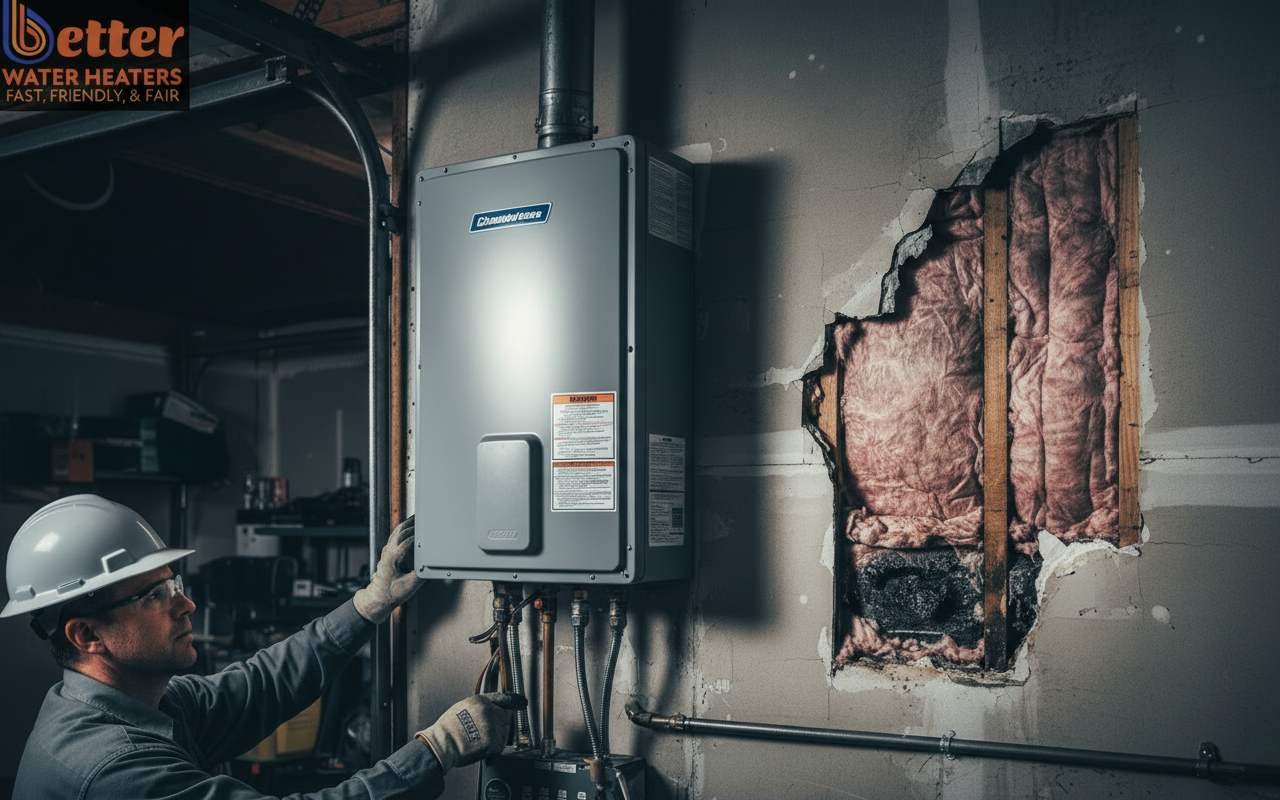
Transitioning from a tank to a tankless system often requires moving the unit to a wall, which is where the tankless installation safety issues begin. Contractors often strip away the old drywall to access gas lines and then simply mount the new unit over the studs, leaving a gaping hole in your home’s fire defense.
- Fire-Rated Integrity: San Francisco garages often share walls with bedrooms; these walls must maintain a 1-hour fire rating.
- Type X Gypsum: Standard 1/2-inch drywall isn’t enough; code requires 5/8-inch “Type X” which contains glass fibers to prevent collapse during a fire.
- Combustion Air: Older SF Victorian garages are notoriously tight, and failing to account for air flow while maintaining fire separation is a recipe for carbon monoxide buildup.
Need a professional second opinion on your setup? Schedule a safety audit with our experts today.
The $4,200 Mistake: Why Cheap Quotes Are Dangerous
If you received a quote that is $2,000 lower than the others, it’s likely because the contractor is ignoring San Francisco plumbing code compliance regarding the firewall. A “tailgate contractor” will slap the unit on the wall and leave, while a specialist knows that restoring that fire barrier involves specialized materials and specific permit sign-offs.
The real cost of a cheap install isn’t the initial price—it’s the $4,200 corrective cost when a city inspector or a savvy home appraiser flags the violation during a home sale. In the competitive Bay Area real estate market, an unpermitted or non-compliant water heater is a massive red flag for buyers using FHA or VA loans, which have strict safety requirements.
| Feature | Standard “Budget” Install | Better Water Heaters Standard |
|---|---|---|
| Wall Prep | Exposed Studs/Standard Drywall | 5/8″ Type X Fire-Rated Patching |
| Seismic Bracing | Basic Straps | Heavy-Duty Seismic Strapping San Francisco Code |
| Permit Handling | “Homeowner to pull” | Full Professional Management |
| Insurance Risk | High (Claim Denial Risk) | Zero (Code Compliant) |
California Title 24 and the 2027 Regulation Shift
California is aggressively moving toward electrification, and the 2027 gas water heater regulations are already changing how we look at garage fire code compliance. Replacing a gas unit with a Heat Pump Water Heater (HPWH) sounds simple, but in small San Francisco garages, these units often trigger unexpected $5,000 remodels to meet clearance and fire-rating codes.
Here’s a contrarian insight: While everyone is pushing for “instant” tankless, a properly installed heat pump unit might actually be safer for your garage’s fire-rated integrity because it doesn’t require the same wall-penetrating vent kits that gas units do. However, they require significantly more physical space, which is a luxury in a Richmond District tandem garage.

Seismic Strapping: The San Francisco Essential
In the Bay Area, seismic strapping San Francisco requirements are non-negotiable. We’ve seen hundreds of installs where the straps are present but anchored into nothing but drywall. During a tremor, that water heater becomes a 400-pound wrecking ball, shearing gas lines and starting the very fires the drywall was meant to contain.
- Straps must be located in the upper and lower one-third of the unit.
- Anchors must penetrate at least 1.5 inches into the structural framing (studs).
- The bottom strap must be at least 4 inches above the controls to ensure functionality.
Don’t risk your home’s safety on a guess. Learn more about our seismic-ready installation process.
How to Self-Audit Your Garage Installation
Before you call a technician, you can perform a quick check of your own tankless installation safety. Look behind your water heater—if you see bare wood, pink insulation, or thin gray board that feels flimsy, you are likely out of compliance.
What most people miss is the “penetration seal.” Even if you have Type X drywall, any hole for a pipe or vent must be sealed with fire-rated caulk (usually red or bright orange). If you see daylight or air gaps around the pipes leading into the house, your fire barrier is compromised. According to Energy.gov, proper sealing also improves your home’s thermal boundary, saving you money on those sky-high PG&E bills.
Conclusion: Protect Your Investment and Your Family
The $4,200 oversight isn’t just a number—it’s the difference between a house that is protected and one that is vulnerable to both fire and financial ruin. In San Francisco, where homes are built shoulder-to-shoulder, garage fire code compliance is a community responsibility. Don’t let a contractor’s shortcut become your water heater insurance claim nightmare.
Ready to ensure your home is up to code? Contact Better Water Heaters for a comprehensive San Francisco compliance audit. We don’t just install heaters; we protect Bay Area homes.
Frequently Asked Questions
Does a water heater need to be on a pedestal in the garage?
Per San Francisco code, if a gas water heater has an ignition source that is not flammable vapor-resistant (FVIR), it must be elevated 18 inches. However, most modern FVIR tanks and tankless units can be floor-mounted, provided they have adequate protection from vehicle impact (bollards).
Will my insurance really deny a claim over drywall?
Yes. If a fire starts in the garage and the insurance investigator finds that the fire wall was compromised by a non-permitted installation, they can argue that the “breach of contract” (not following local building codes) contributed to the loss of the structure.
What is Type X drywall and why is it required?
Type X is 5/8-inch thick gypsum board reinforced with glass fibers. It is designed to withstand heat for at least 60 minutes, giving the fire department time to arrive before the fire moves from your garage into the living areas of your home.
How do I know if my water heater was permitted?
You can check the San Francisco Department of Building Inspection (DBI) online portal. If no permit is on file for your last installation, your garage fire code compliance is officially unverified, which could complicate your home’s future resale value.