
📋 Table of Contents
According to the U.S. Geological Survey (USGS), there is a 72% probability of a magnitude 6.7 or greater earthquake striking the San Francisco Bay Region before 2043. For homeowners, Bay Area seismic retrofitting isn’t just a regulatory hurdle—it is the difference between a minor inconvenience and a flooded, gas-leaking catastrophe during the next big shake.
Many residents assume that two thin metal straps around their water heater satisfy the law. Here’s the thing: California Plumbing Code Section 507.3 requires specific bracing in the top third and bottom third of the unit, but even that is just the baseline. In the shifting soils of San Jose or the Victorian foundations of San Francisco, a standard installation often fails because the wall it’s attached to isn’t structurally sound. If you are planning a replacement or preparing your home for sale, a site readiness audit is your most critical first step.
Key Takeaways for Bay Area Homeowners
- Compliance is Mandatory: California law requires specific water heater seismic strapping for all home sales and new installations.
- Heat Pumps Require More: Modern heat pump water heaters are significantly heavier than gas tanks, requiring reinforced platforms.
- Insurance Benefits: Documented seismic upgrades can often lead to lower premiums or easier claim processing after a disaster.
- ASV Integration: Automatic gas shut-off valves are increasingly mandated by local Bay Area municipalities during retrofits.
Step 1: Structural Integrity and Foundation Assessment
The most robust earthquake straps are useless if they are anchored into rotting wood or crumbling 100-year-old masonry. In our work with typical Bay Area mid-market clients, we often find that the biggest risk isn’t the strap itself, but the lack of a solid mounting point.
But wait—before you drill, you must identify your foundation type. Homes in liquefaction zones, common in parts of the East Bay and San Francisco, experience different seismic forces than those on solid bedrock. A proper audit evaluates:
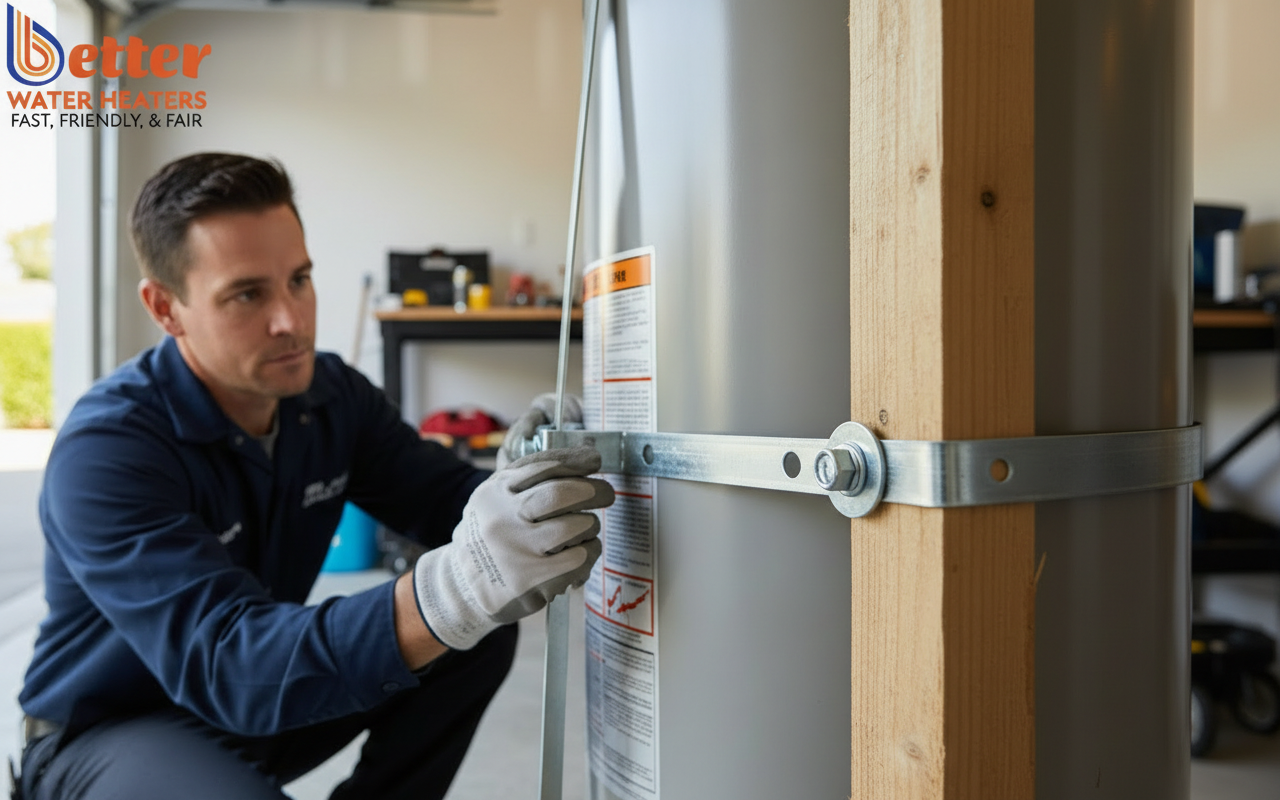
- Wall Stud Condition: Ensuring anchors penetrate at least 1.5 inches into solid wood framing, not just drywall or plaster.
- Foundation Material: Old concrete in many Peninsula homes can be brittle; specialized expansion bolts may be necessary.
- Platform Stability: If the unit sits on a wooden stand, that stand must be bolted to the floor to prevent “walking” during a tremor.
Step 2: Compliance with California Plumbing Code Section 507.3
Legal compliance is the floor, not the ceiling, for safety, yet many DIY installations fail basic inspections during home sales. The International Association of Plumbing and Mechanical Officials (IAPMO), which informs the California Plumbing Code, is very specific about strap placement.
What most people miss is the “offset” rule. Straps must be tight, but they cannot compress the insulation jacket of the heater, and they must maintain a specific distance from the gas control valve. For Bay Area seismic retrofitting, we follow a strict checklist:
- Dual Strap Placement: One strap in the upper one-third and one in the lower one-third of the tank.
- Minimum Clearance: The lower strap must be at least 4 inches above the gas control valve.
- Wrap-Around Security: Straps must fully encircle the tank to prevent it from sliding out vertically.
Need a professional eye to check your compliance? Schedule a professional site audit today to ensure your system meets all local codes.
Step 3: Flexible Connector and ASV Integration
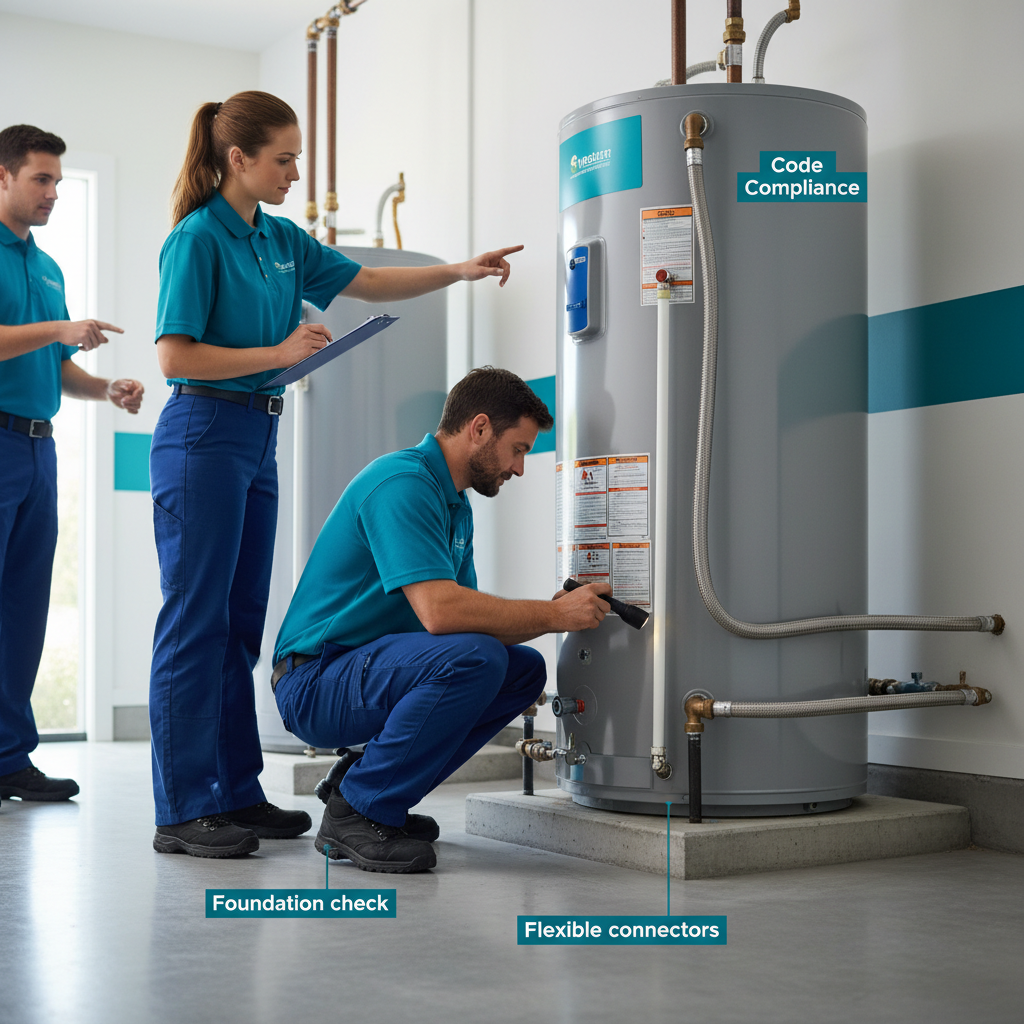
Rigid pipes snap; flexible connectors save homes. During an earthquake, your water heater will move independently of your home’s structure, and if your gas and water lines are rigid copper or steel, they will shear off, leading to fire or flooding.
The real kicker? Many Bay Area cities, including Los Gatos and Berkeley, now strongly encourage or mandate automatic gas shut-off valve installation. These valves detect seismic activity and kill the gas supply before a leak can start. According to the Federal Emergency Management Agency (FEMA), secondary fires cause a massive percentage of total earthquake damage.
| Feature | Standard Installation | Seismic Retrofit Grade |
|---|---|---|
| Gas Lines | Rigid Pipe | Stainless Steel Flexible Connectors |
| Water Lines | Copper Solder | Corrugated Flex Lines | Manual Only | Automatic Seismic Shut-off (ASV) |
Step 4: Future-Proofing for Heat Pump Transitions
Coordinating your seismic audit with the upcoming 2027 Bay Area gas water heater phase-out is the smartest move a homeowner can make today. Heat pump water heaters (HPWH) are the future of California energy efficiency, but they present a new challenge: weight.
A full 80-gallon heat pump unit can weigh over 1,000 pounds when full. A standard seismic setup designed for a light gas tank might buckle under that load. In our work with environmentally-minded residents, we focus on “Resilience Stabilization.” This involves reinforced floor plates and heavy-duty water heater seismic strapping rated for higher sheer forces. If you’re auditing now, build for the weight of the appliance you’ll own in three years, not just the one you have today.
At Better Water Heaters, we utilize our internal AI content engine, Ingest.blog, to track real-time updates to local municipal codes, ensuring our technicians always have the latest Bay Area plumbing codes at their fingertips.
The Hidden Liability: Home Sales and Insurance
Here is an honest, contrarian insight: Most homeowners think seismic retrofitting is for their safety, but in the Bay Area, it’s actually for your bank account. In a competitive real estate market like Palo Alto or Walnut Creek, a non-compliant water heater is a common “contingency killer.”
Insurance companies are also becoming stricter. With the rise in climate-related payouts, carriers are looking for any reason to deny a claim or raise a deductible. By documenting your earthquake safety requirements through a professional audit, you create a paper trail of due diligence. This can be vital when negotiating renewals or filing a claim after a localized tremor.
Ready to secure your home? Don’t wait for the next rumble to find out your straps are loose. Explore our seismic retrofitting services and get your 4-step audit completed by the local experts.
Frequently Asked Questions
Do I really need a permit for seismic strapping in the Bay Area?
Yes, in most Bay Area jurisdictions, seismic bracing is part of the plumbing permit required for any water heater replacement. Even if you are just adding straps to an existing unit, local codes often require a specific inspection to ensure the anchors are placed correctly into the wall studs.
What is California Plumbing Code Section 507.3?
This specific section of the code mandates that all water heaters must be anchored or strapped to resist horizontal displacement caused by earthquake motion. It requires two straps—one in the upper third and one in the lower third—and specifically mentions that the bracing must be installed at the time of any new water heater installation.
How much does a Bay Area water heater retrofit cost?
For a standard tank, a professional seismic retrofit typically costs between $200 and $500 as an add-on to installation. However, if you require a new platform for a heavy heat pump or the installation of an automatic gas shut-off valve, costs can increase. It is a small price to pay compared to the thousands in potential water and fire damage.
Can I install earthquake straps myself?
While DIY kits are available at hardware stores, they are frequently installed incorrectly—often anchored only into drywall or positioned too close to the gas valve. In the Bay Area, where seismic activity is a certainty, professional installation ensures that your bracing will actually hold under the massive G-forces of a major quake.
Does a tankless water heater need seismic strapping?
Tankless units are wall-mounted and do not use traditional straps, but they still have strict seismic mounting requirements. They must be bolted to structural members using specific hardware to prevent them from shaking off the wall, and they still require flexible water and gas connectors to prevent pipe rupture.
Your Monday Morning Action Item: Take a flashlight to your water heater today. Give the tank a firm (but careful) nudge. If it wiggles, or if the straps are only anchored into the drywall, call a specialist this week to schedule a formal audit. Safety is a choice you make before the emergency happens.