Water heater article archive
BAAQMD Water Heater Regulations: The 2027 Countdown Guide
Historical article, not newly reviewed advice. Verify current requirements, incentives and model guidance with the relevant authority or manufacturer before relying on them. Equipment and service needs require an assessment.
📋 Table of Contents
Navigating the complex landscape of BAAQMD water heater regulations is becoming a top priority for sophisticated homeowners in San Jose, Fremont, and across the Peninsula. As we approach the 2027 deadline, the transition from gas-fired appliances to zero-emission technology is no longer a distant policy goal—it is a looming reality for every residential property owner in the region.
Furthermore, the Bay Area Air Quality Management District (BAAQMD) recently adopted landmark amendments to Regulation 9, Rule 4. These changes effectively mandate that all new water heaters sold and installed in the Bay Area must meet a zero-NOx (nitrogen oxide) emissions standard starting in 2027. For the average resident, this means the era of the standard atmospheric gas water heater is coming to an end.
The Strategic Impact of BAAQMD Water Heater Regulations
Consequently, many property owners are asking why these BAAQMD water heater regulations are being implemented with such strict timelines. The primary driver is environmental health, as water heaters currently account for a significant portion of residential nitrogen oxide emissions in the Bay Area.
However, from a strategic home management perspective, the 2027 gas water heater ban creates a unique set of challenges and opportunities:
- Technological Shift: After 2027, if your gas unit fails, you will likely be required to install a heat pump water heater (HPWH).
- Permitting Timelines: Electrical upgrades required for new systems can take weeks, making emergency replacements nearly impossible post-2027.
- Property Valuation: Homes with updated, compliant systems will likely see a boost in marketability as the deadline nears.
- Inventory Shortages: As demand spikes in late 2026, experts predict significant equipment shortages and labor price inflation.
The 'Emergency Failure' Scenario: A Real Risk
Imagine it is a rainy Saturday in January 2028, and your 12-year-old gas water heater finally bursts. Before the new regulations, a Bay Area water heater replacement was a same-day service. Under the new rules, you cannot simply buy another gas unit.
Instead, you may need a 240v electrical circuit installed, which requires a load calculation, a permit, and a licensed electrician. This process can leave a family without hot water for 7 to 14 days. This is exactly why we recommend a proactive planned replacement strategy before your current unit reaches its end-of-life.
Comparing the Cost of Waiting vs. Acting Today
Currently, the financial landscape heavily favors those who act before the gas water heater ban 2027 takes full effect. According to data from Energy.gov, switching to high-efficiency heat pump models can reduce water heating costs by up to 70%.
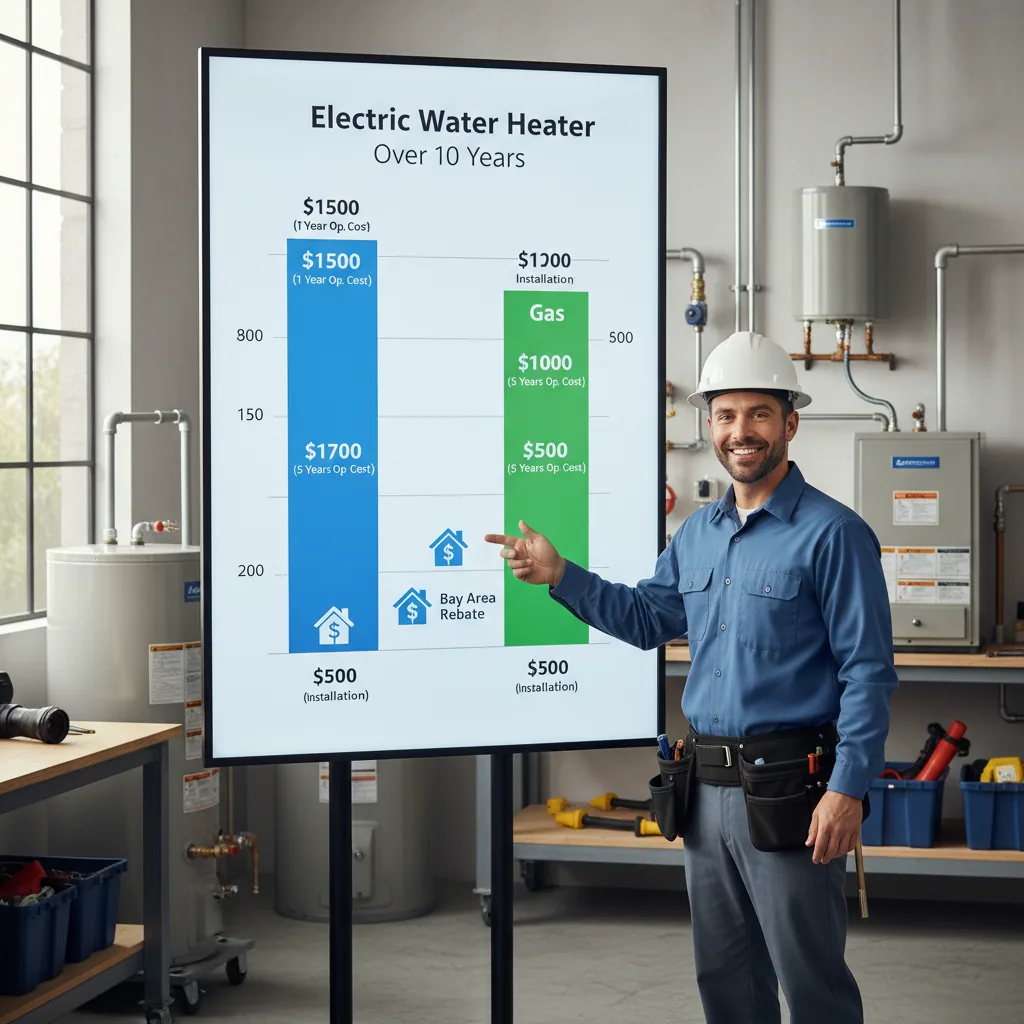
Specifically, the "Cost of Waiting" includes the loss of current high-value rebates and the inevitable rise in labor costs as the compliance deadline approaches. Below is a breakdown of the current financial incentives available for a Bay Area water heater replacement.
| Incentive Source | Estimated Value | Eligibility / Status |
|---|---|---|
| TECH Clean California | $1,000 - $3,100 | Available now (Funding fluctuates) |
| Federal Tax Credit (25C) | 30% (Up to $2,000) | Annual cap applies |
| Local Utility (SVCE/PCE) | $1,000 - $2,000 | Varies by city/county |
| Total Potential Savings | $4,900+ | Highest in 2024-2025 |
The 2026 Gas Upgrade: A Stealth Strategy
While the focus is often on electrification, some homeowners are choosing a different path to navigate the BAAQMD water heater regulations. This involves installing a high-efficiency, ultra-low NOx gas unit in late 2026.
By replacing an aging gas unit just before the 2027 ban, you effectively "grandfather" a gas system into your home for another 12 to 15 years. This strategy is particularly effective for:
- Homes with limited electrical panel capacity (100-amp service).
- Landlords who need to maintain low-complexity systems for tenants.
- Homeowners planning to sell within the next 5-7 years who want to avoid the cost of a full electrical retrofit.
- Properties where the water heater is located in a tight interior closet without the airflow required for a heat pump.
Nevertheless, it is critical to consult with local water heater specialists to ensure your chosen unit meets the interim ultra-low NOx requirements mandated by BAAQMD before the total zero-emission cutoff.
Overcoming Installation Hurdles: Panel Upgrades and Space
Adhering to the 2027 gas water heater ban 2027 requirements often reveals hidden infrastructure needs. Many older Bay Area homes in Redwood City or San Mateo were built with 100-amp electrical panels that are already at capacity.
Fortunately, technology has evolved to meet these challenges. Sophisticated solutions now exist that allow for zero-emission water heater installation without a $5,000 panel upgrade:
- 120v 'Plug-In' Heat Pumps: These units can plug into a standard outlet, avoiding the need for a dedicated 240v circuit.
- Smart Load Managers: These devices pause the water heater's power when another high-draw appliance (like an EV charger) is active.
- Split-System Heat Pumps: These allow the tank to stay inside while the compressor sits outside, solving the "small closet" airflow issue.
Moreover, organizations like BAAQMD emphasize that while the transition is mandatory, the flexibility in technology makes it achievable for most architectural styles found in the Silicon Valley area.
Real Estate and Property Value Implications
In the high-stakes Bay Area real estate market, compliance with BAAQMD water heater regulations is becoming a standard line item in home inspections. Prospective buyers in San Jose and Palo Alto are increasingly savvy about upcoming electrification mandates.
Consequently, a home that already features a high-efficiency heat pump water heater is seen as "future-proofed." This removes a $4,000 to $8,000 liability from the buyer’s plate, making your property more competitive. Conversely, a home with a 15-year-old gas unit will likely face credit requests during the closing process as the 2027 deadline nears.
Why Proactive Replacement is the Best ROI
Ultimately, the goal for any Bay Area homeowner should be to control the timeline of their Bay Area water heater replacement. Waiting for a leak means losing your leverage and potentially missing out on thousands in rebates.
By scheduling a consultation today, you can benefit from:
- Expert Sizing: Ensuring your new heat pump system provides enough hot water for your family's specific usage patterns.
- Rebate Management: Professional help navigating the complex paperwork for TECH Clean California and HEEHRA.
- Permit Handling: Ensuring all seismic strapping and local building codes are met for a seamless inspection.
- Peace of Mind: Knowing that when the 2027 ban arrives, your home is already ahead of the curve.
At Better Water Heaters, we have spent 20 years helping our neighbors navigate shifting regulations. Whether you want to maximize your gas system's life or lead the charge into electrification, we provide the expert guidance you need. Contact our team today to schedule your home assessment.
Frequently Asked Questions
Do BAAQMD water heater regulations mean I have to replace my working gas heater?
No, the regulations do not require you to remove a functioning gas water heater. The mandate applies only to the sale and installation of new units. However, once your current gas unit fails after 2027, you will be required to replace it with a zero-emission model, such as a heat pump.
Can I still buy a gas water heater in San Jose in 2026?
Yes, you can still purchase and install ultra-low NOx gas water heaters in San Jose and the rest of the Bay Area through December 31, 2026. This is why many experts suggest 2026 as a strategic 'last call' year for homeowners who are not yet ready to transition to full electric systems.
How much do heat pump water heater rebates 2024 actually cover?
In 2024, combined rebates from TECH Clean California, local utility programs, and federal tax credits can cover between $3,000 and $5,000 of the installation cost. In many cases, this brings the net cost of a heat pump installation down to the same price as a traditional gas unit replacement.
Will the Bay Area power grid handle all these new electric water heaters?
Yes, the transition is being phased in specifically to allow for grid infrastructure improvements. Furthermore, heat pump water heaters are highly efficient and can be programmed to heat water during 'off-peak' hours, actually helping to balance the grid rather than straining it during high-demand periods.