
📋 Table of Contents
According to the California Department of Housing and Community Development, ADU permit applications have surged by over 15,000% since 2016, yet many homeowners overlook the critical infrastructure needed to support them. Navigating ADU water heater options in the Bay Area requires more than just picking a brand; it’s a strategic choice between extending your main house system or installing a dedicated unit that fits within tight square footage and strict energy codes.
Key Takeaways for Bay Area Homeowners
- Electrical Capacity is King: High-draw electric tankless units often require a 200-amp panel upgrade, a “hidden cost” that can exceed $3,000.
- Distance Matters: If your ADU is more than 30 feet from the main house, a whole-home extension often leads to “cold water lag” and tenant frustration.
- Rebate Maximization: Heat pump water heaters (HPWH) can qualify for up to $4,900 in local and federal incentives in 2024.
- Title 24 Compliance: California’s energy code heavily favors high-efficiency electric options for new secondary dwellings.
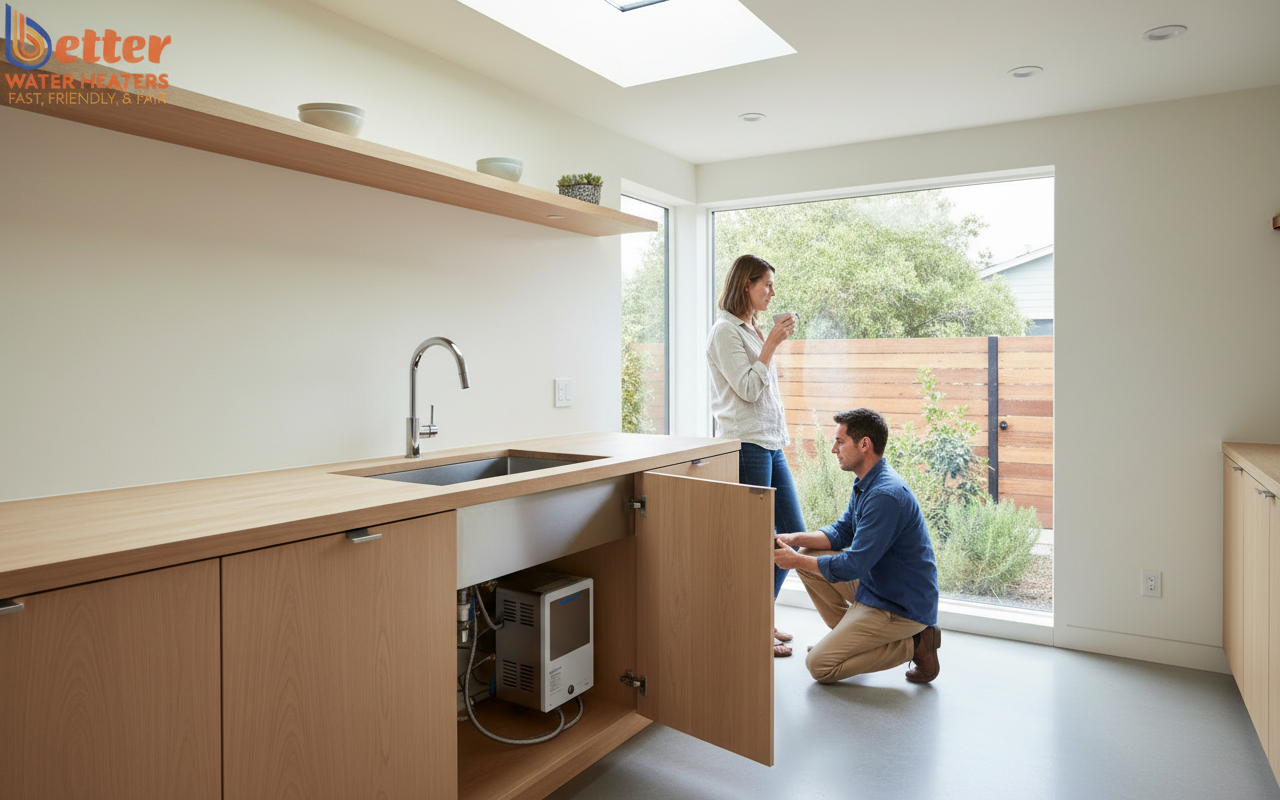
The Real Cost of Point-of-Use vs. Whole-Home Systems
The smartest way to view your ADU plumbing is through the lens of “Total Cost of Ownership” rather than just the initial price tag. While tapping into the main home’s water heater seems cheaper upfront, the labor for trenching and the heat loss through long pipe runs often negate those savings. What most people miss: the energy lost waiting for hot water to travel 50 feet across a backyard can increase utility bills by 10-15% annually.
Consider these primary factors when weighing your options:
- Pipe Run Distance: Anything over 25-30 feet typically justifies a dedicated ADU unit.
- Tenant Experience: If you are renting the unit, instant hot water is a “five-star review” factor that prevents complaints.
- Space Constraints: A 400-sq-ft cottage cannot afford to lose a 3×3 closet to a traditional tank.
| Feature | Point-of-Use (Electric Tankless) | Dedicated Heat Pump (Tank) | Main House Extension |
|---|---|---|---|
| Upfront Cost | Medium ($1,500 – $3,000) | High ($4,000+) | Low to Medium (Trenching dependent) |
| Space Required | Minimal (Wall-mounted) | Moderate (Needs closet/garage) | Zero (Inside ADU) |
| Electrical Needs | Very High (60-120 Amps) | Low (30 Amps) | None (Uses main house) |
In our work with Silicon Valley homeowners, we often see the “Electrical Wall.” A typical mid-market home in San Jose might only have a 100-amp or 125-amp main panel. Installing a whole-home electric tankless unit for an ADU can draw 80 amps alone, instantly triggering a mandatory and expensive panel upgrade. This is why we often recommend heat pump water heater technology which uses significantly less power.
Why Point-of-Use (POU) Wins in Compact ADUs
POU systems reclaim valuable square footage in 400-sq-ft floor plans by mounting directly under sinks or in small utility panels. The real kicker? They eliminate the need for a recirculating pump, which is often required by California Title 24 when water has to travel long distances. For a typical Bay Area backyard cottage plumbing setup, a POU unit in the kitchen and another for the shower can be more efficient than one large central unit.
Advantages of POU for ADUs include:
- Instant Hot Water: Zero wait time because the heater is inches from the faucet.
- Modular Reliability: If one unit fails, the other still provides hot water elsewhere.
- Decarbonization: POU units are almost exclusively electric, aligning with the 2027 gas water heater phase-out.
Need help navigating local codes? Schedule a free consultation with our Bay Area specialists to find the right fit for your ADU project.
The Centralized Heat Pump: The Efficiency King
If your ADU has a small garage or a dedicated mechanical closet, a central heat pump water heater is often the superior long-term investment. While POU units are convenient, they are “resistance” heaters, meaning they are less efficient than heat pumps that move heat rather than creating it. According to Energy.gov, heat pump units can be 2-3 times more energy-efficient than conventional electric models.
The trade-offs to consider:
- Noise: Heat pumps have a fan and compressor; they shouldn’t be placed directly next to a bedroom.
- Condensate: These units produce water (condensate) and require a drain line.
- Cooling: They exhaust cool air, which is great for a warm garage but less ideal for a conditioned living space.
Navigating Bay Area Backyard Cottage Plumbing Regulations
Plumbing an ADU isn’t just about pipes; it’s about permits and compliance with the Bay Area Air Quality Management District. Most East Bay and South Bay cities now require “electric-ready” construction. This means even if you want gas, you must provide the electrical infrastructure for a future electric heater. Many homeowners find that by the time they satisfy these “future-proofing” codes, it’s cheaper to just go all-electric from day one.
The Retrofit Reality: If you are converting an existing garage into a JADU (Junior ADU), tapping into the main house line is often a nightmare. You’ll likely need to cut through existing concrete driveways or patios. In these cases, a dedicated electric tankless water heater for ADU use is almost always the path of least resistance. It avoids the mess of trenching and keeps the utility metering separate if you choose to install a sub-meter for a tenant.
But wait—before you buy that 27kW tankless unit on Amazon, check your panel. We’ve seen dozens of projects stall because the homeowner didn’t realize their ADU plumbing code compliance also required a massive electrical overhaul. Here’s a contrarian take: Sometimes a small, 30-gallon high-efficiency tank is better than a tankless unit because it doesn’t require the massive electrical spike that causes lights to flicker across the property.
Maximizing Rebates and Tax Credits in 2024
The financial landscape for ADU water heater options has never been better for Bay Area residents. Between the TECH Clean California program and the Inflation Reduction Act, the “sticker shock” of high-end systems can be significantly mitigated. For example, a typical Bay Area mid-market client can often stack local utility rebates (like those from Peninsula Clean Energy or Silicon Valley Clean Energy) with federal tax credits.
Current incentive opportunities include:
- Federal Tax Credit (25C): 30% of the cost up to $2,000 for heat pump water heaters.
- TECH Clean California: Incentives ranging from $1,000 to $3,100 depending on the installation type.
- Local Utility Rebates: Additional $500 – $1,000 for switching from gas to electric.
Ready to upgrade? Contact us today to see which rebates apply to your specific zip code.
Decision Matrix: Which System Should You Choose?
To make this easy, we’ve developed a quick framework based on our 20+ years of Bay Area experience. Here is how to decide this week:
- Choose Point-of-Use (Electric Tankless) if: Your ADU is under 500 sq ft, has no room for a tank, and your electrical panel is already upgraded to 200 amps.
- Choose a Dedicated Heat Pump if: You want the lowest possible utility bills, you have a garage or closet for the unit, and you want to maximize 2024 tax credits.
- Choose a Whole-Home Extension if: The ADU is a JADU (sharing a wall with the house), the pipe run is under 15 feet, and your current water heater is oversized for your needs.
One thing we often see with property managers is the desire for “low maintenance.” In that scenario, we steer them away from complex POU arrays and toward a single, high-quality central tank. It’s one less point of failure and easier for a standard plumber to service on a Sunday night. If you’re managing content for a real estate portfolio, tools like Ingest.blog can help you distribute these maintenance guides to your tenants automatically, but for the physical installation, you need a specialist who knows the local dirt.
Frequently Asked Questions
Do I need a separate permit for an ADU water heater?
Yes, in almost every Bay Area jurisdiction, including San Jose and Oakland, a plumbing and/or electrical permit is required for an ADU water heater installation. This ensures the unit meets California Title 24 energy standards and seismic strapping requirements. We handle the entire permit process for our clients to ensure full compliance with local building departments.
Can I use a gas water heater for my new ADU?
While still technically legal in some areas, many Bay Area cities have implemented “reach codes” that effectively ban gas appliances in new construction, including ADUs. Additionally, the 2027 California ban on gas water heater sales makes electric or heat pump options a much more “future-proof” investment for your property value.
How much electrical power does an ADU water heater need?
A point-of-use electric tankless unit can require 60 to 120 amps, which often necessitates a panel upgrade. Conversely, a high-efficiency heat pump water heater typically only requires a 30-amp, 240V circuit. Always have an expert evaluate your current panel capacity before purchasing a unit to avoid unexpected $3,000+ electrical costs.
How long does it take to get hot water in an ADU from the main house?
If your ADU is 50 feet away, it can take 60-90 seconds for hot water to arrive. This results in significant water waste and user frustration. To solve this without a dedicated heater, you would need a recirculating pump, which increases energy costs and may conflict with Title 24 efficiency requirements for new ADUs.
Stop guessing and start planning. The right water heater can save you thousands in construction costs and years of tenant complaints. Get a professional ADU water heater assessment from Better Water Heaters today.