
📋 Table of Contents
According to the U.S. Department of Energy, water heating is the second largest energy expense in most homes, accounting for roughly 18% of your utility bill. For Bay Area homeowners, choosing the right heat pump installation location isn’t just a matter of where it fits; it’s a strategic decision that dictates your unit’s efficiency, noise levels, and long-term reliability.
Here is the reality: a heat pump water heater (HPWH) works like a refrigerator in reverse, pulling heat from the surrounding air to warm your water. Because it moves heat rather than creating it, the environment where you place the unit—be it a chilly garage in Pacifica or a tight utility closet in a Sunnyvale ranch—drastically changes how hard the system has to work. If you put a high-tech hybrid unit in a space that’s too small or too cold, you essentially turn a Ferrari into a lawnmower.
The 1,000 Cubic Foot Rule: Why Size Matters for Your Heat Pump Installation Location
Your heat pump needs to breathe, and starving it of air is the fastest way to kill your ROI.
- Air Volume Requirements: Most manufacturers, including Rheem and AO Smith, require at least 750 to 1,000 cubic feet of air space to operate efficiently without specialized venting.
- The Exhaust Effect: As the unit pulls heat from the air, it exhausts cool, dehumidified air. In a small, sealed closet, this creates a “cold air pocket” that causes the unit to work harder and eventually switch to inefficient electric resistance mode.
- Bay Area Microclimates: In the East Bay, where summer temps climb, a garage installation can actually provide a “free cooling” effect for your car or workshop.
What most people miss is that a standard 3’x3′ utility closet only offers about 80 cubic feet of air. Without a louvered door or a dedicated ducting kit, an interior garage water heater setup will always outperform a cramped closet. If you’re unsure if your space meets the HPWH clearance requirements, schedule a professional site assessment to avoid a costly efficiency mistake.
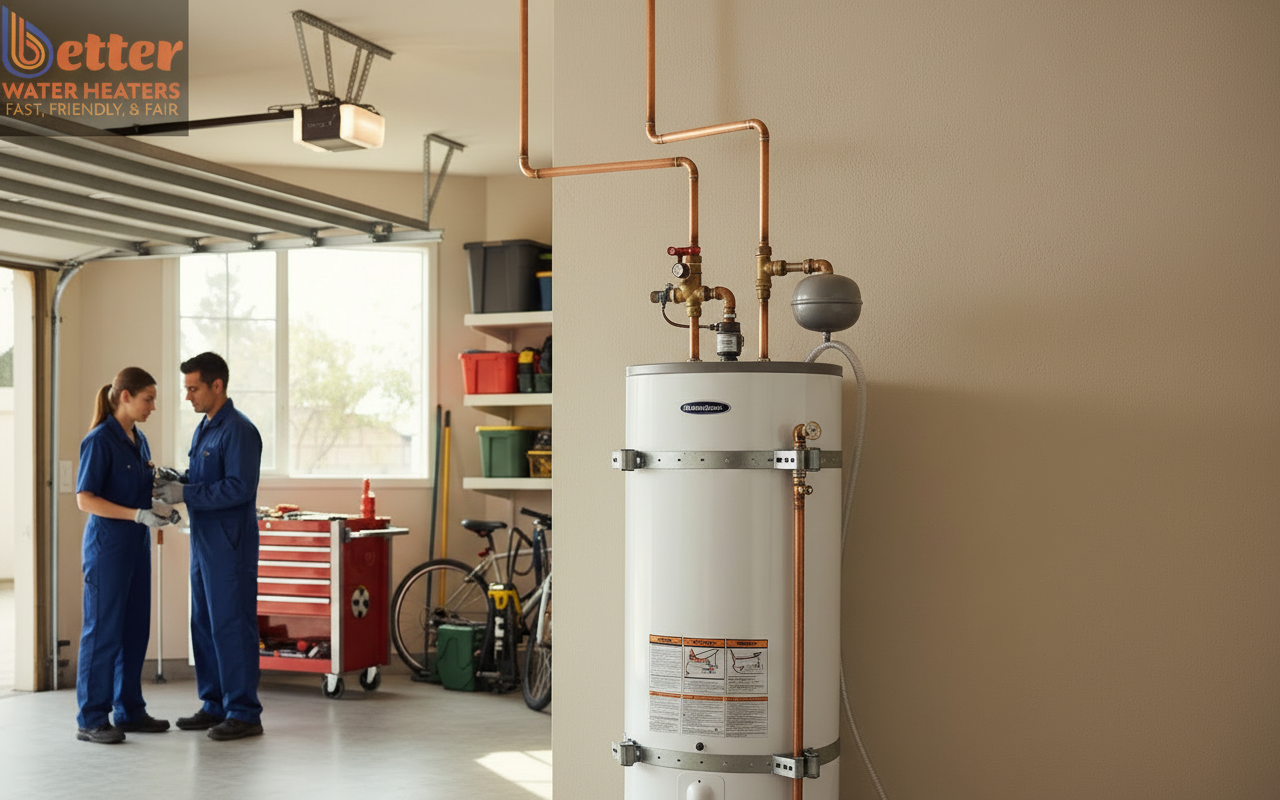
Garage Installations: The Performance Powerhouse for Bay Area Homes
The garage is the natural habitat for a hybrid water heater because it offers the thermal mass needed for high-efficiency operation year-round.
In our work with typical Bay Area mid-market homeowners, we find that the garage is the preferred location for 80% of installations. The ambient air temperature in a San Jose or Fremont garage rarely drops below the 40°F threshold where heat pumps lose their edge. Furthermore, the concrete floor provides a stable base that minimizes vibration transfer into the living space.
- Ambient Air Heat Exchange Efficiency: Larger air volumes mean the unit doesn’t significantly lower the room temperature, maintaining a higher UHR (Uniform Energy Factor).
- Maintenance Accessibility: Service technicians have 360-degree access, which lowers the labor cost for annual anode rod checks or filter cleanings.
- Condensate Management: Routing the drainage to a garage floor drain or exterior wall is significantly simpler and cheaper than installing a condensate pump in an interior hallway.
But wait—there is a downside. If your garage isn’t insulated, those rare 35-degree mornings in the Tri-Valley will force the unit into “High Demand” mode, using the backup heating elements. This is why we often recommend sizing the tank slightly larger for garage installs to ensure you have enough stored hot water to bridge those cold snaps without relying on expensive resistive heat.
Interior Closet Challenges: Managing Interior Water Heater Noise and Airflow
Installing a heat pump inside your home requires a specific strategy to handle the “refrigerator hum” and the cold exhaust air.
The real kicker? Interior water heater noise is the number one source of buyer’s remorse for unguided DIY installs. While modern hybrid water heater noise levels dB ratings are around 45-55 decibels (similar to a dishwasher), the low-frequency vibration can resonate through wood-framed walls. To mitigate this, we use vibration isolation pads and sound-dampening blankets, which are essential for closets located near bedrooms.
- Louvered Door vs. Ducted Intake: To solve the airflow problem, you must either install a fully louvered door (top and bottom) or use a ducting kit to pull air from the attic or crawlspace.
- The Cooling Trade-off: An interior closet install will effectively air-condition the immediate hallway. Great in August, but you’ll feel that draft in January.
- Space Value: In the high-priced Bay Area real estate market, reclaiming a 10-square-foot interior closet by moving the unit to the garage can actually add perceived value to your home layout.
Need a quiet solution that doesn’t sacrifice your hallway comfort? Explore our guide on soundproofing hybrid water heaters.
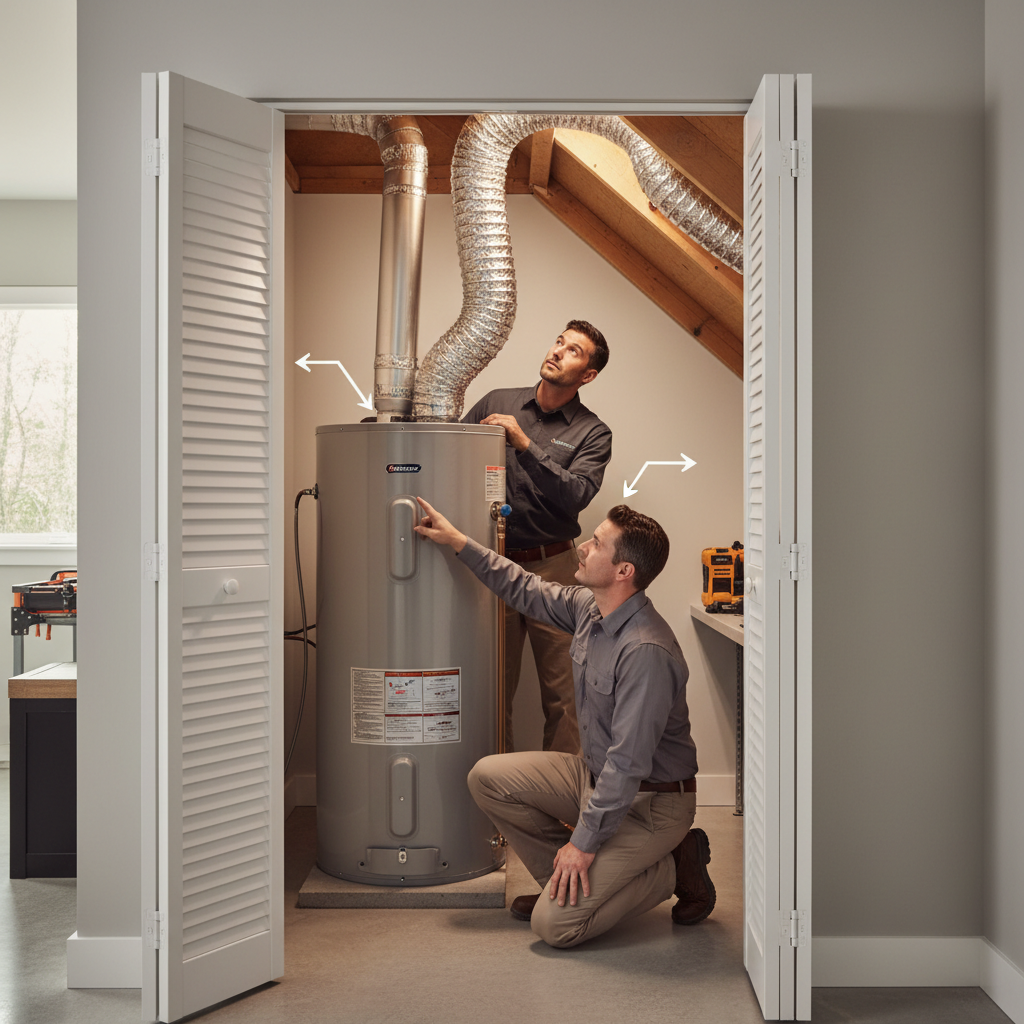
The Dual-Ducting Revolution: The Best of Both Worlds
Ducting is the “secret sauce” that allows interior installations to mimic the performance of a spacious garage.
By using a dual-duct system, you can pull warm air from the attic and exhaust the cold air outside. This eliminates the “cold air pocket” problem entirely. According to Energy.gov, proper airflow is the single most important factor in maintaining the promised 300% efficiency of these units. For a typical Bay Area mid-market client, this setup provides the quiet of an interior location with the high COP (Coefficient of Performance) of a garage unit.
| Feature | Garage Location | Interior Closet (Standard) | Interior Closet (Ducted) |
|---|---|---|---|
| Efficiency | High | Medium-Low | Very High |
| Noise Impact | Negligible | Noticeable | Moderate |
| Install Cost | $ | $$ | $$$ |
| Best For | Most Homes | Warm Climates | Luxury Remodels |
The contrarian insight here? Most contractors will tell you ducting is always better. However, in the temperate Peninsula climate, the extra $500–$800 for a ducting kit often takes 7+ years to pay for itself in energy savings. Sometimes, a simple louvered door is the smarter financial move.
Condensate and Electrical: The Hidden Costs of Placement
Your heat pump installation location is often dictated by two things: where the water goes and where the power comes from.
Every heat pump produces a few liters of water per day through condensation. In a garage, this is an easy fix. In an interior closet, you often need a condensate pump to lift that water up into a laundry drain or out through the roof. These pumps are reliable, but they do add another mechanical point of failure and a small amount of additional noise.
- Electrical Upgrades: Most older Bay Area homes have a 30-amp circuit for the water heater. If you’re switching from gas to heat pump, you’ll need a new 240V line. The cost of running this wire is significantly lower if the unit is in the garage near the main panel.
- Seismic Safety: California code requires double strapping. Garage installs offer more flexibility for anchoring into studs or masonry compared to tight closets.
- Permit Requirements: Regardless of location, the Bay Area Air Quality Management District and local building departments require specific permits for these high-efficiency upgrades.
Ready to maximize your savings? Contact us today for a free estimate and we’ll help you navigate the $4,900+ in available rebates for your specific installation.
The Verdict: Which Location Wins for You?
Choosing between a garage water heater and an interior setup comes down to your tolerance for noise and your home’s layout. If you have the space, the garage is the clear winner for performance and ease of maintenance. However, if an interior closet is your only option, don’t settle for a basic install. Insist on vibration isolation and proper airflow management to ensure your investment actually delivers on its energy-saving promises.
At Better Water Heaters, we’ve spent 20 years perfecting these installations across the Bay Area. We don’t just swap tanks; we engineer systems that fit your home’s unique microclimate. Whether you’re in the foggy hills of San Mateo or the heat of Livermore, we’ll ensure your heat pump is positioned for success.
Frequently Asked Questions
How loud is a heat pump water heater in a closet?
Most modern units produce 45-55 dB, similar to a modern dishwasher. However, the noise is a constant hum while heating. In an interior closet, this can be heard through the wall unless you use sound-dampening pads and ensure the unit isn’t touching the drywall, which acts like a sounding board.
Do I really need 1,000 cubic feet for a garage water heater?
While a standard two-car garage provides plenty of air, a small single-car garage filled with storage might struggle. If the air volume is too low, the unit will discharge cold air faster than the room can reheat, dropping the unit’s efficiency and increasing your PG&E bill.
Will a heat pump water heater make my garage too cold?
In the Bay Area, the cooling effect is usually a benefit. A typical unit will drop the temperature of a standard garage by about 3 to 5 degrees during a heating cycle. Most homeowners find this helpful in the summer, and it is rarely noticeable during our mild winters.
Can I install a heat pump water heater in a closet without a louvered door?
Only if you use a ducting kit. Without a louvered door or ducts, the heat pump will quickly exhaust all the heat from the closet, turn the space into a refrigerator, and shut down the heat pump mode, relying entirely on expensive electric backup heat.
What is the best heat pump installation location for maximizing rebates?
The location itself doesn’t change the rebate amount, but the installation costs do. A garage install is typically the most cost-effective, allowing you to keep more of the TECH Clean California or federal tax credit money in your pocket rather than spending it on complex ducting or plumbing reruns.