
📋 Table of Contents
In the dense, vertical landscape of San Francisco and the wider Bay Area, a staggering 60% of red-tagged water heater installations stem from improper venting in renovated multi-story homes. When you transition from a legacy atmospheric unit to a high-efficiency condensing system, you aren’t just swapping a tank; you are fundamentally altering the sequential venting framework of a building designed in a different era.
The challenge for homeowners in Pacific Heights or the Mission isn’t just finding space for a new unit. It is ensuring that the water heater exhaust doesn’t backdraft into living spaces or violate strict California Title 24 energy codes. This guide breaks down the technical sequencing required to keep your home safe, efficient, and up to code.

1. The Anatomy of Multi-Story Plumbing and Venting Constraints
The real kicker in Bay Area architecture is that verticality creates a natural chimney effect that can interfere with modern power-vented systems if not sequenced correctly.
- Structural Integrity: Drilling new 3-inch penetrations through 100-year-old floor joists can compromise the seismic stability of a narrow-lot home.
- The Middle Floor Dilemma: Units located on the second floor of a three-story Victorian often lack direct roof access, requiring horizontal runs that exceed standard blower capacities.
- Salt Air Corrosion: For homes in the Sunset District or near the Embarcadero, vent caps must be high-grade stainless steel to prevent premature failure from coastal moisture.
Most people miss the fact that modern high-efficiency units produce acidic condensate. This means your multi-story plumbing must account for both the exhaust gas path and the sequential drainage of liquid waste, often requiring a neutralizer before it hits legacy cast-iron pipes. According to the California Energy Commission, Title 24 standards now strictly regulate how these systems interact with the building envelope.
2. Stage One: Intake Sequencing and Air Pressure Balancing
You cannot move air out if you aren’t strategically bringing air in, especially in tightly sealed, modern-renovated homes.
What we call the sequential venting framework starts with the intake. In a typical Bay Area mid-market client’s home, we often find that the mechanical closet is too small to provide the 50 cubic feet of air per 1,000 BTU required for atmospheric combustion. This leads to “starved” burners and carbon monoxide risks.
- Concentric Venting Systems: These “pipe-within-a-pipe” designs allow for a single penetration through an exterior wall, handling both intake and exhaust.
- Zero-Clearance Vertical Venting: Ideal for the “Victorian Vertical” strategy where side-yard clearances are less than 3 feet.
- Combustion Air Ducts: If exterior walls are inaccessible, we sequence intake from attic spaces or crawlspaces, provided they are properly screened.
Here’s the thing: air pressure imbalances in multi-story homes can cause “ghosting”—where the water heater struggles to stay lit because the bathroom exhaust fans on the third floor are pulling a vacuum on the entire house. Schedule a professional site assessment to ensure your home’s pressure is balanced before you buy a new unit.
3. Stage Two: High-Velocity Exhaust Pathing (Category IV)
The best way to manage exhaust in a multi-story environment is to treat the vent path as a pressurized vessel, not a passive chimney.
High-efficiency units (condensing) use Category IV Venting Multi-Story protocols, which require airtight, water-tight plastic piping like PVC, CPVC, or Polypropylene. Unlike old metal B-vents, these materials handle the cool, moist exhaust of a 95% AFUE heater without rusting through.
- Slope Matters: Every foot of horizontal vent must slope back toward the heater at a 1/4-inch pitch to allow condensate to drain sequentially.
- Support Intervals: In vertical stacks, multi-story plumbing codes require bracing at every floor fire-stop to prevent the weight of the pipe from stressing the heater’s manifold.
- Termination Clearances: In San Francisco, you cannot terminate a vent within 3 feet of an operable window or 10 feet of a property line.
What most people miss is noise mitigation. Power-vented units use high-RPM blowers. In high-density Oakland neighborhoods, we use vibration-isolated hangers to ensure the hum of the heater doesn’t keep the neighbors (or you) awake at night.
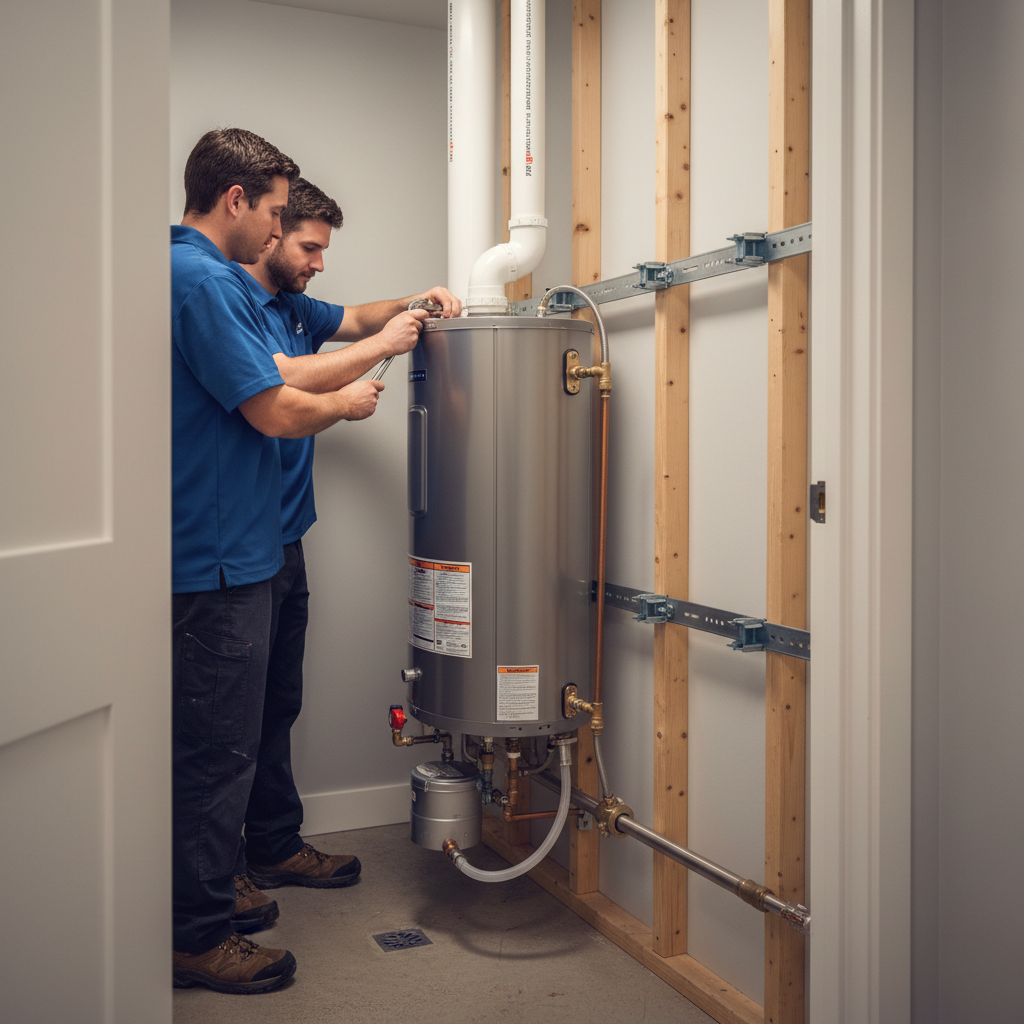
4. Stage Three: Seismic Bracing and Vertical Stack Integration
In the Bay Area, your venting system must be as earthquake-ready as your water tank itself.
The sequential venting framework isn’t complete without addressing California’s strict seismic codes. If a 7.0 quake hits, a rigid PVC vent pipe that isn’t properly braced can snap at the roofline, leading to exhaust leaks inside the attic. We utilize flexible transitions and heavy-duty strapping to ensure the vent moves with the structure.
- SB 721 Compliance: For multi-family units with balconies, we ensure vent penetrations don’t compromise the structural waterproofing of exterior elevated elements.
- Fire-Stopping: When a vent passes through multiple floors, it must be encased in a fire-rated chase with intumescent fire-stops at each level.
- Future-Proofing: With the 2027 zero-NOx regulations looming, we design today’s vent paths to be easily adaptable for the next generation of electric heat pump units.
Contrarian Insight: Many contractors will tell you to simply “run it through the old chimney.” This is often a mistake. Old masonry chimneys are frequently oversized for modern high-velocity exhaust, leading to condensation that can dissolve the mortar from the inside out. Always pull a dedicated liner or a new dedicated vent path. To see how we handle these complex retrofits, explore our tankless venting resources.
5. Navigating Bay Area Title 24 and Local Permits
The San Francisco Plumbing Code Water Heater requirements are among the most stringent in the country, often requiring architectural review for exterior penetrations on historic facades.
We see many DIY attempts fail inspection because they didn’t account for the Bay Area Title 24 Water Heater Compliance requirements regarding pipe insulation. Every hot water line and the first 5 feet of cold water line must be insulated to a specific R-value, and the venting must be verified for proper total equivalent length (TEL).
| Venting Type | Best For | Efficiency Range |
|---|---|---|
| Atmospheric | Single-story, older homes | 60-70% |
| Power Vent | Multi-story, no chimney | 80-90% |
| Concentric | Tight spaces, high-density | 90-98% |
Ready to upgrade without the headache? Get a free estimate from our Bay Area specialists today.
6. Future-Proofing for the 2027 Gas Water Heater Ban
The transition to zero-emission appliances is coming, and your current venting strategy should reflect that reality.
By 2027, the Bay Area Air Quality Management District will begin phasing out gas water heaters. If you are installing a system today, we recommend a sequential venting framework that allows for easy conversion to Heat Pump Water Heaters (HPWH). These units require massive amounts of air circulation—often necessitating louvered doors or dedicated ducting that can be pre-planned during a current renovation.
In our work with property managers, we focus on “venting-as-an-asset.” A well-installed, compliant vent stack increases the value of a multi-unit building by reducing future retrofit costs. For more on this, check out our guide on heat pump rebates and incentives.
7. Final Checklist for Multi-Story Success
Before the installer leaves, verify these three critical components of the sequential venting framework.
- Pressure Test: Ensure the vent system holds pressure and shows zero CO leakage under full load.
- Clearance Verification: Measure the distance from the termination cap to any air intakes or windows.
- Condensate Path: Confirm the acidic waste is flowing to a neutralizer and then to a legal drain point.
Don’t let a poorly planned exhaust system turn your high-efficiency dream into a code-enforcement nightmare. If you’re managing a complex vertical property, we can help you navigate the multi-story plumbing hurdles that stop other contractors in their tracks. We’ve spent 20+ years mastering the unique quirks of Bay Area homes—from the hills of Berkeley to the flats of San Jose.
Key Takeaways
- Always use Category IV materials (PVC/Polypropylene) for high-efficiency exhaust to prevent corrosion.
- Sequence your intake air to prevent backdrafting in tightly sealed modern homes.
- Ensure all vertical vent stacks are seismically braced at every floor level.
- Plan for the 2027 NOx ban by choosing vent paths that accommodate future heat pump transitions.
Frequently Asked Questions
Can I use my existing chimney for a high-efficiency water heater exhaust?
Generally, no. High-efficiency (condensing) water heaters produce cool, acidic exhaust that will damage a standard masonry or metal B-vent chimney. You must either install a specialized flexible liner or run a new dedicated PVC/Polypropylene vent path as part of your sequential venting framework.
What is the difference between power venting and concentric venting?
Power venting uses a blower to push exhaust through a single pipe, usually pulling combustion air from the room. Concentric venting uses a “pipe-within-a-pipe” to pull fresh air from outside through the outer layer while pushing exhaust out through the inner core, making it safer for tight spaces.
Do I need a permit for water heater venting changes in San Francisco?
Yes. Any change to the water heater exhaust system requires a plumbing permit in San Francisco. This ensures the new venting meets Title 24 energy codes, seismic requirements, and proper termination clearances to prevent fire hazards and carbon monoxide buildup.
How does the 2027 gas water heater ban affect my venting choices today?
While you can still install gas units now, you should choose a vent location that won’t interfere with future electrical upgrades. Heat pump water heaters require significant airflow, so planning your mechanical room’s layout today can save thousands in ducting costs when you eventually switch to electric.
Ready to ensure your home is safe and compliant? Contact Better Water Heaters today for an expert consultation on your multi-story project.