
📋 Table of Contents
In the Bay Area, where real estate is priced by the square inch, many homeowners are discovering that their 1970s-era “broom closets” are physically incapable of housing 2024-standard appliances. According to the California Energy Commission, modern high-efficiency units often require 20-30% more physical volume than the legacy gas tanks they replace, creating a massive serviceability gap.
The service access framework is our proprietary approach to solving this spatial puzzle. Without a strategic plan, a “zero-clearance” installation isn’t just a tight fit—it’s a future liability that could lead to failed inspections or unrepairable equipment. This guide breaks down how to navigate utility closet code compliance while transitioning to the next generation of water heating technology.
Key Takeaways for Homeowners
- Modern heat pump units are taller and wider, requiring intentional spatial planning.
- The service access framework ensures technicians can reach critical components without removing the unit.
- Strict utility closet code compliance protects your home insurance and property resale value.
- Seismic bracing in tight spaces requires specialized hardware and engineering.
1. Spatial Auditing: Measuring for Utility Closet Code Compliance
The first rule of Bay Area retrofitting is that the nameplate dimensions of a water heater are a lie when it comes to actual footprint requirements. While a unit might be 22 inches wide, utility closet code compliance typically demands at least 12 inches of clear working space in front of the controls and specific clearances for ventilation.
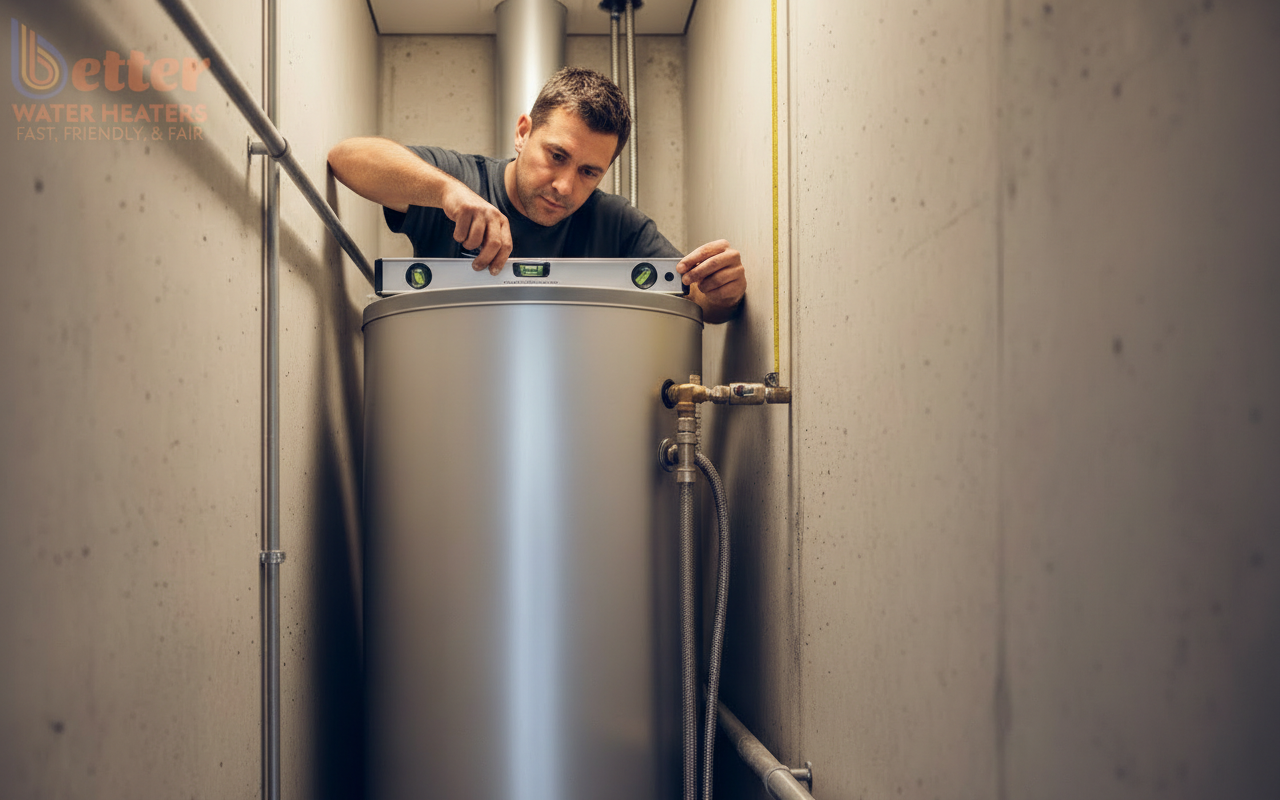
What most people miss is the “service swing.” If a technician cannot use a pipe wrench or replace an anode rod because the ceiling is too low or the door frame is too narrow, the unit is effectively disposable. In our work with established homeowners in San Jose and Palo Alto, we frequently see water heater space requirements ignored during DIY installs, leading to “red-tagged” systems during home appraisals.
- Vertical Clearance: Heat pump water heaters (HPWH) pull heat from the air; they need roughly 700-1,000 cubic feet of air space or dedicated ducting.
- Seismic Bracing: California code requires two straps, but in zero-clearance closets, these must be anchored to studs that are often blocked by the unit itself.
- Combustion Air: If you are staying with gas, the service access framework must account for permanent openings to prevent carbon monoxide buildup.
The real kicker? Many 1950s-1970s homes have closets located in the center of the house. Forcing a modern unit into these spaces without a service access framework often results in excessive noise vibration that resonates through bedroom walls. Learn more about noise mitigation strategies here.
2. The 3-Step Service Access Framework
A maintenance-first design approach is the only way to ensure that your $4,000 investment doesn’t become a $10,000 nightmare when a simple sensor needs replacing. Here is the framework we use to bridge the gap between electrification goals and physical reality.
Step A: Component Mapping
We identify the “high-touch” areas of the specific model—such as the T&P valve, the drain valve, and the electrical panel. In a Bay Area heat pump water heater retrofit, these components are often in different locations than your old gas tank. We map the installation so these remain accessible via the existing door opening.
Step B: The “Removable Obstacle” Strategy
If a closet is truly zero-clearance, we utilize flexible connectors and quick-disconnect unions that meet Title 24 water heater installation requirements. This allows a technician to pivot the unit slightly for major repairs without draining the entire system or cutting copper pipes.
Step C: Ventilation and Filtration Access
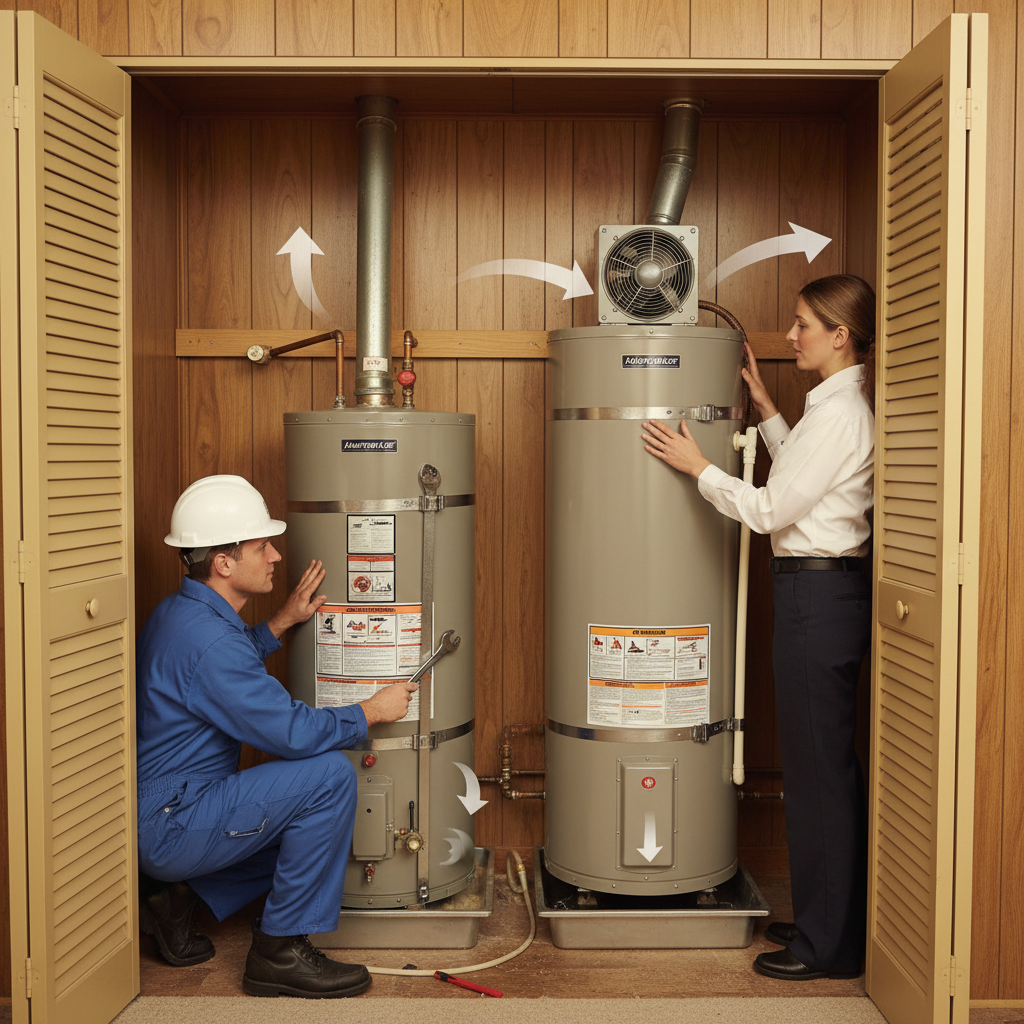
Heat pumps have air filters that must be cleaned every 6-12 months. If the filter is on top of a 7-foot unit in a 7.5-foot closet, it will never be serviced. Our service access framework involves installing side-access filters or custom ducting to ensure the homeowner can maintain the unit easily.
Need a professional eye on your tight space? Schedule a site evaluation with our specialists to see if your closet is ready for an upgrade.
3. Navigating Bay Area Heat Pump Water Heater Retrofits
The transition from gas to electric is the biggest challenge for zero-clearance spaces because of the sheer physical size of the tanks. According to ENERGY STAR, heat pumps are the most efficient option, but they are “divas” when it comes to space.
Here’s an honest, contrarian insight: Sometimes, a heat pump is not the right choice for a zero-clearance hallway closet. If the water heater space requirements cannot be met without violating utility closet code compliance, a high-efficiency tankless system might be the only legal path forward. While the state pushes for full electrification, building safety must come first.
| Feature | Standard Gas Tank | Heat Pump (HPWH) | Tankless (Electric/Gas) |
|---|---|---|---|
| Avg. Width | 20-22″ | 24-28″ | 14-18″ |
| Clearance Needed | Minimal | Significant (Airflow) | Minimal |
| Serviceability | High | Moderate/Complex | High |
But wait—if you are a property manager in San Francisco or Oakland, the San Francisco plumbing seismic bracing codes are even stricter for these larger units. You cannot simply “squeeze it in.” The extra weight of a 50-80 gallon hybrid tank requires reinforced flooring and heavy-duty anchoring that standard closets weren’t built to handle.
4. Title 24 and Insurance: The Hidden Risks
Installing a unit that blocks access to the main water shut-off valve is a massive insurance liability. In our work with typical Bay Area mid-market clients, we’ve seen claims denied because a leak occurred and the shut-off was inaccessible due to an oversized water heater installation.
Title 24 water heater installation requirements aren’t just red tape; they are designed to prevent catastrophic home damage. A proper service access framework includes the integration of smart leak detection. When a unit is tucked into an inaccessible footprint, you need a sensor that can shut off the water automatically, as you won’t be able to see the leak until it hits your floorboards.
Here’s the thing: If your installer doesn’t mention the 2027 gas water heater regulations or how to future-proof your closet today, they are doing you a disservice. We help our clients access up to $4,900 in rebates by doing the job right the first time. Check our service areas to see if you qualify.
5. The Minimalist Mechanic: Tools for Tight Spaces
When you have only 3 inches of clearance, standard plumbing tools fail. We’ve invested in specialized offset wrenches and borescope cameras to ensure we can inspect and service zero-clearance units. This is part of our commitment to being the Bay Area’s trusted specialists for over 20 years.
What most people miss is that water heater space requirements also apply to the “exit path.” If we have to remove a door frame just to get the old tank out and the new one in, that needs to be factored into the labor cost. Transparency is key here—we never inflate numbers, but we do provide honest assessments of the structural work required for a modern upgrade.
If you’re curious about how we document these complex installs for permit approval, we actually use ingest.blog, our internal AI content engine, to help streamline our technical documentation and city permit applications. This ensures every detail of the service access framework is recorded for future technicians.
Don’t Risk a Red-Tag: Act This Week
Before you purchase a new unit from a big-box retailer, take ten minutes this weekend to measure your closet’s width, depth, and height. If you have less than 6 inches of clearance on any side, you need a professional service access framework. Don’t wait until your current unit fails and you’re forced into an emergency installation that won’t pass inspection. Call Better Water Heaters today for a proactive consultation that saves you thousands in future retrofit costs.
Frequently Asked Questions
What is the minimum clearance for a water heater in a closet?
Most local Bay Area codes require a minimum of 1 to 2 inches on the sides and back, and 12 inches of clear working space in front. However, utility closet code compliance for gas units also requires specific “combustion air” clearances that can vary by city, often requiring significantly more open space or vented doors.
Can I put a heat pump water heater in a small closet?
Yes, but it requires a service access framework that includes louvered doors or ducting. Since heat pumps exhaust cold air and need to pull in warm air, a sealed closet will cause the unit to fail. You must ensure there is enough volume—typically 1,000 cubic feet—or a direct path for airflow.
What happens if my water heater installation doesn’t meet code?
Non-compliant installs can lead to “red-tagging” by utility companies like PG&E, meaning they will shut off your service until it’s fixed. Additionally, it can complicate home sales during the inspection phase and may give insurance companies a reason to deny water damage claims if the unit was not accessible for maintenance.
How do seismic bracing requirements change in tight spaces?
In zero-clearance closets, we often use wall-mounted brackets or specialized “low-profile” straps that meet San Francisco plumbing seismic bracing standards. The challenge is ensuring the straps are anchored to the wall studs without creating a fire hazard or blocking the service panels of the water heater.