
📋 Table of Contents
According to the U.S. Department of Energy, heat pump water heaters can be up to three times more energy-efficient than conventional electric resistance models, yet many homeowners fear a heat pump transition will leave them with cold showers or massive electrical bills. In the Bay Area, where local air quality districts are pushing for a total phase-out of gas water heaters by 2027, the pressure to switch is mounting, but the path to a reliable installation remains clouded by technical jargon.
Key Takeaways for Your Electrification Journey
- Electrical Readiness: Most homes require a 240V circuit, but the new 120V “plug-in” models are changing the game for older Bay Area panels.
- Space & Airflow: Heat pumps need roughly 1,000 cubic feet of air space to operate efficiently—roughly the size of a small utility room.
- Financial Strategy: Combining federal IRA tax credits with local TECH Clean California incentives can reduce upfront costs by up to $4,900.
- Future-Proofing: High-efficiency units increase property value by aligning with upcoming 2027 zero-NOx regulations.
1. The Infrastructure Quadrant: Electrical and Panel Capacity
The biggest hurdle in any heat pump transition isn’t the heater itself; it’s the copper wires hidden behind your drywall. Many established homes in San Jose or Redwood City still operate on 100-amp or 125-amp electrical panels that are already near their limit.
What most people miss is that you don’t always need a $4,000 panel upgrade to go electric. The “120-volt revolution” has introduced plug-in Heat Pump Water Heaters (HPWH) that draw roughly the same power as a toaster, allowing for a home electrification framework that fits into existing infrastructure. However, these models often have slower recovery rates, meaning they take longer to heat back up after a long shower.
- 240V Dedicated Circuit: Best for large families requiring fast recovery and high thermal storage capacity.
- 120V Plug-in Models: Ideal for 1-2 person households or homes where a panel upgrade is cost-prohibitive.
- Load Management: Smart circuit breakers can prioritize the water heater without overloading the main bus bar.
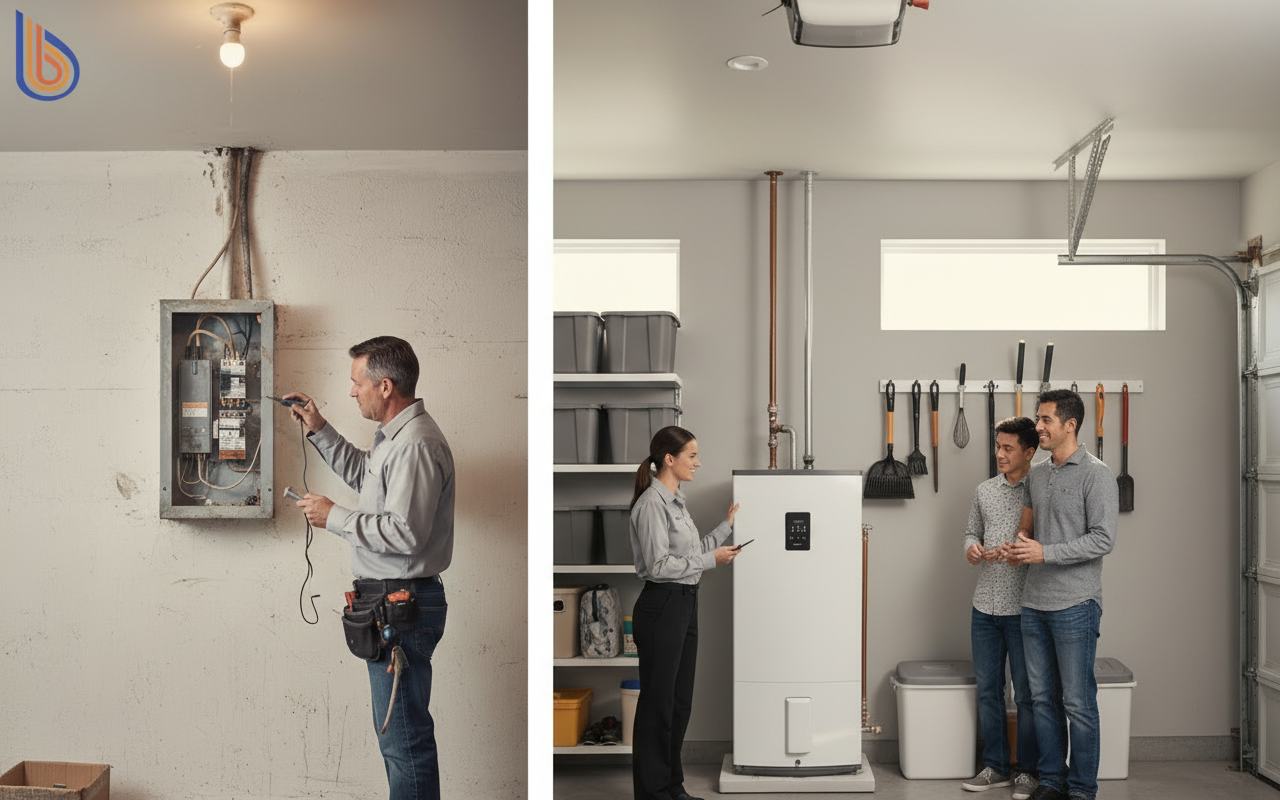
2. The Spatial Quadrant: Airflow and Environmental Physics
Reliability in a heat pump system is directly tied to how well the unit can “breathe” within its environment. Because a heat pump moves heat from the surrounding air into the water, it essentially acts as a tiny air conditioner for your garage or basement.
The real kicker? If you stick a heat pump in a tiny, unvented closet, it will eventually exhaust the available heat, causing its Coefficient of Performance (COP) to plummet and forcing the unit to rely on expensive backup electric elements. For Bay Area heat pump readiness, we look for at least 750 to 1,000 cubic feet of space, or the ability to install louvered doors to let air circulate freely.
In our work with typical Bay Area established homeowners, we often find that noise mitigation is just as important as airflow. Placing a compressor-driven unit directly under a primary bedroom can lead to “buyer’s remorse” due to the low-frequency hum, making the garage the gold standard for placement.
Need a professional eye on your space? Schedule a site assessment today to ensure your home meets the physical requirements for a seamless switch.
3. The Performance Quadrant: Sizing and Recovery Rates
A common fear is that heat pumps can’t keep up with back-to-back showers. This is where the tension between energy efficiency and operational resiliency becomes clear.
To maintain high reliability, we often recommend “upsizing” the tank when moving from gas to a heat pump. If you had a 50-gallon gas heater, a 65-gallon or 80-gallon heat pump provides the necessary thermal storage capacity to bridge the gap during peak usage times. Here is how the technologies compare in a standard Bay Area environment:
| Feature | Standard Gas Tank | 240V Heat Pump | 120V Plug-In HPWH |
|---|---|---|---|
| Recovery Rate | Excellent | Moderate | Low |
| Annual Operating Cost | $600 – $800 | $150 – $250 | $200 – $300 |
| Bay Area Rebates | None | Up to $4,900 | Up to $3,100 |
Here’s an honest, contrarian insight: If you have a five-person household and only have space for a 40-gallon tank, a heat pump might actually decrease your quality of life unless you use a thermostatic mixing valve to store water at 140°F and deliver it at 120°F.
4. The Economic Quadrant: Incentives and Decarbonization ROI
The heat pump transition is a financial chess match. While the upfront installation premium can be 2-3x higher than a standard gas unit, the combination of lower operating costs and massive incentives often leads to a break-even point in under five years.
Under the Inflation Reduction Act, homeowners can claim a 30% tax credit up to $2,000 annually for heat pump water heaters. When you layer this with TECH Clean California incentives and local utility rebates from providers like Peninsula Clean Energy or Silicon Valley Clean Energy, the net cost often drops below that of a traditional gas replacement.
- Federal Tax Credit (25C): 30% of project cost, capped at $2,000.
- TECH Clean California: Direct-to-contractor incentives that lower your invoice immediately.
- Grid-Interactive Rebates: Some utilities offer extra cash if you allow them to slightly shift your heating cycles during peak grid stress.
5. Why the Framework Fails During an Emergency
Here’s the thing: The absolute worst time to use this 4-Quadrant Reliability Framework is at 2:00 AM when your current heater is flooding the garage. Emergency replacements almost always default to the “easiest” option, which is usually another gas tank.
A successful home electrification framework requires a planned transition. If your water heater is over 10 years old, you are in the “Yellow Zone.” This is the time to check your panel, measure your airflow, and secure your permit. Waiting until a leak occurs means you likely won’t have the 48-72 hours required to run a new electrical circuit or wait for a specialized heat pump model to be delivered.
Want to avoid the emergency scramble? Check out our guide on water heater lifespan to see if your unit is a ticking time bomb.
Conclusion: Your Monday Morning Action Plan
The transition to heat pump technology is no longer a “green” hobby—it’s a regulatory reality for the Bay Area. To ensure your home is ready, take these three steps this week:
- Check your panel: Do you have two empty slots for a double-pole breaker? If not, start researching 120V plug-in models.
- Measure your space: Ensure you have roughly 10′ x 10′ of breathing room around your current unit.
- Verify rebates: Visit the Switch Is On website to see which specific Bay Area incentives apply to your zip code.
At Better Water Heaters, we’ve spent 20 years helping homeowners navigate these shifts. If you’re ready to de-risk your home’s future, contact us for a professional electrification audit. We’ll handle the permits, the rebates, and the heavy lifting so you can enjoy reliable hot water for the next two decades.
Frequently Asked Questions
Do heat pump water heaters work in the Bay Area’s climate?
Absolutely. Heat pumps are most efficient in climates that stay between 40°F and 90°F. The Bay Area’s moderate temperatures are ideal, allowing the units to maintain a high Coefficient of Performance (COP) year-round without relying on inefficient backup heating elements as often as they would in freezing climates.
How much can I actually save with a heat pump transition?
While results vary, a typical Bay Area family of four can save between $300 and $500 annually on energy bills. When combined with up to $4,900 in available rebates and tax credits, the total cost of ownership over 10 years is significantly lower than a traditional gas or electric resistance water heater.
Will I run out of hot water faster with a heat pump?
If sized correctly using our 4-Quadrant Framework, no. Heat pumps have a slower recovery rate than gas, so we typically recommend increasing the tank size (e.g., moving from a 50-gallon gas to a 65-gallon heat pump) to provide a larger buffer of hot water during peak usage periods.
Are heat pump water heaters noisy?
Heat pumps do have a compressor and fan, which create a sound similar to a modern dishwasher or a quiet refrigerator (about 45-55 decibels). While audible, they are rarely disruptive when installed in garages or utility rooms, though we recommend sound-dampening pads if the unit is located near living quarters.