
📋 Table of Contents
According to the U.S. Department of Energy, water heating is the second largest energy expense in multi-family buildings, often accounting for up to 25% of total energy use. For Bay Area property managers, aging multi-family water systems aren’t just a maintenance headache; they are a looming capital expenditure crisis as we approach the 2026-2027 zero-NOx emission mandates.
Waiting for a central boiler to fail on a Friday evening is a high-stakes gamble that results in 30% higher replacement costs and displaced tenants. Here is the thing: most property owners view water heating as a ‘fix-it-when-it-breaks’ utility, but in the current regulatory climate, that approach is a fast track to non-compliance and massive unbudgeted losses. This 4-stage performance audit is your framework to transition from reactive repairs to strategic asset management.
Stage 1: Data-Driven Reliability and Thermal Imaging
The most expensive water heater is the one you don’t know is failing until the lobby is flooded.
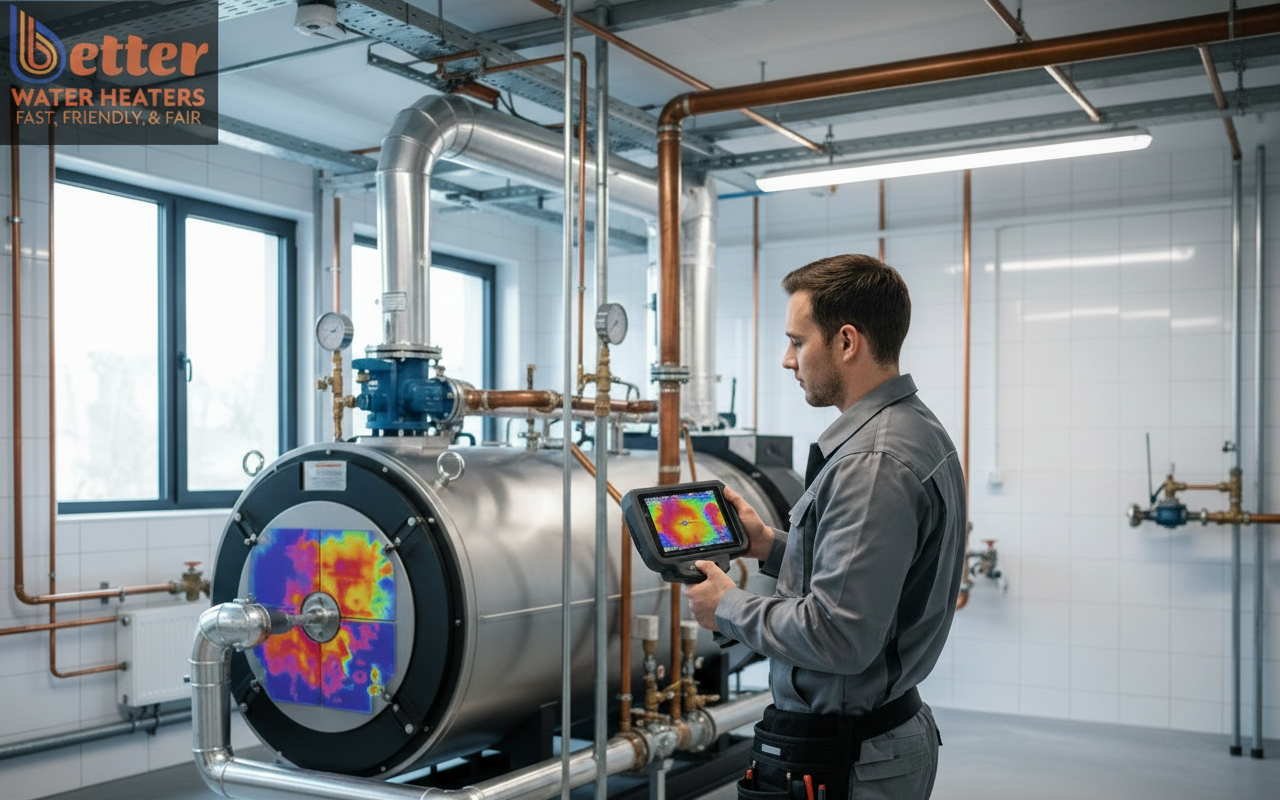
- Thermal Mapping: We use infrared cameras to identify heat loss in circulating loops and failing insulation in storage tanks.
- Flow Monitoring: Installing temporary IoT ultrasonic flow meters helps identify ‘ghost loads’ where water is being heated but not used.
- Vibration Analysis: For centralized plants, checking pump housing for cavitation can predict motor failure months in advance.
In our work with typical Bay Area mid-market clients, we often find that localized scale buildup in the heat exchanger is forcing the burner to run 15% longer than designed. By capturing this data during a boiler efficiency audit, you can quantify the exact ROI of a descaling treatment versus a full system replacement.
Stage 2: Regulatory Readiness and Decarbonization Mapping
Compliance is no longer optional; it is a timeline that is already counting down for California property owners.
The real kicker? The California Energy Commission is aggressively pushing for building decarbonization trends that will eventually phase out gas-fired atmospheric boilers. An audit identifies if your current electrical infrastructure can even support heat pump water heater integration without a costly panel upgrade.
- Code Gap Analysis: Evaluating seismic strapping, expansion tanks, and venting against current Title 24 requirements.
- Electrification Feasibility: Assessing the physical footprint required for heat pump storage tanks compared to compact gas boilers.
- Rebate Eligibility: Mapping your system to programs like TECH Clean California, which can offer thousands in incentives for high-efficiency upgrades.
What most people miss is that insurance providers are starting to look at these audits as risk-mitigation tools. A documented 4-stage audit can sometimes be used to negotiate lower liability premiums by proving proactive leak detection and property management maintenance protocols are in place.
Need a professional set of eyes on your central plant? Schedule a professional system evaluation with our Bay Area specialists to avoid the 2026 rush.
Stage 3: System Optimization and Thermal Balancing
A system that provides hot water to the first floor but only lukewarm water to the penthouse is a system that is burning money.
Many multi-family water systems suffer from ‘short-circuiting’ in the return loop, where hot water takes the path of least resistance. This leads to the boiler cycling constantly to satisfy the furthest fixture. Optimization involves:
- Installing Thermal Balancing Valves: These automatically adjust flow based on temperature, ensuring even distribution throughout the building.
- Calibrating Aquastats: Dropping your storage temperature by just 10 degrees (while staying above Legionella risks) can reduce standby loss significantly.
- Master-Meter to Sub-Meter Assessment: Evaluating if shifting to individual unit billing could reduce overall consumption by 15-20% through tenant accountability.
But wait—optimization isn’t just about the hardware. It’s about the data. We’ve seen scenarios where a simple adjustment to the recirculation pump timer saved a 20-unit complex over $200 a month in gas and electricity costs.
Stage 4: Life Cycle Assessment and CAPEX Planning
The final stage of the audit is turning technical data into a five-year financial roadmap.
Instead of a surprise $50,000 bill, you get a water heater lifecycle assessment. This document ranks your equipment by ‘Probability of Failure’ and ‘Criticality of Failure.’ For a commercial water heater retrofit, this allows you to source equipment during off-peak seasons when labor rates are lower and equipment availability is higher.
| Audit Factor | Standard System (Aging) | Optimized System (Post-Audit) |
|---|---|---|
| Energy Waste | 20-30% (Scale & Standby) | <5% (Modulating Burners) |
| Tenant Complaints | High (Fluctuating Temps) | Low (Balanced Loops) |
| Regulatory Status | At Risk (Pre-2026 Code) | Compliant / Future-Proof |
Contrarian insight: Sometimes, the most ‘efficient’ move is not to replace the whole system immediately. If your audit shows the tank is structurally sound but the controls are failing, a ‘brain transplant’ (replacing old controllers with modern modulating ones) can extend the life of a multi-family water systems plant by 5-7 years for a fraction of the cost.
The Role of Predictive Maintenance
Modern property management maintenance is shifting toward IoT sensors. By monitoring water pressure and temperature 24/7, we can catch a pinhole leak before it becomes a catastrophic ceiling collapse. This is especially vital in aging Bay Area buildings where copper piping is reaching the end of its natural lifespan. For those managing high volumes of property data, we’ve even seen teams use Ingest.blog as our internal AI content engine to keep tenants informed about these proactive maintenance schedules via automated updates.
Don’t wait for a cold shower complaint to take action. Explore our commercial maintenance plans designed specifically for the unique demands of Bay Area multi-family housing.
Frequently Asked Questions
How long does a typical multi-family water system audit take?
For most 10-50 unit buildings in the Bay Area, a comprehensive 4-stage audit takes between 4 to 6 hours of on-site time. This includes boiler room inspection, sampling water at the furthest fixtures for thermal balancing checks, and reviewing utility bills from the past 12 months to establish a performance baseline.
What are the 2026-2027 NOx regulations I keep hearing about?
The Bay Area Air Quality Management District (BAAQMD) has passed rules that will phase out the sale of gas-fired water heaters. By 2027, most new installations must be ‘zero-NOx,’ which effectively mandates a shift toward high-efficiency electric heat pump technology for many residential and commercial applications.
Can we integrate heat pumps into our existing gas boiler loop?
Yes, this is known as a hybrid or ‘swing tank’ configuration. You can use heat pumps to handle the primary heating load while keeping a high-efficiency gas boiler as a backup for peak demand periods. This strategy is often the most cost-effective way to meet building decarbonization trends without a full electrical overhaul.
Is a boiler efficiency audit tax deductible?
While we recommend consulting with a tax professional, most property management maintenance audits are considered necessary operating expenses. Furthermore, the data gathered in the audit is required to apply for federal tax credits under the Inflation Reduction Act, which can offset up to 30% of the cost of energy-efficient upgrades.
Your Next Step: This week, pull your gas and water bills for the last three years. If you see a steady 5% increase in usage despite consistent occupancy, your system is likely scaling up or leaking. Contact Better Water Heaters today to schedule your 4-stage audit and secure your capital budget for 2025 and beyond.