
📋 Table of Contents
According to the Pecan Street Research Institute, nearly 50% of U.S. homes will require electric service upgrades to fully electrify their heating and transportation. In the Bay Area, where many homes still operate on 100-amp or 125-amp panels, this bottleneck often results in a $5,000 to $15,000 surprise when simply trying to install a modern heat pump water heater.
Key Takeaways for Homeowners
- Smart load management can often bypass the need for a full utility service upgrade, saving months of permitting delays.
- A traditional electrical panel upgrade is necessary if your existing busbar is physically damaged or lacks space for any new breakers.
- The 120V ‘plug-in’ heat pump water heater is a game-changer for homes with severe capacity constraints.
- Federal tax credits (25C) and local Bay Area rebates can offset up to $4,900 of these electrification costs.
The Electrification Bottleneck: Why Your Panel Matters
The real kicker for most homeowners is that your electrical panel wasn’t designed for the 2030s; it was designed for a 1970s load of incandescent bulbs and a gas stove. When you add a heat pump water heater, an EV charger, and an induction cooktop, the math simply stops working.
Most home electrification projects hit a wall when the NEC 220.87 load calculation shows that the home’s peak demand exceeds the main breaker’s rating. Historically, the only answer was to call PG&E and wait months for a service entrance upgrade cost estimate that could easily reach five figures.
But wait—modern technology has introduced a ‘bypass’ known as smart load management. Instead of making the “pipe” (your service line) bigger, we make the appliances “smarter” about when they drink from it.
Electric Service Upgrades: When Is a Full Swap Mandatory?
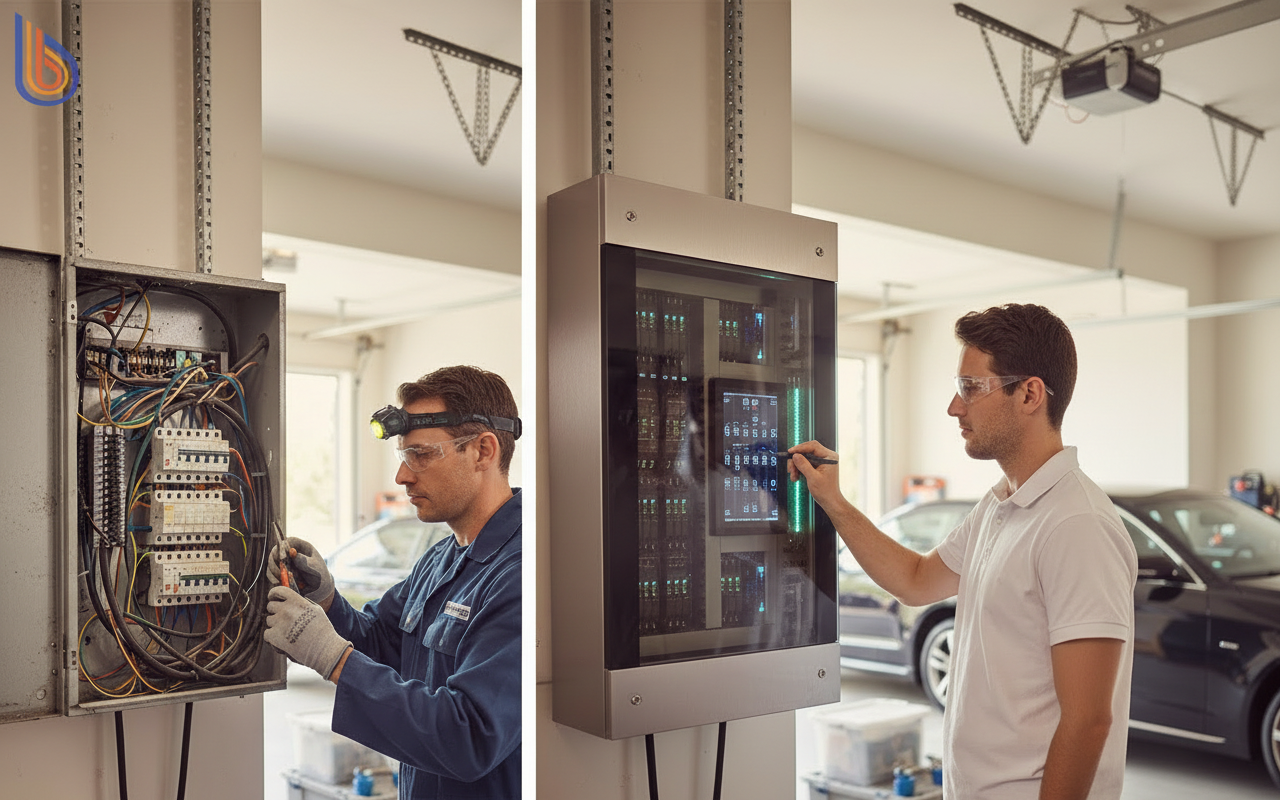
An electrical panel upgrade is a physical infrastructure project that replaces your breakers, busbars, and potentially the wires leading to the street. In our work with established homeowners in San Jose and Palo Alto, we find that physical degradation is often the deciding factor.
- Safety Hazards: If you have a Zinsco or Federal Pacific panel, a replacement is a safety mandate, not just an electrification choice.
- Physical Space: If the panel is literally out of physical slots for new breakers, and tandem breakers aren’t an option, you’re looking at an upgrade.
- Future-Proofing: If you plan on adding a double-car EV charging station AND a heat pump HVAC system, a 200-amp electrical panel upgrade is often the most stable long-term path.
Typically, a full electric service upgrades project involves coordination with the city building department and the utility provider. This process can take anywhere from 3 to 9 months in some Bay Area jurisdictions due to transformer capacity issues in older neighborhoods.
Need help navigating local codes? Schedule a professional load assessment with our team to see if your panel can handle a new heat pump system.
Smart Load Management: The High-Tech Alternative
Smart load management acts as a digital traffic cop for your home’s electricity, ensuring that two high-draw appliances never run at the same time. This is often called “load shedding” or “non-coincident loading.”
For example, a smart electrical subpanel (like those made by Span or Lumin) can automatically pause your water heater for 20 minutes while your EV charger is ramping up. Because the water heater is a thermal battery, you’ll never notice the dip in service, but your electrical panel stays well within its safety limits.
- Cost Savings: Avoids the $2,000–$8,000 cost of utility-side trenching and service wire replacement.
- Speed: Installation usually happens in a single day without waiting for PG&E to disconnect the street power.
- Efficiency: Provides real-time data on which appliances are costing you the most during peak pricing hours.
Here’s the thing: many homeowners are choosing smart load management not just to save money, but to gain control. Being able to participate in ‘Virtual Power Plants’ (VPPs) can actually turn your water heater into a small revenue generator during grid emergencies.
The Decision Matrix: Upgrade vs. Management
What most people miss is that the “best” choice depends entirely on your 10-year plan for the home. We’ve developed this matrix based on hundreds of home electrification consultations across the Peninsula.
| Feature | Full Panel Upgrade | Smart Load Management |
|---|---|---|
| Average Cost | $4,000 – $15,000+ | $1,500 – $4,500 |
| Installation Time | Months (Utility delays) | 1-2 Days | High (City & Utility) | Moderate (City only) |
| Future-Proofing | Maximum Capacity | Maximum Control |
In our work with property managers, we often recommend smart load management for multi-unit buildings where upgrading the entire building’s service is financially impossible. It allows for heat pump water heater electrical requirements to be met without triggering a massive capital expenditure.
The 120V Revolution: Is Any Upgrade Necessary?
An honest, contrarian insight that many contractors won’t tell you: you might not need either. The rise of 120-volt ‘plug-in’ heat pump water heaters, supported by the Department of Energy, has changed the math for home electrification.
These units can plug into a standard 15-amp or 20-amp outlet—the same kind you use for a toaster. While they have a slower recovery time than 240V models, they are perfectly adequate for a typical Bay Area household of 2-4 people. This completely bypasses the need for electric service upgrades or complex smart load management systems.
Ready to go electric? Explore our 120V and 240V heat pump options to find the right fit for your existing panel.
Maximizing Rebates and Tax Credits
Whether you choose a full electrical panel upgrade or a smart controller, the Inflation Reduction Act water heater rebates are designed to help. Under Section 25C, homeowners can claim 30% of the cost of electrical panel upgrades (up to $600) if performed in conjunction with a heat pump installation.
Furthermore, local programs like BayREN and TECH Clean California often offer thousands in stacked incentives. Our internal AI content engine, Ingest.blog, helps us stay updated on these rapidly changing local regulations so we can pass that knowledge directly to you.
Conclusion: Your Next Steps
Don’t let a 100-amp panel stop your transition to a cleaner, more efficient home. The “Panel-Saving” strategy is real, and it’s often the smarter financial move. This week, take a photo of your electrical panel’s main breaker and the manufacturer’s label. This simple step will allow a specialist to tell you exactly which path in the decision matrix is open to you.
Stop guessing about your home’s capacity. Contact Better Water Heaters today for a comprehensive electrical load evaluation and a transparent quote on your heat pump upgrade.
Frequently Asked Questions
Do I need a 200-amp panel for a heat pump water heater?
Not necessarily. While a 200-amp panel is the gold standard for full home electrification, many 100-amp or 125-amp panels can accommodate a heat pump water heater through smart load management or by using a 120V ‘plug-in’ model that draws significantly less power.
What is the typical cost of an electrical panel upgrade in the Bay Area?
In the San Francisco Bay Area, a standard 200-amp electrical panel upgrade typically ranges from $4,000 to $7,000 for labor and materials. However, if the utility company (PG&E) determines that your service line or transformer needs upgrading, costs can escalate to $15,000 or more.
How does smart load management save me money?
Smart load management saves money by preventing the need for expensive infrastructure upgrades. By digitally managing when high-load appliances run, you avoid the “peak demand” that would otherwise require a larger physical service line and panel, while also helping you avoid peak utility pricing.
Is smart load management code-compliant?
Yes, smart load management systems that are UL-listed and installed according to NEC 220.87 standards are fully code-compliant. These systems are recognized by building departments across the Bay Area as a valid method for managing residential electrical loads without a service upgrade.