
📋 Table of Contents
San Francisco real estate is currently valued at over $1,000 per square foot, making the decision to dedicate a utility closet to a split-system heat pump water heater a high-stakes financial move. According to the U.S. Department of Energy, heat pump technology can be up to three times more energy-efficient than conventional electric resistance water heaters, but in the dense architecture of Noe Valley or Pacific Heights, the challenge isn’t efficiency—it’s geometry.
Key Takeaways:
- Internal units require significant air volume (typically 700-1,000 cubic feet) or complex ducting.
- Split systems save indoor space but require navigating strict San Francisco property line setbacks.
- San Francisco Title 24 compliance and noise ordinances are the primary hurdles for outdoor condensers.
- Rebates up to $4,900 can offset the higher installation costs of specialized small space units.
The Spatial Trade-Off: Internal vs. Split-System Heat Pump Water Heater
Choosing between an all-in-one internal unit and a split system is essentially a choice between sacrificing your broom closet or your narrow side-yard. The real kicker? In many San Francisco row houses, the “side yard” is actually a zero-lot-line wall, making a split-system installation a feat of engineering rather than a simple swap.
Internal units are “monobloc” systems where the heat pump sits on top of the tank. They are simpler to install but demand massive heat pump water heater CFM requirements to prevent the room from turning into a refrigerator. Conversely, a split-system heat pump water heater separates the tank from the compressor, placing the noisy, air-moving component outside.
- Internal Units: Best for homes with large garages or unfinished basements.
- Split Systems: Ideal for tight interior closets where every square inch of storage matters.
- Hybrid Ducting: A middle-ground solution that vents an internal unit through old chimney flues or masonry.
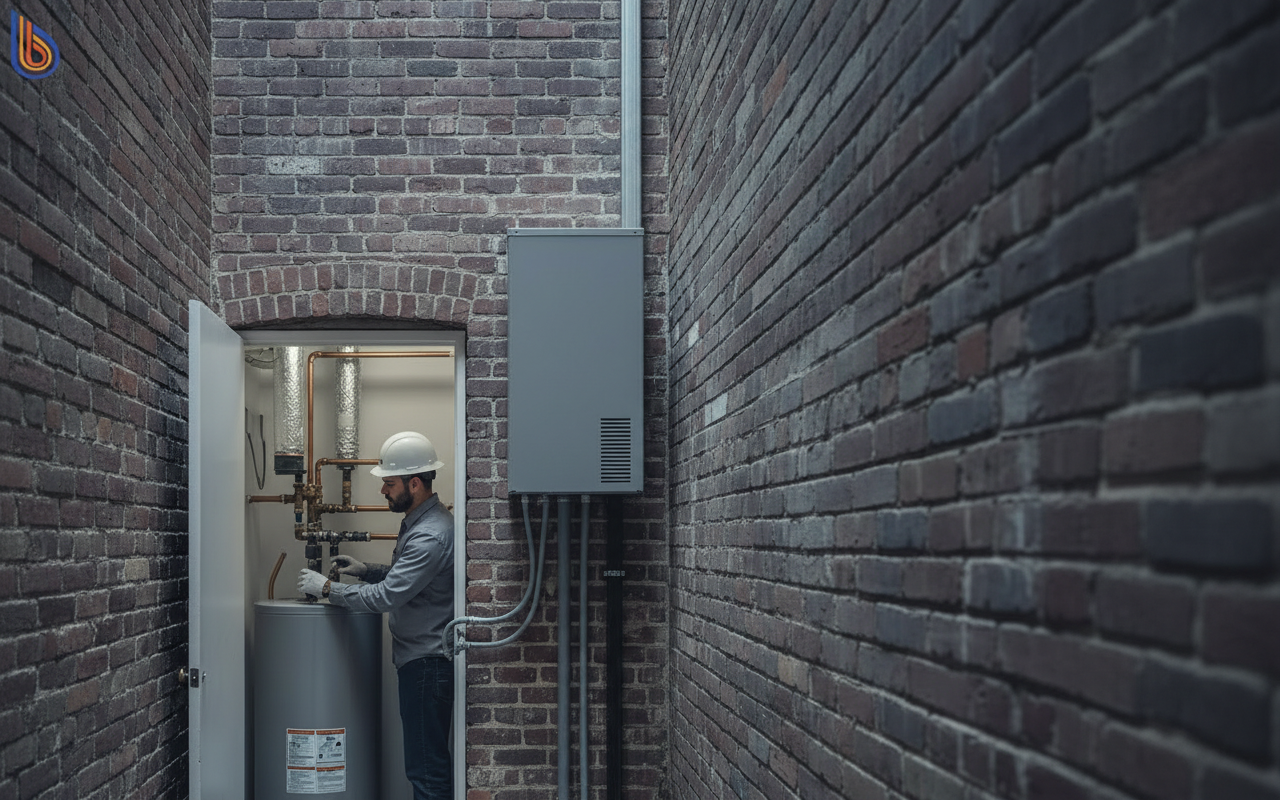
Navigating San Francisco Home Plumbing and Zero-Clearance Realities
In our work with established homeowners in the Richmond District, we often find that the biggest obstacle to electrification isn’t the technology, but the 100-year-old lath and plaster walls. San Francisco home plumbing in historic row houses rarely provides the “elbow room” that modern heat pump manuals assume you have.
When dealing with small space water heater solutions, we have to look at verticality. If you have a stairwell with “dead space” underneath, a split-system tank can often be tucked away while the slimline outdoor condenser is mounted on a roof or a back deck. However, you must account for heat pump water heater clearance requirements; most units need at least 5 to 7 inches of space on all sides to prevent overheating and ensure serviceability.
| Factor | Internal Monobloc | Split-System |
|---|---|---|
| Indoor Footprint | Large (Needs Air Volume) | Minimal (Tank Only) |
| Noise Level | Audible Indoors | Quiet Indoors / Fan Outdoors |
| Installation Complexity | Moderate | High (Requires Line Sets) |
| SF Permit Difficulty | Standard | High (Outdoor Placement) |
Need a professional eye to measure your clearances? Schedule a free site assessment with our experts to avoid costly permitting mistakes.
Acoustic Engineering and Neighbor Relations
The most common reason a split-system heat pump water heater project fails in SF isn’t the plumbing—it’s the neighbor’s bedroom window. Because row houses are built so closely together, the humming of an outdoor condenser can echo in narrow light wells, leading to noise complaints and potential code violations.
What most people miss is that San Francisco has strict decibel limits for outdoor equipment. To mitigate this, we recommend high-quality brands like SANCO2 or Mitsubishi, which offer ultra-quiet operation. Additionally, placing the unit on vibration-dampening pads and choosing a location away from shared bedroom walls is critical for long-term peace. Here’s the thing: a cheaper unit might save you $500 today, but a noise abatement order from the city will cost you thousands later.
- Select units with decibel ratings under 50 dB(A).
- Use seismic-rated wall brackets for roof or wall mounting.
- Ensure the slimline outdoor condenser doesn’t block required egress paths.
The Hidden ‘Square Footage Tax’ of Internal Units
For a typical Bay Area mid-market client, losing 15 square feet of usable pantry space to a large internal heat pump isn’t just an inconvenience—it’s a reduction in property value. If we value SF living space at $1,000/sq ft, that “free” internal installation actually costs you $15,000 in functional real estate value. This is why many of our clients opt for the more expensive split-system heat pump water heater; it pays for itself by keeping your floor plan open.
But wait—there is a contrarian view. If your home has a damp, unconditioned basement, an internal unit actually acts as a dehumidifier. It pulls moisture out of the air while it heats your water, which can prevent mold in older SF foundations. In this specific scenario, the internal unit provides a secondary benefit that a split system cannot match.
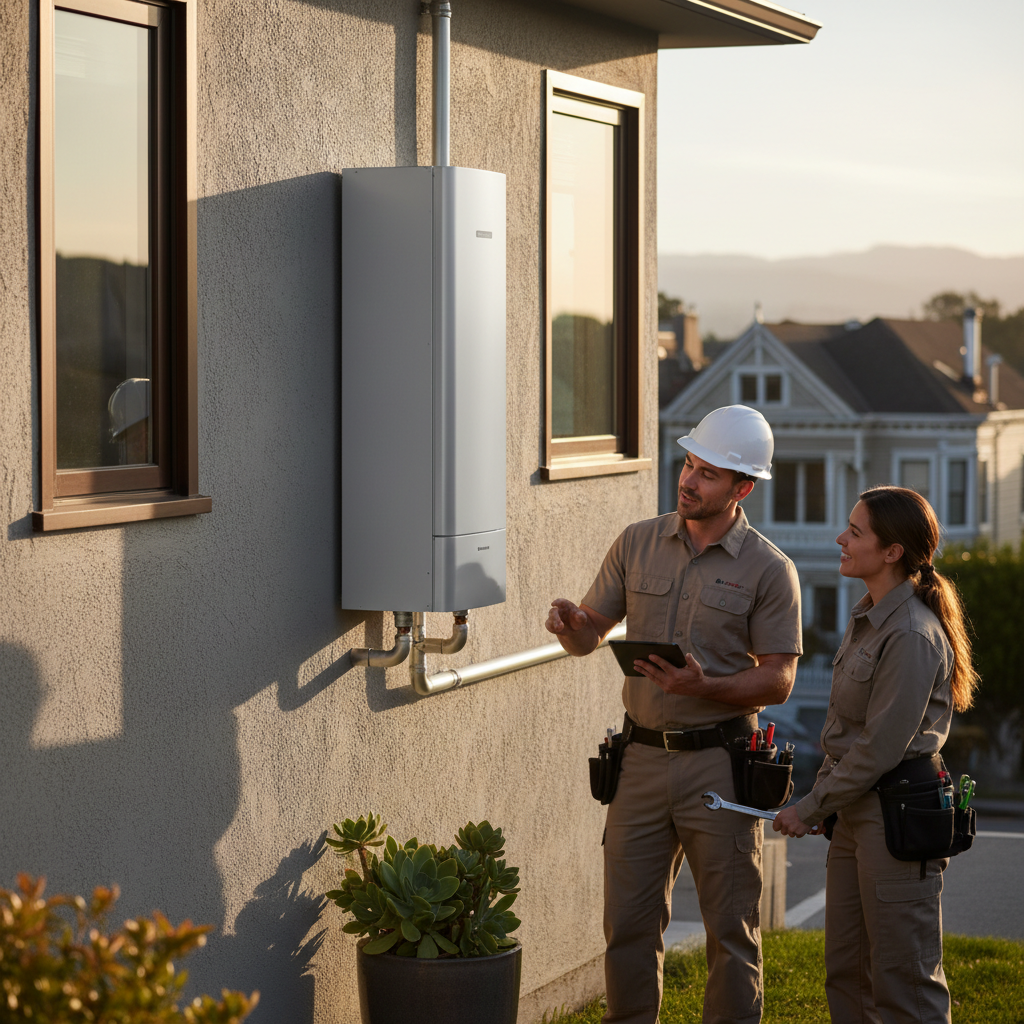
Venting Through Masonry: Managing CFM Requirements
If you choose an internal unit but lack the 1,000 cubic feet of air required, you’ll need to duct the intake and exhaust. In many SF homes, this means core-drilling through historic brick or concrete. Heat pump water heater CFM requirements are non-negotiable; if the unit can’t breathe, it will default to expensive electric resistance mode, defeating the purpose of the upgrade.
We’ve successfully used existing, decommissioned chimney flues as vent pathways for these units. This preserves the exterior aesthetic of the home while meeting San Francisco Title 24 compliance standards. It’s a sophisticated maneuver that requires a deep understanding of local building codes and airflow dynamics.
Ready to reclaim your closet space? Explore the latest Bay Area electrification rebates and see how much you can save on a premium split-system installation.
Maximizing Rebates and Federal Tax Credits
The transition to heat pumps is heavily incentivized in the Bay Area. Programs like TECH Clean California and Peninsula Clean Energy offer substantial rebates that can often cover the price gap between a standard tank and a split-system heat pump water heater. As of 2024, homeowners can also claim a federal tax credit of up to $2,000 under the Inflation Reduction Act.
What most homeowners miss is that these rebates often require a licensed contractor who is enrolled in specific program portals. We handle the paperwork for our clients to ensure no money is left on the table. When you factor in the energy savings—which ENERGY STAR estimates at over $300 annually—the ROI on these systems becomes clear within a few years.
- TECH Clean California: Up to $3,100 for gas-to-HPWH conversions.
- BayREN: Additional local incentives for energy efficiency.
- Federal 25C Tax Credit: 30% of project cost, capped at $2,000.
Final Verdict: Which is Right for Your Row House?
The decision ultimately comes down to your specific architectural constraints. If you have a garage or a basement with ample airflow, an internal monobloc unit is the most cost-effective path to decarbonization. However, if you are living in a tight urban footprint where every inch of storage is gold, the split-system heat pump water heater is the gold standard for small space water heater solutions.
Don’t wait until your current water heater fails and you’re forced into an emergency replacement. An emergency swap usually results in getting whatever is on the truck, not the most efficient or space-saving solution for your home. Take a photo of your current setup and send it to us for an honest, expert evaluation this week. We’ll help you navigate the permits, the rebates, and the tight corners of San Francisco living.
Frequently Asked Questions
Does a split-system heat pump water heater work in SF’s foggy climate?
Yes, modern split systems are designed to operate efficiently even in cool, damp conditions. While extreme cold can impact performance, San Francisco’s moderate climate is actually ideal for heat pump technology. Most units maintain high efficiency down to 40°F, which covers nearly every night in the city.
How much space do I really need for an internal heat pump?
Typically, an internal unit needs a room that is roughly 10′ x 10′ x 10′ (1,000 cubic feet) to operate without ducting. If your closet is smaller, you must install louvered doors or duct the air from a larger room or the outdoors to meet the manufacturer’s airflow requirements.
Are split systems louder than traditional water heaters?
The indoor tank is virtually silent because there are no moving parts inside. The outdoor condenser makes a humming sound similar to a modern dishwasher or a small air conditioning unit. By using high-end brands and proper mounting, the noise is rarely an issue for neighbors.
Do I need an electrical panel upgrade for a heat pump water heater?
Possibly. Most heat pumps require a 240V circuit. However, new “plug-in” 120V heat pump models are hitting the market, specifically designed for San Francisco homes where upgrading a 100-amp panel is too costly or difficult. We can help determine if your current panel can handle the load.