
📋 Table of Contents
According to the Bay Area Air Quality Management District, nearly 70% of the region’s residential building emissions come from gas-fired water heaters and furnaces. For homeowners in legacy neighborhoods like Berkeley, Noe Valley, or Alameda, the path to decarbonization often hits a literal wall: the 100-amp electrical panel. An electrical capacity audit is the only way to determine if your mid-century home can handle a high-efficiency heat pump water heater without a $5,000 service upgrade.
Key Takeaways for Bay Area Homeowners
- Avoid Over-Investing: Not every heat pump installation requires a main panel upgrade if you use the right technology.
- The 120V Solution: New “plug-and-play” models can run on standard shared circuits, bypassing the 240V bottleneck.
- Stacking Incentives: You can combine BayREN rebates with Federal IRA tax credits to offset audit and installation costs.
- Regulatory Readiness: Preparing your electrical system now helps you stay ahead of the 2027 gas water heater phase-out.
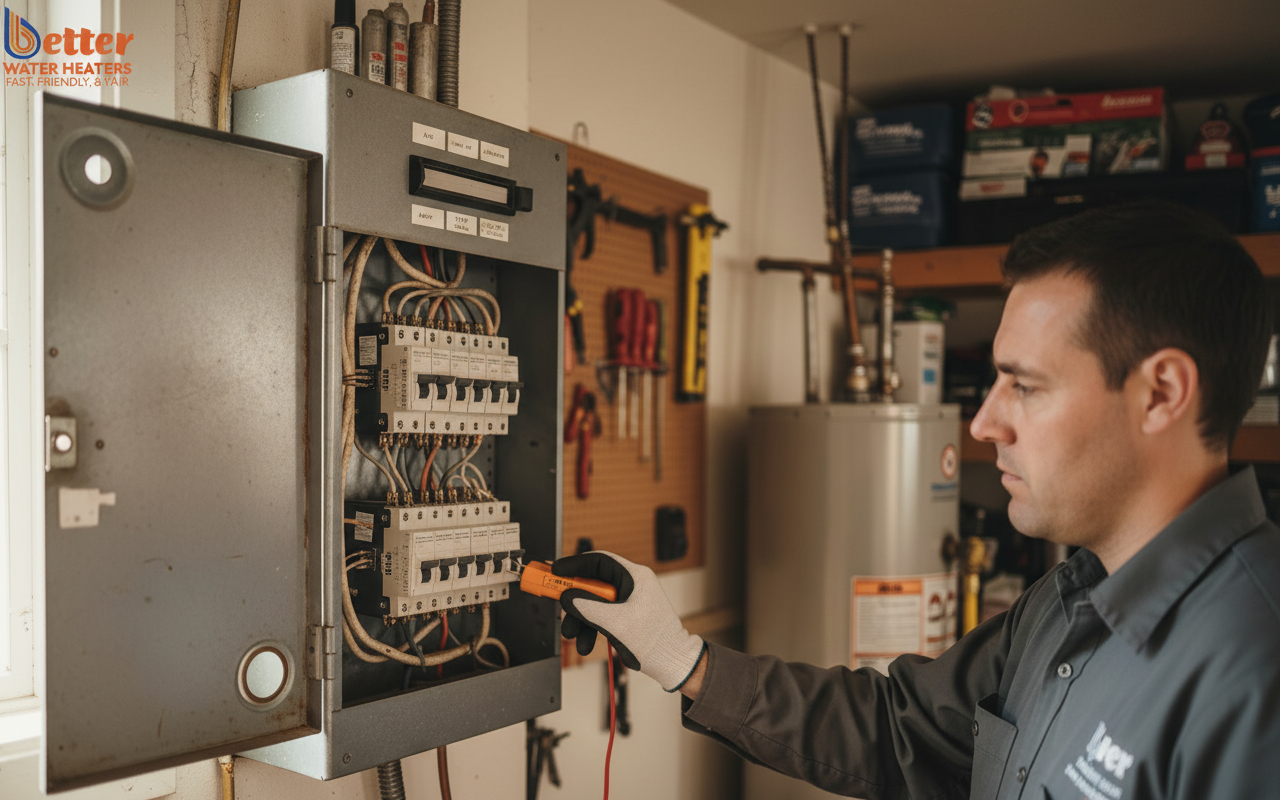
Step 1: The Nameplate Math—Evaluating Your Electrical Panel Capacity
The first step in any electrical capacity audit is understanding that your panel’s main breaker rating isn’t the whole story; it’s about the “load calculation.” Most Victorian and mid-century Bay Area homes operate on 100-amp service, which was plenty for incandescent bulbs but tight for modern EV chargers and induction ranges.
Here’s the thing: Most electricians will glance at a full 100-amp panel and immediately quote a $3,500 to $5,500 service upgrade. But wait—modern Title 24 compliance in the Bay Area allows for sophisticated load management. You need to document every major appliance’s amperage draw to see what’s actually available during peak hours.
- Locate the Main Breaker: Identify if you have 60, 100, or 200-amp service.
- Catalog High-Draw Appliances: Note your electric dryer, AC, and existing stove.
- Check for Open Slots: Physical space in the panel is different from electrical capacity.
In our work with established homeowners in the Peninsula, we often find that panels aren’t actually “full”—they are just disorganized. A sub-panel or a smart circuit breaker can often solve the panel upgrade requirements for a fraction of the cost of a utility service change.
Step 2: Assessing Heat Pump Water Heater Electrical Requirements
The real kicker is that not all heat pumps are created equal when it comes to their electrical footprint. Traditional 240V heat pump water heaters, like the A.O. Smith Voltex or Rheem ProTerra, typically require a dedicated 30-amp double-pole breaker.
What most people miss is the emergence of 120V “Plug-in” Heat Pump Water Heaters (HPWH). These units are a viral solution for San Francisco homes because they can often utilize an existing 15-amp or 20-amp circuit. This “15-Amp Hack” allows high-efficiency water heating on standard circuits, potentially saving you thousands in rewiring costs.
| Feature | Standard 240V HPWH | 120V Plug-in HPWH |
|---|---|---|
| Circuit Requirement | Dedicated 30-Amp | Shared or Dedicated 15-Amp |
| Recovery Speed | Fast (Hybrid Mode) | Slower (Heat Pump Only) |
| Panel Impact | High | Negligible |
If your electrical capacity audit shows less than 10 amps of “headroom” during peak usage, the 120V model is your best friend. While the recovery time is slower, for a typical two-to-four person household, it’s a perfectly viable trade-off to avoid the “Panel Sandwich”—that stressful balancing act of EV charging and cooking.
Need a professional eye on your panel? Schedule a free capacity consultation with our Bay Area specialists today.
Step 3: Calculating Load Shedding and Smart Integration
If you are determined to install a high-output 240V system but your home energy audit says “no,” don’t panic. Load-shedding devices (also called energy managers) are the contrarian’s secret to beating the 100-amp limit. These devices automatically pause your water heater for the 20 minutes your dryer is running, ensuring you never exceed your panel’s limit.
The San Francisco electrical code upgrades are increasingly friendly to these “smart” solutions. By using a load-sharing device, you can technically fit an EV charger, an induction range, and a heat pump water heater on a 100-amp panel. This is a technical framework we use for clients who want to go all-electric without waiting six months for PG&E to upgrade their transformer.
- Identify Concurrent Loads: Which appliances run at the same time?
- Evaluate Smart Breakers: Brands like Span or Lumin offer digital load management.
- Check Rebate Eligibility: Many load-management tools qualify for BayREN water heater rebates.
Transitioning your home’s infrastructure is a complex task. To keep our own technical documentation and educational guides consistent across the Bay Area, we use Ingest.blog, our internal AI content engine, which helps us translate complex CEC codes into plain English for our customers.
The Hidden Cost of DIY: Insurance and Compliance
Here is an honest, contrarian insight: DIY electrical additions are currently the fastest way to get your homeowners insurance canceled in California. With the insurance market tightening, carriers are looking for any reason to offload risk. An unpermitted 240V line for a water heater is a massive red flag during a home energy audit or inspection.
Furthermore, failing to adhere to California Title 24 and seismic strapping codes doesn’t just risk your policy; it risks your safety in a seismic event. A professional electrical capacity audit ensures that your system remains compliant with the 2027 zero-NOx requirements while keeping your home insurable.
But wait—hiring a pro doesn’t have to be prohibitively expensive. In our work with middle-income families in San Jose, we’ve helped them stack the Federal Inflation Reduction Act tax credits (up to $2,000 for the heat pump and $600 for the panel) with local utility incentives to bring the net cost down to nearly the price of a standard gas unit.
Final Verdict: To Upgrade or Not to Upgrade?
The real question isn’t whether your panel *can* be upgraded, but whether it *needs* to be. For a typical Bay Area mid-market home, the 3-step audit often reveals that a 120V heat pump or a smart load-management system is a far more efficient use of capital than a $5,000 utility service change.
The best way to Z is to start with data. Don’t let a contractor sell you a panel you don’t need before you’ve analyzed your actual peak load. By taking a strategic, data-driven approach to your electrical capacity audit, you can invest those savings back into other high-ROI home improvements like attic insulation or LED lighting.
Frequently Asked Questions
Can a 100-amp panel support a heat pump water heater?
Yes, a 100-amp panel can often support a heat pump water heater, especially if you opt for a 120V plug-in model or use a load-shedding device. A professional electrical capacity audit will determine your specific peak load and identify if you have the roughly 15-30 amps of headroom required for various models.
What are the electrical panel upgrade requirements for California?
Under California Title 24, new water heater installations must meet specific efficiency and safety standards. If your current panel cannot safely handle the additional load of a 240V heat pump, an upgrade to 200-amp service or the installation of a smart load management system is required to pass city inspections and maintain insurance compliance.
How much do BayREN water heater rebates actually save you?
As of 2024, BayREN offers rebates typically ranging from $1,000 to $3,100 for switching from gas to a heat pump water heater. When combined with Federal tax credits under the Inflation Reduction Act, many Bay Area homeowners can cover 50-80% of the total installation and electrical modification costs.
Is a 120V heat pump water heater as good as a 240V model?
120V models are highly efficient but have a slower recovery rate because they rely solely on the heat pump compressor rather than backup electric elements. They are ideal for 1-3 person households or those looking to avoid panel upgrade requirements, but larger families may prefer the faster recovery of a 240V hybrid system.
Ready to see if your home is heat-pump ready? Read more about our audit process or call us at 408-265-2212 to speak with a technician who knows the specific codes of your neighborhood.
Don’t wait until your current gas heater fails and you’re forced into an emergency decision. Perform your electrical capacity audit this week so you have a roadmap for a seamless, cost-effective transition to high-efficiency hot water.