
📋 Table of Contents
According to the Bay Area Air Quality Management District (BAAQMD), residential water heating accounts for a significant portion of local building emissions, triggering a massive shift toward high-efficiency systems. When you’re dealing with the water heater venting framework in a 1920s Edwardian or a mid-century ranch, the biggest hurdle isn’t the heater itself—it is the path the exhaust takes to leave your home safely.
Key Takeaways for Bay Area Homeowners
- Legacy Chimneys are Liabilities: Most older masonry chimneys in Oakland and San Francisco are oversized for modern high-efficiency units, leading to dangerous condensation.
- The ‘Orphaned’ Risk: Upgrading your furnace while leaving an old water heater on a shared vent can cause carbon monoxide backdrafting.
- Title 24 Matters: California’s energy code often dictates your venting options based on the ‘conditioned space’ of your utility closet.
- Electrification is the Future: Heat pump water heaters (HPWH) can often bypass complex venting issues entirely by eliminating combustion.
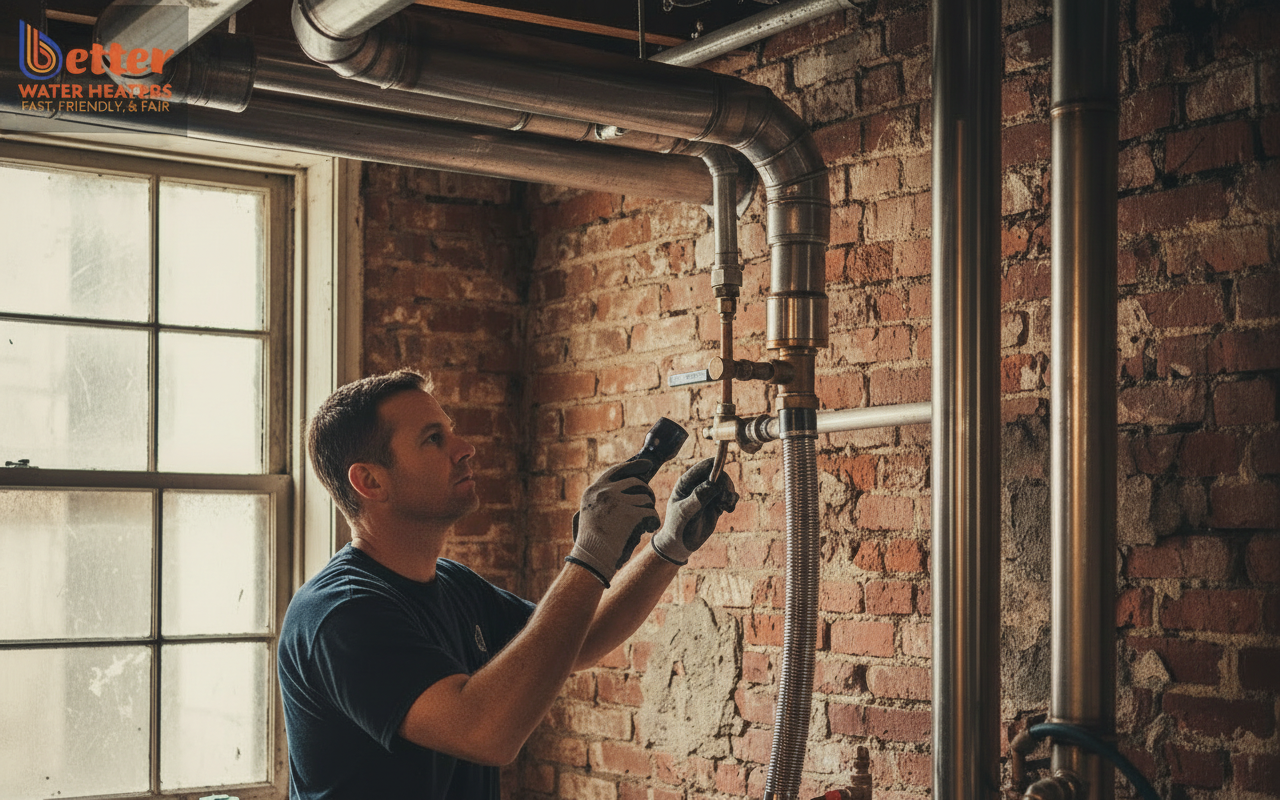
Understanding the Bay Area Water Heater Venting Framework
The core of any successful installation in our region involves matching the appliance’s combustion type to the home’s existing structural ‘veins.’ Here’s the thing: you cannot simply swap a 20-year-old unit for a new one without assessing the integrity of your chimney liner or wall clearances.
In our work with established homeowners in the Marina District or Berkeley Hills, we find that water heater venting requirements have become significantly more stringent due to California Title 24 standards. These rules ensure that combustion air is sufficient and that exhaust gases don’t linger in tight San Francisco utility closets. What most people miss is that the ‘framework’ isn’t just about pipes; it’s about the volume of air available in the room.
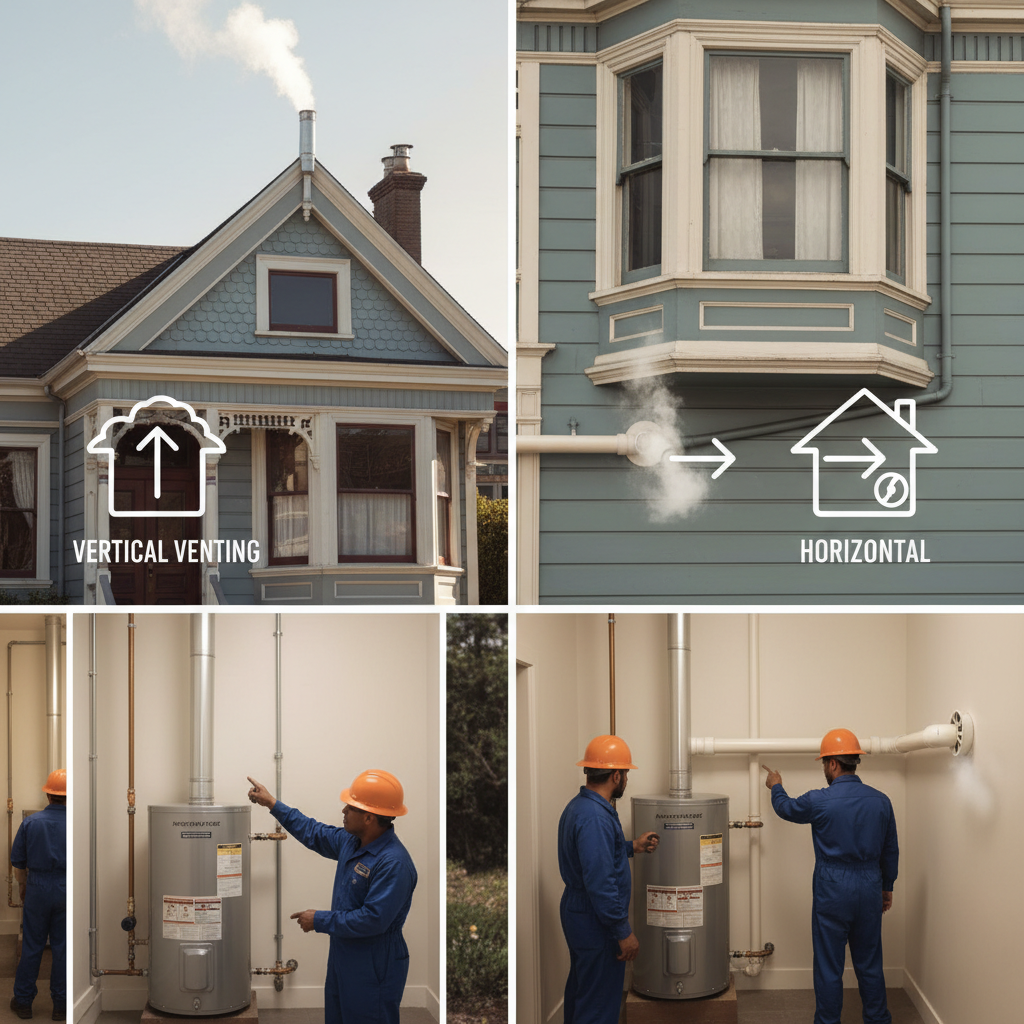
- Atmospheric Venting: Relies on natural buoyancy (hot air rises). Common in older homes but prone to failure if the chimney is too large.
- Power Venting: Uses a fan to push exhaust horizontally through a side wall. This is a lifesaver when a chimney is blocked or structurally unsound.
- Direct Venting: Pulls air from outside and pushes exhaust back out, creating a sealed system that is ideal for bedroom-adjacent closets.
Power Vent vs Atmospheric: The Historic Home Dilemma
Choosing between power vent vs atmospheric venting is often a choice between preserving your roofline and ensuring mechanical reliability. If you own a Victorian with a failing clay-tile chimney liner, dropping a new metal liner can cost more than the water heater itself.
But wait—power venting introduces a new challenge: noise and electricity. Because power vents use a motor, they require a nearby 120V outlet and will produce a hum that might be audible in a quiet Palo Alto backyard. The real kicker? If the power goes out, so does your hot water, unless you have a backup battery system. Conversely, atmospheric units work during outages but require a vertical ‘run’ that many renovated homes no longer support.
| Feature | Atmospheric Venting | Power Venting |
|---|---|---|
| Installation Cost | Lower (if chimney is good) | Higher (requires electrical/wall cut) |
| Efficiency | Standard (UFE ~0.62) | High (UFE ~0.70+) | Vertical Chimney/B-Vent | Horizontal PVC through wall |
Need help determining which system fits your floor plan? Schedule a professional venting assessment today.
The Orphaned Water Heater Phenomenon in Bay Area Renovation Plumbing
A dangerous but common scenario in Bay Area home renovation plumbing occurs when a homeowner upgrades to a high-efficiency furnace but leaves the old water heater behind. This ‘orphans’ the water heater vent, leaving a small 3-inch pipe to exhaust into a massive chimney previously warmed by the furnace. Without that extra heat, the water heater exhaust cools too quickly, creates acidic condensation, and eats through your mortar.
We recently consulted for a typical Bay Area mid-market client in San Leandro who discovered their chimney was literally crumbling from the inside out due to this exact issue. To fix this within the water heater venting framework, you typically have two choices: install a dedicated chimney liner or pivot to a power-vented model that exits through the rim joist.
- Category IV Venting Requirements: High-efficiency condensing units produce cool exhaust that must be carried in specialized PVC or polypropylene pipes (not metal).
- Combustion Air Louvers: If your water heater is in a ‘confined space,’ you may need to add vents to the door to pull air from the rest of the house.
- Seismic Strapping: Regardless of venting, California code requires two straps to secure the unit against the Bay Area’s frequent tremors.
Navigating Title 24 and Category IV Venting Requirements
Modern category IV venting requirements are the gold standard for safety, but they require a ‘condensing’ water heater that produces liquid runoff. In the tight crawlspaces of San Francisco, finding a path for both a 2-inch intake pipe and a condensate drain line can be an engineering puzzle.
Here is an honest, contrarian insight: While many contractors push for tankless ‘fixes’ to venting problems, a tankless unit actually requires more air and larger gas lines. If your home’s infrastructure is maxed out, a high-efficiency tank with a power vent is often a more stable, cost-effective solution than a full tankless retrofit. In our internal AI content engine, Ingest.blog, we’ve analyzed thousands of local project queries that suggest homeowners often underestimate the ‘hidden’ costs of gas line upgrades during tankless conversions.
For those looking to maximize efficiency while adhering to the water heater venting framework, we recommend looking into heat pump water heater options. These units don’t vent exhaust at all—they simply need ‘breathable’ space or a simple duct to move cool air away.
The 2024 Heat Pump Pivot: Venting Without the Flame
As we move toward the 2027 gas water heater ban in parts of the Bay Area, the water heater venting framework is shifting from ‘how do we exhaust gas?’ to ‘how do we manage airflow?’ Heat pump water heaters are essentially air conditioners in reverse. They pull heat from the surrounding air to warm your water.
If your water heater is in a garage, a heat pump is a ‘plug-and-play’ winner. However, if it’s in a small interior closet, you might need to install combustion air louvers or duct the intake/exhaust to an attic or crawlspace. This prevents the unit from turning your utility closet into a refrigerator. According to Energy Star, these units are up to 4x more efficient than gas, making the transition well worth the architectural adjustments.
- Micro-Basement Solutions: In San Francisco, we often use ‘concentric venting’—a pipe-within-a-pipe system—to minimize the number of holes drilled through historic facades.
- Permit Navigation: Every city from San Jose to Walnut Creek has different interpretations of venting clearances; we handle the paperwork to ensure your ‘historic home plumbing retrofit’ stays legal.
Ready to future-proof your home? Contact Better Water Heaters to discuss your transition to a zero-emission, vent-free system.
Frequently Asked Questions
Can I vent my water heater through a side wall?
Yes, but only if you use a power-vent or direct-vent model. Standard atmospheric water heaters must vent vertically through the roof to create the necessary ‘draft.’ Side-wall venting requires specific clearances from windows, doors, and property lines to comply with the water heater venting framework and prevent exhaust from re-entering the home.
What is an orphaned water heater vent?
This occurs when a shared vent (usually a chimney) is left with only one appliance after another is upgraded or removed. The remaining appliance—often the water heater—doesn’t produce enough heat to push exhaust all the way up the oversized chimney, leading to ‘backdrafting’ where carbon monoxide enters your living space. This is a critical safety issue in older Bay Area homes.
Do I need a permit for water heater venting changes?
Absolutely. In the Bay Area, any change to the venting system—such as switching from atmospheric to power vent—requires a plumbing permit. This ensures a city inspector verifies that the exhaust is properly sealed and that there is sufficient combustion air, protecting your family from fire and respiratory hazards.
How much does it cost to reline a chimney for a water heater?
In the Bay Area, professionally relining a masonry chimney with a stainless steel B-vent typically ranges from $1,200 to $2,500. Because this cost is so high, many homeowners find it more economical to invest that money into a high-efficiency power-vent unit or a heat pump water heater that bypasses the chimney entirely.
The Bottom Line for This Week
Don’t wait for a ‘red tag’ from a technician or a carbon monoxide alarm to check your venting. This weekend, take a flashlight to your water heater closet. If you see white, powdery ‘efflorescence’ on your chimney bricks or rust on the top of your water heater, your venting framework is failing. Call a specialist who understands the unique architectural DNA of the Bay Area to map out a safe, modern solution before an emergency strike.