
📋 Table of Contents
San Francisco row houses are architectural marvels, but their ‘mechanical closets’ are often where logic goes to die. According to the U.S. Energy Information Administration, water heating is the second largest energy expense in California homes, yet upgrading to efficient tech in a 100-year-old Edwardian often feels like playing a high-stakes game of Tetris.
If you are a homeowner or a property manager in the Richmond or Sunset districts, you know the struggle: the small space water heater you need must somehow satisfy modern energy mandates while fitting into a crawl space originally designed for a coal bin. Here is the strategic roadmap for navigating the physical footprint of new water heating technology without sacrificing your square footage.
Key Takeaways for SF Homeowners
- Side-Discharge Units: The secret weapon for narrow side yards where traditional heat pumps won’t fit.
- Zero-Footprint Mounting: Why wall-hung tankless units are the gold standard for San Francisco’s ‘Forbidden Closets.’
- Permit Precision: Navigating San Francisco plumbing code is non-negotiable for insurance and resale value.
- Rebate Maximization: How to access up to $4,900 in incentives even for complex, tight-space retrofits.
1. The Reality of the ‘Forbidden Closet’ in SF Architecture
The biggest hurdle in a row house isn’t the technology; it is the fact that modern heat pumps require significantly more cubic feet of air than the gas tanks they replace. What most people miss is that a compact heat pump water heater needs roughly 700 to 1,000 cubic feet of air space to operate efficiently without freezing out the surrounding room.
In our work with established Bay Area homeowners, we often find water heaters tucked under stairwells or in unconditioned lean-tos. These spaces are frequently non-compliant with the current San Francisco plumbing code regarding ventilation and seismic bracing. When you transition from a standard gas tank to a high-efficiency model, the physical dimensions change—tanks get wider and taller due to increased insulation requirements (Title 24).
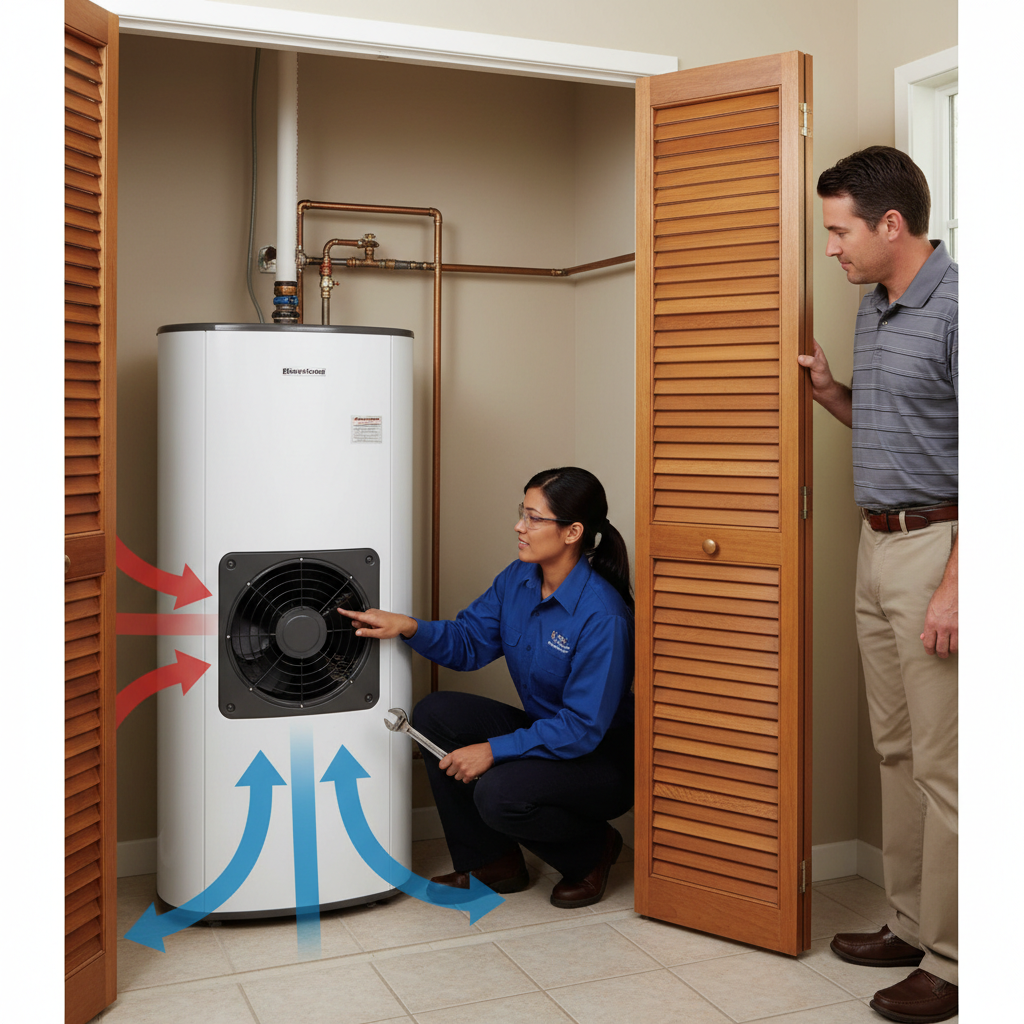
But wait—there is a workaround for the ‘cold closet’ problem. By utilizing louvered doors or ducting the exhaust air to a different room (or even outdoors), you can place a high-efficiency unit in a space that would otherwise be too small. This is a common strategy we use for mid-market residential clients who want to go green without moving their laundry room.
2. Tankless Water Heater San Francisco: The Vertical Solution
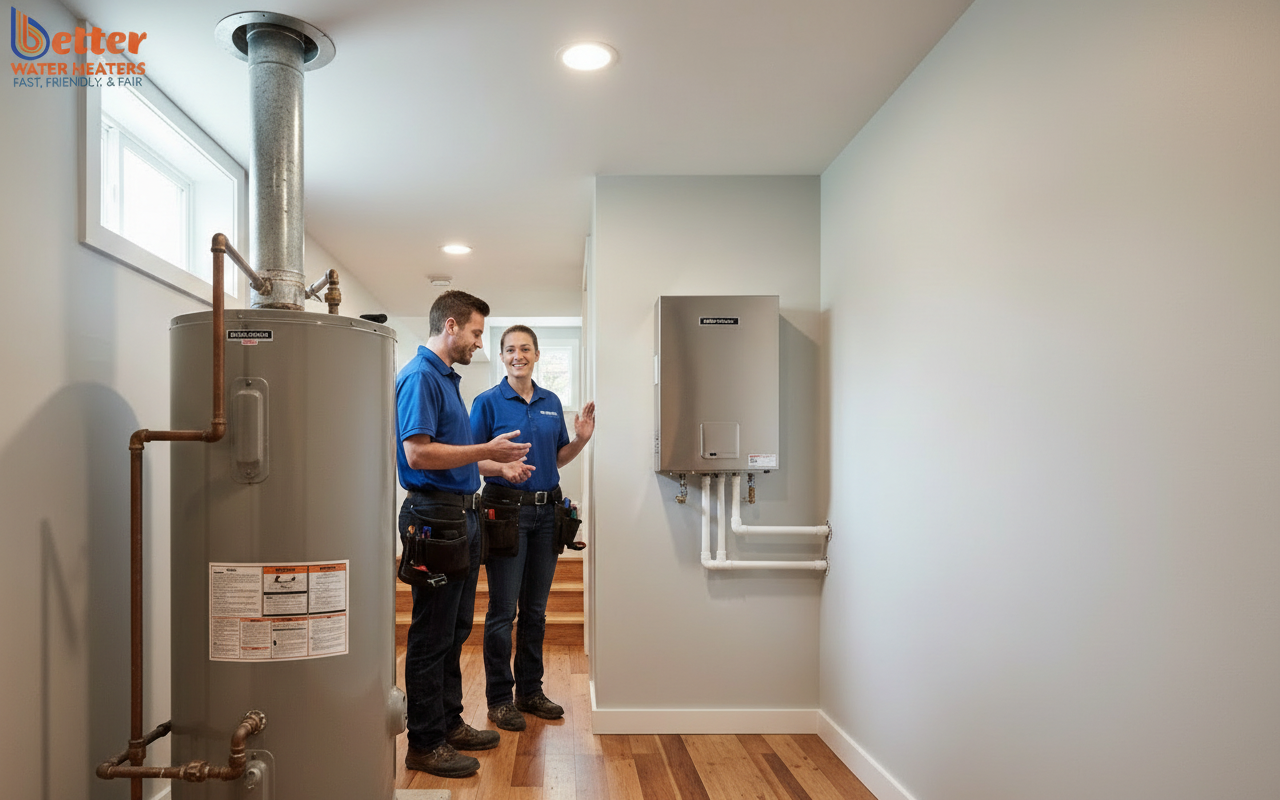
Wall-mounted systems are the undisputed kings of the zero-footprint mechanical room because they reclaim floor space for storage or shelving. For a typical tankless water heater San Francisco installation, we move the unit from the floor to the wall, instantly freeing up about 9 square feet of premium real estate.
- Mounting Flexibility: These units can be installed in attics, crawl spaces, or even exterior-grade recessed boxes.
- Endless Hot Water: Ideal for high-density living where multiple bathrooms might run simultaneously.
- Venting Innovation: Modern concentric venting allows us to exhaust through side walls, avoiding expensive roof penetrations in multi-story row houses.
The real kicker? While tankless units are incredibly compact, they require larger gas lines (usually 3/4 inch). In 100-year-old SF homes, this often means a gas line upgrade from the meter. If you’re a startup founder looking for a low-maintenance, high-ROI upgrade, this is the most space-efficient path, provided your electrical or gas infrastructure can handle the instantaneous load.
Need help deciding if your walls can support a tankless system? Schedule a free space-assessment with our experts.
3. Compact Heat Pump Water Heater: Side-Discharge Tech
Most heat pump water heaters are ‘top-discharge,’ meaning they blow cold air out of the top, requiring high ceilings that many SF basements simply don’t have. The compact heat pump water heater market has evolved, introducing side-discharge models like those from Rheem or AO Smith that are designed specifically for narrow clearances.
These units allow for installation in rooms with ceilings as low as 7 feet. For a typical Bay Area mid-market client, this is the difference between an easy install and a $5,000 basement excavation project. Here is how they compare to traditional tanks:
| Feature | Standard Tank | Compact HPWH | Slimline Tankless |
|---|---|---|---|
| Floor Space | High (9+ sq ft) | Medium (7 sq ft) | Zero (Wall-hung) |
| Energy Efficiency | Low | Highest (3.5+ UEF) | High (0.95 UEF) |
| SF Code Compliance | Standard | Requires Airflow | Requires Venting |
Here’s an honest, contrarian insight: Not every SF home should go 100% electric right now. If your electrical panel is maxed out at 100 amps and located at the opposite end of a finished house, the cost of the ‘space-saving’ electric retrofit might outweigh the energy savings for a decade. Sometimes, a high-efficiency gas tankless is the more pragmatic ‘green’ choice for a small space water heater solution.
4. Navigating San Francisco Plumbing Code and Seismic Requirements
In the Bay Area, we don’t just worry about space; we worry about the ground moving. The San Francisco plumbing code is notoriously strict regarding seismic strapping and sediment traps. In a tight row house closet, finding the required 12 inches of clearance for the gas shut-off and the T&P valve can be a nightmare.
- Seismic Strapping: Must be in the upper and lower third of the tank, bolted into studs—difficult in lath-and-plaster walls.
- Drainage: Heat pumps produce condensate (water). In a basement with no floor drain, we must install a condensate pump to move that water up and out.
- Permitting: SF inspectors are looking for specific clearances that many DIY or ‘handyman’ installs ignore, which can haunt you during a home sale.
What most people miss is that 2027 regulations will essentially ban the sale of standard gas water heaters in the Bay Area. Moving to a compact heat pump water heater now isn’t just about efficiency; it’s about future-proofing your home before the rush. We handle the permit process entirely, ensuring your installation meets every local nuance of the San Francisco plumbing code.
5. ROI of Space: Increasing Your Home Value
In a city where the median price per square foot is over $1,000, reclaiming a 3’x3′ closet is effectively a $9,000 gain in usable home value. For property managers, this space can be converted into a stacked washer/dryer hookup, significantly increasing rental yields. We’ve seen this strategy work wonders for Series B tech professionals who want to maximize every inch of their Mission District condos.
To help our team produce these detailed guides at scale, we use Ingest.blog, our internal AI content engine, which ensures we stay updated on the latest Energy.gov standards and local rebate changes. This allows us to focus on what we do best: high-precision installations in impossible spaces.
The real value isn’t just the unit; it’s the rebate. Currently, programs like TECH Clean California offer massive incentives for switching to heat pumps. When you combine federal tax credits with local Bay Area incentives, the ‘premium’ price of a small space water heater often drops below the cost of a basic tank.
Ready to reclaim your closet? Get a custom quote for your SF row house today or call us at (408) 250-6672.
Frequently Asked Questions
Can a heat pump water heater be installed in a small closet?
Yes, but it requires strategic ventilation. A compact heat pump water heater needs airflow to extract heat. In a small closet, we typically install louvered doors or use a ducting kit to pull air from a larger room or the outdoors. Without this, the unit will lose efficiency and potentially cause the closet to become excessively cold.
What is the best small space water heater for a 1-bedroom SF condo?
For most 1-bedroom SF condos, a wall-mounted electric tankless or a point-of-use (POU) system is ideal. These eliminate the need for a large storage tank entirely. If you have gas access, a tankless water heater San Francisco residents prefer is the Rinnai Sensei series for its compact size and high reliability.
Does San Francisco plumbing code allow exterior installations?
Yes, exterior installations are common in the Bay Area due to our temperate climate. However, the unit must be rated for outdoor use and properly protected from the elements with an approved enclosure. This is an excellent way to save interior square footage in narrow row houses while satisfying all San Francisco plumbing code requirements.
How much can I save with Bay Area water heater rebates?
As of 2024, Bay Area homeowners can access up to $4,900 in total incentives. This includes up to $3,100 from TECH Clean California and $2,000 in federal tax credits (25C). These rebates are specifically designed to offset the higher cost of a compact heat pump water heater, making the transition to electric much more affordable.
Is a tankless water heater better than a heat pump for small spaces?
It depends on your infrastructure. A tankless unit is physically smaller and hangs on the wall, making it the ultimate small space water heater. However, a heat pump is significantly more energy-efficient and qualifies for much larger rebates. We typically recommend tankless for maximum space saving and heat pumps for maximum long-term ROI.