
📋 Table of Contents
Your iconic Eichler home was designed to bring the outdoors in, but in 2026, those floor-to-ceiling windows are becoming a $8,400 liability for your next water heater upgrade. While California’s decarbonization mandates push everyone toward electric, the standard Eichler home water heater replacement is currently seeing a 40% performance drop-off because most installers treat a glass-walled masterpiece like a stucco box in the suburbs.
The real kicker? Homeowners are spending thousands on high-end heat pump systems only to realize their “efficient” upgrade can’t keep up with a single morning shower cycle. This isn’t just a minor technical glitch; it is a fundamental physics mismatch between mid-century architecture and modern appliance logic. If you are living in a post-and-beam classic in San Jose or San Rafael, the “standard install” is your fastest route to cold showers and skyrocketing utility bills.
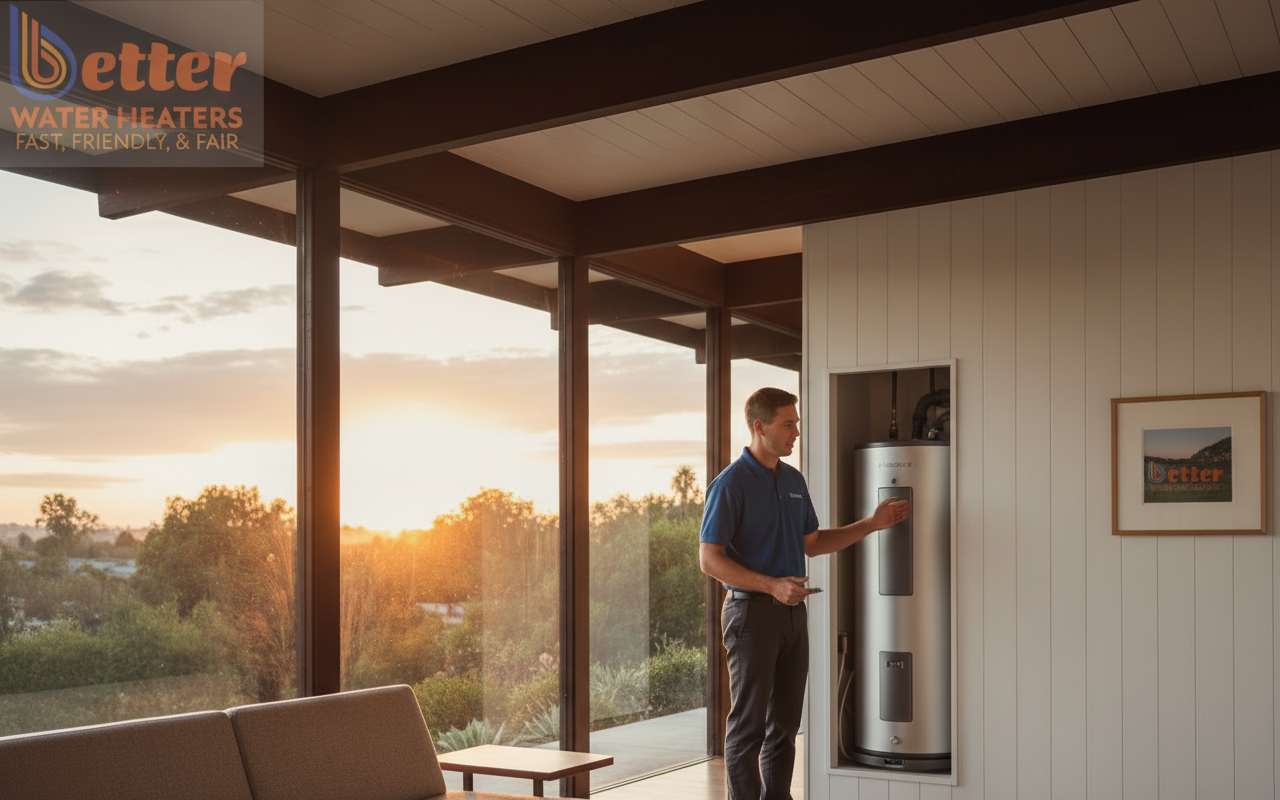
The Physical Footprint Paradox: Why Your Utility Closet is Too Small
Most 2026-compliant heat pump water heaters require nearly 1,000 cubic feet of ambient air to operate efficiently, yet the average Eichler utility closet offers less than 150. This creates a localized “refrigeration effect” where the unit chills its own air supply, leading to massive heat pump efficiency loss as the system struggles to extract heat from an increasingly cold closet.
- Airflow Requirements: Modern units need massive clearance for intake and exhaust that original MCM closets simply don’t have.
- The R-454B Factor: The EPA’s shift to R-454B refrigerants in 2026 means units are getting physically larger to maintain the same capacity.
- Noise Pollution: In open-floorplan homes, the 45-55 decibel hum of a heat pump compressor in a central closet can resonate through the entire living area.
What most people miss is that the 2026 mandates don’t care about your architectural preservation. We recently saw a client in Palo Alto who was told they needed to cut a 12-inch vent hole through their original tongue-and-groove ceiling just to meet the airflow specs for a standard Rheem install. That is a permanent structural scar for a temporary appliance fix. Before you cut into your roof, consult with a specialist who understands MCM constraints.
The Thermal Bridge Crisis: Glass vs. BTU Calculations
Eichlers are essentially “thermal sieves” where the single-pane glass and lack of attic space mean your water heater has to work 30% harder just to maintain tank temperature during a Bay Area winter. Standard sizing calculators used by big-box retailers assume a modern R-38 insulation value, but your Eichler is likely rocking an R-value closer to a cardboard box.
The Bay Area mid-century modern HVAC landscape is littered with “short-cycled” units because contractors fail to account for the high glass-to-wall ratio. When the sun goes down, the ambient temperature in an Eichler drops faster than in a traditional home, forcing the heat pump into “high-resistance” electric mode—the most expensive way to heat water.
| Feature | Standard Suburban Home | Eichler MCM Home |
|---|---|---|
| Insulation Level | High (R-38+) | Low (R-5 to R-11) |
| Recovery Rate Needed | Standard | High (due to thermal loss) |
| Closet Ventilation | Ample | Severely Restricted |
But wait—the heat pump recovery rate vs gas is already a point of contention. A gas heater recovers almost instantly; a heat pump takes its time. In an Eichler, where the pipes often run through a cold slab, that delay feels like an eternity. You aren’t just losing heat in the tank; you’re losing it in the transit from the closet to the master bath.
The $3,000 Hidden Electrical Tax
Here is a contrarian insight: The “free” rebates you see advertised for heat pumps are often swallowed whole by the electrical upgrades required to run them. Most original Eichler panels are capped at 100 or 125 amps, which was plenty for a few lights and a toaster in 1955, but won’t support a 30-amp dedicated circuit for a Eichler home water heater upgrade.
- Panel Congestion: Adding a heat pump often triggers a full panel upgrade, costing between $2,500 and $4,500.
- Sub-panel Logistics: Because of the slab construction, running new conduit to the utility closet isn’t a simple “attic crawl”—it often involves visible exterior conduit that ruins the roofline.
- Title 24 Compliance: In many Bay Area jurisdictions, these upgrades trigger Title 24 compliance for historic homes, adding layers of permit costs.
One of our clients in Willow Glen thought they were getting a “free” upgrade via state incentives, only to be hit with a $3,200 bill for a heavy-up on their Zinsco panel—a panel that should have been replaced decades ago but was forced to the forefront by the new water heater. Need a reality check on your home’s capacity? Check our guide on electrical readiness.
Eichler Radiant Heating Retrofit: The Integration Trap
Many Eichler owners still use their original radiant floor heating systems, and the dream is to integrate the water heater into this loop. However, the Eichler radiant heating retrofit using a standard residential heat pump is often a recipe for disaster. These units aren’t designed for the high-duty cycle of floor heating and domestic hot water simultaneously.
The real kicker? When you ask a heat pump to do both, the heat pump efficiency loss doubles. You end up with lukewarm floors and cold showers. As of 2025, we are seeing a massive spike in “compressor burnout” for units installed by generalists who didn’t understand the load calculations of a hydronic-to-heat pump conversion.
What you need is a decoupled system or a high-capacity hybrid, but those require even more space—space you don’t have. This is why a 100% electric solution is often a financial mistake for MCM owners who haven’t first addressed their building envelope. You are essentially buying a Ferrari engine and putting it in a car with square wheels.
The 2026 Compliance Gap: Why Waiting Might Cost You
The R-454B refrigerant transition 2026 is going to change the hardware landscape permanently. If you think finding a technician who understands Bay Area mid-century modern HVAC is hard now, wait until the new flammable-refrigerant standards kick in. The complexity of these systems is outpacing the skills of the average “truck and a ladder” plumber.
- Specialized Tools: R-454B requires specific recovery and charging equipment.
- Training Gap: There is a massive lack of technicians certified for integrated MCM plumbing constraints.
- Supply Chain: Older, simpler units are being phased out, leaving only the complex, space-hungry models.
If your water heater is over 10 years old, the time to act is now—before the 2026 hardware mandates make a simple replacement an architectural nightmare. Schedule a site assessment today to see if your closet can even handle the next generation of tech.
How to Beat the Trap: A Realist’s Strategy
You don’t have to settle for cold showers or ruined aesthetics. Beating the efficiency trap requires a “System First” approach rather than an “Appliance First” one. According to ENERGY STAR, heat pumps can save 70% on energy, but only if the environment is optimized.
- Ducting is Non-Negotiable: In an Eichler, you must duct the cold exhaust air out of the closet (usually through the roof or a side wall) to prevent the refrigeration effect.
- Hybrid is your Friend: Use a hybrid unit that allows for high-demand gas or electric resistance backup during the Bay Area’s damp winter weeks.
- Tank Sizing: Upsize the tank. Because the recovery rate is slower, a 65- or 80-gallon tank acts as a necessary buffer for the Eichler home water heater.
The bold takeaway? Don’t let a contractor sell you a “standard” install. If they aren’t talking about cubic footage, R-values, and circuit loads on their first visit, they aren’t installing a water heater—they’re installing a headache. Your Eichler survived the 20th century; don’t let a bad HVAC choice ruin it in the 21st.
Frequently Asked Questions
Why does my heat pump water heater run constantly in my Eichler?
In mid-century modern homes with high glass ratios, the ambient temperature drops quickly, and standard closets often lack the 1,000 cubic feet of air needed for efficient heat exchange. This causes the unit to struggle to pull heat from the air, forcing it into a continuous cycle or expensive electric-resistance mode to meet demand.
Can I install a heat pump water heater in a small Eichler closet?
Yes, but it requires specialized ducting to move the cold exhaust air out of the space. Without proper ventilation, the unit will create a ‘micro-fridge’ effect in your closet, significantly increasing your energy bills and reducing the lifespan of the compressor due to overwork.
What are the electrical requirements for an Eichler water heater upgrade?
Most heat pump water heaters require a dedicated 240V, 30-amp circuit. For many Eichler homes with original 100-amp panels, this often necessitates a service upgrade or a smart circuit splitter to avoid overloading the system, especially if you also have an EV charger or electric dryer.
Is a tankless gas heater better for an Eichler than a heat pump?
While California is moving toward electric, a high-efficiency tankless gas heater often fits the physical footprint of an Eichler much better. However, with 2027 gas bans looming in some Bay Area districts, a hybrid heat pump with proper structural modifications is often the better long-term investment for property value.