
📋 Table of Contents
I recently walked into a $3.5M home in Los Gatos where the homeowner was frantic because his electric bill hit $640 in a single month. He thought his new ‘ultra-efficient’ water heater was the solution, but due to massive heat pump installation errors, he was essentially running a giant hair dryer 24/7 to heat his water.
The truth is, most general plumbers treat a heat pump like a standard gas tank—they drop it in, strap it down, and walk away. That ‘cookie-cutter’ approach is the fastest way to turn a 300% efficient machine into a financial disaster. If your contractor doesn’t understand thermodynamics, they aren’t installing an appliance; they’re installing a debt center.
The ‘Emergency Mode’ Trap: Why Your Unit is Eating Cash
Most homeowners don’t realize that their hybrid water heater has a ‘dumb’ backup system called resistive heating that costs four times more to operate than the heat pump mode.
- Resistive heating vs heat pump mode: Heat pump mode pulls heat from the air (efficient), while resistive mode uses electric coils (expensive).
- The Trigger: If the unit can’t find enough heat in the surrounding air, it panics and switches to high-draw electric mode.
- The Result: You get hot water, but your meter spins like a top, leading to high electric bills that catch you off guard in January.
What most people miss: A contractor who doesn’t set the default operating mode to ‘Heat Pump Only’ is practically guaranteeing you’ll be subsidizing PG&E’s next quarter. We see this in 9 out of 10 ‘failed’ installs in San Jose and Oakland.
The Air Volume Myth: Your Closet is Suffocating the System
You cannot stick a hybrid water heater in a 3×3 broom closet and expect it to work; these units need to ‘breathe’ at least 1,000 cubic feet of air to maintain a high heat pump COP (Coefficient of Performance).
The real kicker? When a unit is starved for air, it creates a ‘cold room’ effect, dropping the ambient temperature so low that the heat pump can no longer extract energy. Here is how the math fails when air volume is ignored:
| Installation Factor | Standard ‘Plumber’ Install | Better Water Heaters Specialist Install |
|---|---|---|
| Air Volume Check | Ignored (installed in tight closet) | Calculated (1,000+ cu. ft. or ducted) |
| Operating Mode | ‘Hybrid’ (Defaults to expensive electric) | ‘Heat Pump Only’ optimized |
| Bypass Valves | None | Full thermal expansion protection |
| Monthly Energy Cost | $85 – $150 | $15 – $30 |
But wait—if you don’t have the space, you aren’t out of luck. A professional ducting strategy can pull air from an attic or crawlspace, but Bay Area HVAC contractors who purely do ‘box-swapping’ won’t even mention this because it requires extra labor.
The ‘One-for-One’ Replacement Fallacy
A heat pump water heater is significantly taller and heavier than your old gas tank, yet contractors keep trying to wedge them into the same footprint without seismic or structural audits.
Here’s a contrarian insight: Sometimes, the ‘best’ water heater for your neighbor is the worst one for you. If your electrical panel is maxed out, the hidden cost of 240V upgrades can add $2,500 to your bill before the first drop of water is heated. According to Energy.gov, proper sizing and placement are the most critical factors in ROI. We recently helped a Palo Alto landlord save $4,000 by steering them away from an oversized unit that would have required a main panel upgrade they didn’t need.
Need help navigating the technical maze? Schedule your free Bay Area home audit today to ensure your system is sized for efficiency, not just convenience.
The 10-Year Math: How Bad Installs Kill Your ROI
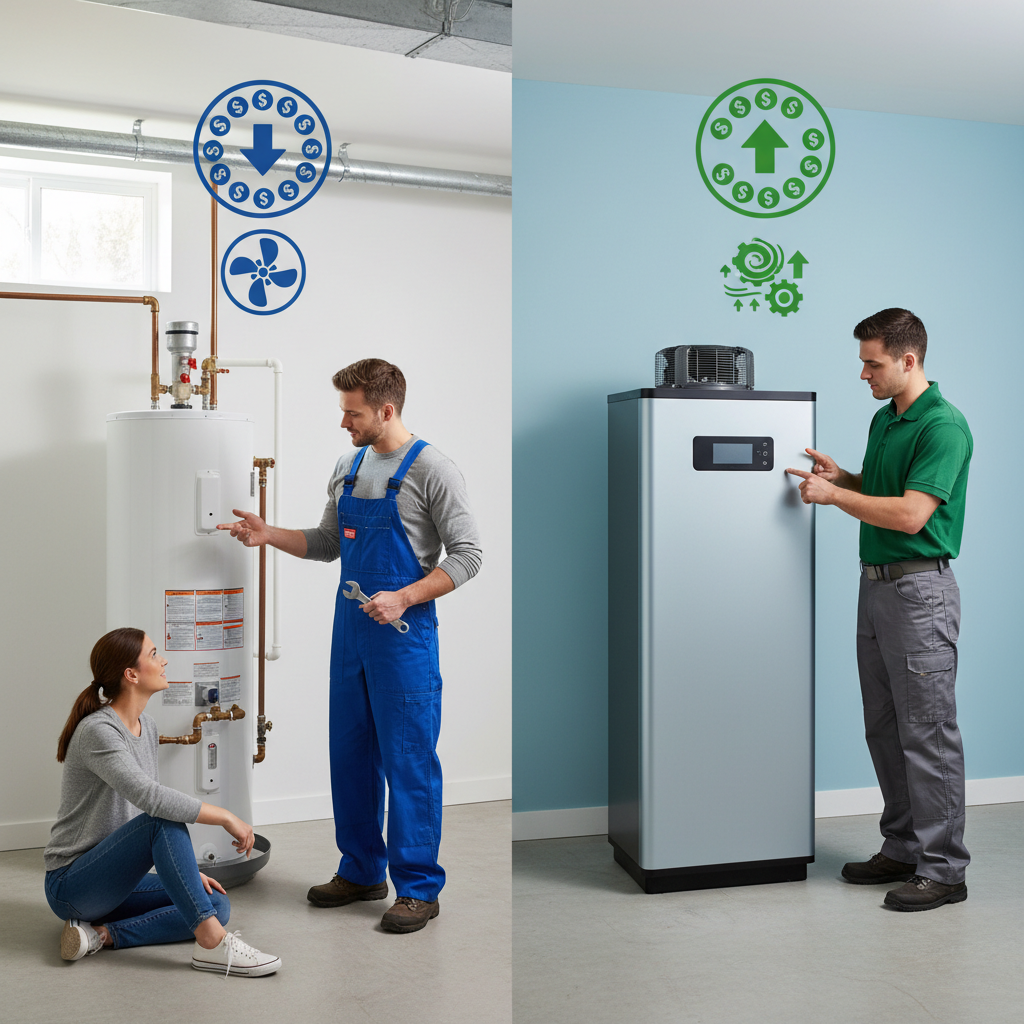
A properly installed hybrid system should pay for itself in 3-4 years via energy savings and TECH Clean California rebates, but a bad install stretches that to 15 years—the entire lifespan of the unit.
- Short cycling prevention: Incorrect sensor placement causes the unit to turn on and off too frequently, wearing out the compressor.
- Anode rod maintenance: Hybrids are sensitive to water quality; skipping the specific filtration or anode checks in hard-water areas like Fremont leads to premature tank failure.
- Vibration Isolation: Many ‘pro’ installs forget that heat pumps have moving parts. If it’s bolted directly to your floorboards, your whole house will hum like a refrigerator.
The ‘Plumber vs. HVAC’ gap is real. You need someone who understands refrigeration cycles AND pipe fitting. Most general contractors are only good at one, leading to the heat pump installation errors we spend half our time fixing.
Maximizing Bay Area Rebates (Up to $4,900+)
Don’t leave money on the table because your contractor was too lazy to fill out the paperwork or didn’t follow Inflation Reduction Act (IRA) tax credit compliance guidelines.
At Better Water Heaters, we handle the permits and the rebate applications for you. We know the 2027 gas water heater regulations are coming, and we’re positioning our clients to be ‘future-ready’ now. If you’re in San Mateo or Santa Clara County, the incentives are too high to ignore—but only if the installation is done to code.
Ready to stop overpaying for hot water? Call us at (408) 250-6672 or book your expert installation online. Don’t become ‘Case Study #43’ of a failed install.
Frequently Asked Questions
Why is my new heat pump water heater making my electric bill higher?
The most common reason for high bills after a heat pump installation is the unit running in ‘Electric Resistance’ or ‘Emergency’ mode. This happens when the unit is installed in a space with insufficient air volume (less than 1,000 cubic feet) or when the settings haven’t been optimized for ‘Heat Pump Only’ operation. Without enough ambient heat, the unit defaults to inefficient heating coils.
Do I need to upgrade my electrical panel for a heat pump water heater?
Not necessarily. While many hybrid units require a 240V/30A circuit, there are now 120V ‘plug-in’ models designed specifically for homes with limited panel capacity. A qualified specialist can perform a load calculation to determine if your current panel can handle the addition or if a smart circuit sharer can solve the problem without a $3,000 panel upgrade.
How much can I actually save with a heat pump water heater in the Bay Area?
In the moderate Bay Area climate, a properly installed heat pump water heater can save the average family $300 to $500 per year on utility bills. When combined with available TECH Clean California rebates and federal tax credits, which can total over $4,900, many homeowners see a full return on investment in under three years.
Why is my heat pump water heater so noisy?
Noise issues are usually a result of poor vibration isolation. Because heat pumps contain a compressor (like a refrigerator), they must be installed with vibration pads or flexible connectors to prevent sound from traveling through the home’s framing. If your unit is in an interior closet, proper mounting is essential to keep decibel levels low.
The bottom line: A heat pump is a precision instrument, not a tank of water. If your contractor is quoting you the same price for a gas swap as they are for a hybrid install, they are likely skipping the 12 critical steps that guarantee efficiency. Demand a specialist, or prepare to pay the price on your next utility bill.