
📋 Table of Contents
Managing San Francisco multi-unit hot water systems in aging Victorian conversions or high-density SROs presents a unique set of challenges for modern property managers. As California moves toward a zero-emission future under SB 1221, the decision between maintaining a centralized boiler or transitioning to point-of-use retrofits has become a high-stakes financial strategy.
Key Takeaways for Property Owners
- Efficiency Gains: Transitioning to point-of-use systems can reduce standby heat loss by up to 30%.
- Regulatory Compliance: New BAAQMD regulations will phase out gas water heaters starting in 2027.
- Utility Management: Shifting to individual units allows for direct tenant billing, eliminating utility disputes.
- Incentives: Access up to $4,900+ in rebates through programs like BayREN multi-family incentives.
The Hidden Costs of Centralized San Francisco Multi-Unit Hot Water Systems
Traditional centralized boiler systems have long been the standard for San Francisco apartment buildings, but they carry significant operational baggage. In older properties, the long plumbing runs from a basement boiler to a fourth-floor unit result in massive energy waste and tenant frustration over “wait-to-hot” times.
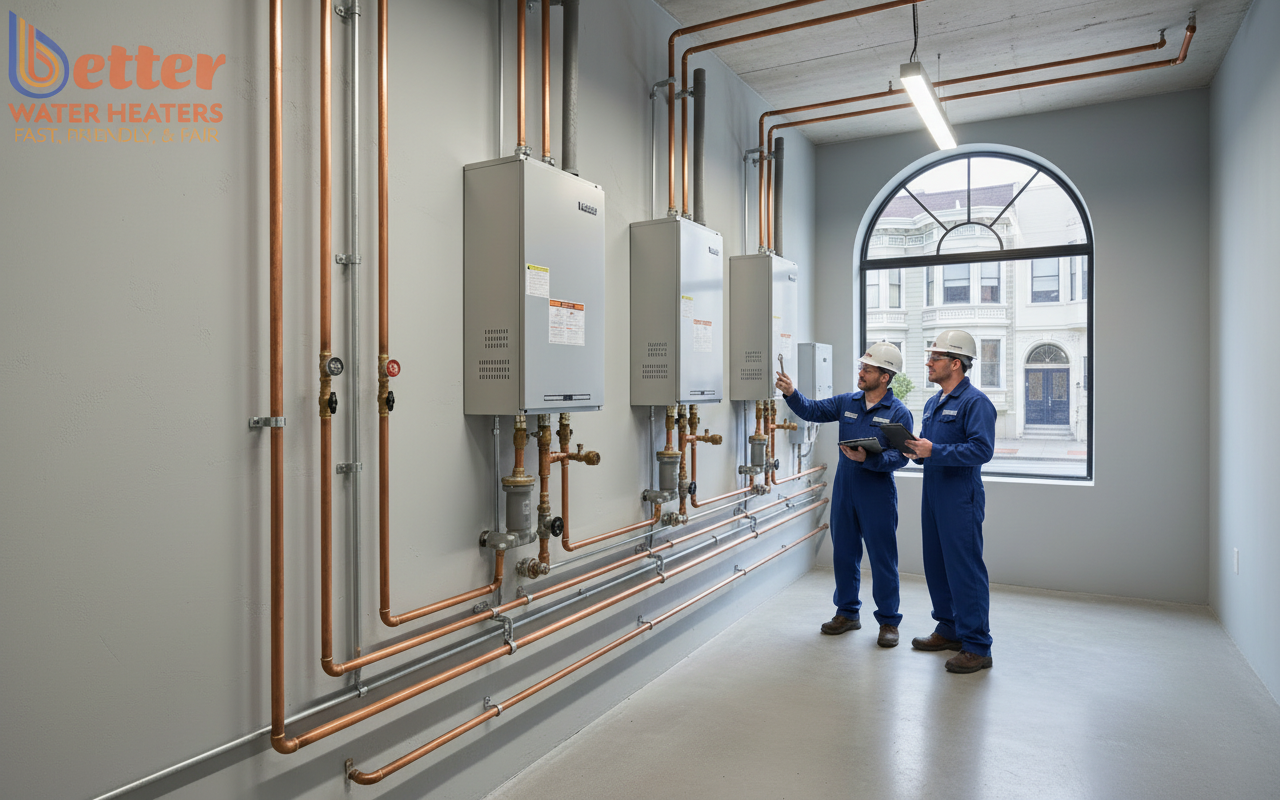
Furthermore, centralized systems often lack sub-metering capabilities, forcing landlords to swallow the cost of hot water as a flat monthly expense. This “water-included” model provides no incentive for tenant conservation, often leading to inflated PG&E bills that eat into your Net Operating Income (NOI).
- Maintenance Overhead: A single boiler failure leaves an entire building without hot water, creating emergency repair costs and tenant legal risks.
- Energy Waste: Heat loss through uninsulated copper pipes in drafty 100-year-old walls is a constant drain on resources.
- Regulatory Pressure: According to the U.S. Department of Energy, centralized systems can lose significant efficiency compared to localized heating.
Point-of-Use Retrofits: A Strategic Alternative for SF Landlords
A point-of-use water heater San Francisco retrofit involves installing individual, high-efficiency tankless or small-tank units directly within each apartment. This approach is particularly effective for subdivided Victorians where space is at a premium and existing gas lines may be undersized for large commercial upgrades.
By decentralizing the hot water supply, you effectively transfer the utility responsibility to the tenant’s electrical or gas meter. This transition not only improves building efficiency but also modernizes the property’s infrastructure ahead of the 2030 decarbonization mandates.
- Space Savings: Modern tankless units can be wall-mounted in closets or under sinks, freeing up valuable basement square footage for storage or ADU conversions.
- Tenant Satisfaction: Instant hot water at the tap eliminates complaints about temperature fluctuations during peak morning hours.
- Seismic Safety: Smaller individual units are easier to secure per California seismic strapping codes compared to massive 100-gallon commercial tanks.
Need a professional assessment of your building? Schedule a multi-unit site evaluation with our expert technicians today.
Comparing the ROI: Centralized vs. Point-of-Use
When evaluating a commercial water heater retrofit, it is essential to look beyond the initial installation price. While a centralized heat pump system might have a lower upfront cost per unit, the long-term ROI of point-of-use systems often wins in the dense San Francisco market.
| Feature | Centralized Boiler/Heat Pump | Point-of-Use (Tankless/Electric) |
|---|---|---|
| Upfront Cost | Moderate to High | Higher (per unit installation) |
| Maintenance | Complex / Single Point of Failure | Simplified / Isolated Issues | Usually Landlord Paid | Tenant Paid (Direct Meter) |
| Lifespan | 10-15 Years | 20+ Years (Tankless) |
Navigating San Francisco Multi-Unit Hot Water Regulations
San Francisco’s regulatory environment is among the strictest in the nation, involving Title 24 energy requirements and specific BAAQMD (Bay Area Air Quality Management District) rules. Any multi-unit water heater replacement must now account for the upcoming 2027 ban on NOx-emitting natural gas water heaters.
Strategic landlords are already pivoting toward multi-family electrification SF initiatives. By upgrading electrical panels now—perhaps during a mandatory soft-story retrofit—you can future-proof your building and take advantage of current HEEHRA rebates that may not be available later.
- Permit Complexity: SF Department of Building Inspection (DBI) requires specific venting and drainage plans for high-efficiency retrofits.
- Noise Ordinances: Centralized heat pump units must be carefully placed to avoid violating SF’s strict noise codes in dense residential corridors.
- Electrical Loads: Many older buildings require a service upgrade to 200A or 400A to support multiple electric point-of-use units.
Technical Challenges: Electrical Capacity and Historic Constraints
One of the primary hurdles for San Francisco multi-unit hot water electrification is the aging electrical grid. In many Mission District or Pacific Heights properties, the existing service is insufficient to support ten individual electric tankless heaters simultaneously.
However, the emergence of 120V heat pump water heaters and smart load-shedding controllers has changed the game. These technologies allow for tankless water heater retrofit San Francisco projects without the need for a full, six-figure utility service upgrade from PG&E.
- Load Calculation: Our team performs a detailed load study to ensure your existing panel can handle the new equipment.
- Venting Solutions: For gas-to-gas retrofits, we navigate the complex chimney and side-wall venting requirements of SF’s historic building codes.
- Hybrid Models: In some cases, a “clustered” approach—one small heater for every 2-3 units—provides the best balance of cost and efficiency.
Ready to upgrade your property’s value? Call us at 408-261-2342 to discuss your San Francisco multi-unit hot water options with a local specialist.
Maximizing Rebates for Your Commercial Water Heater Retrofit
The financial landscape for water heater upgrades has never been more favorable for Bay Area property owners. Between federal tax credits and local utility incentives, a significant portion of your commercial water heater retrofit can be subsidized.
- TECH Clean California: Offers substantial rebates for heat pump water heater installations in multi-family settings.
- Federal Tax Credit (25C): Provides up to $2,000 annually for energy-efficient upgrades.
- Local Utility Programs: Clean Energy programs in the Bay Area often offer “stackable” incentives that can cover up to 50-70% of project costs.
FAQs About San Francisco Multi-Unit Hot Water
How does the 2027 gas water heater ban affect my multi-unit building?
Starting in 2027, the BAAQMD will prohibit the sale and installation of natural gas water heaters that emit NOx. While you don’t have to replace a working unit immediately, any new multi-unit water heater replacement after that date must be a zero-emission model, such as an electric heat pump system.
Can I switch to point-of-use heaters without upgrading my building’s main electrical panel?
It depends on the current load. While traditional electric tankless units require high amperage, new 120V heat pump technology or gas-fired tankless units can often be installed with minimal electrical changes. We recommend a professional electrical load assessment before proceeding.
What is the typical lifespan of a commercial-grade tankless retrofit?
A high-quality tankless water heater retrofit San Francisco using brands like Navien or Rinnai can last 20-25 years with proper maintenance. This is nearly double the lifespan of traditional commercial tank boilers, which typically fail every 10-12 years due to sediment buildup and corrosion.
Are there specific San Francisco permits required for multi-unit retrofits?
Yes. Any San Francisco multi-unit hot water project requires a plumbing permit from the DBI. If electrical work or new gas lines are involved, additional permits are necessary. Better Water Heaters handles the entire permitting process to ensure your building remains compliant with local codes.
Conclusion: Future-Proofing Your San Francisco Real Estate
Choosing the right San Francisco multi-unit hot water strategy is about more than just plumbing; it is a vital part of your long-term asset management. Whether you opt for a high-efficiency centralized heat pump or a decentralized point-of-use model, the goal is to reduce liability, lower overhead, and meet the city’s evolving environmental standards.
At Better Water Heaters, we bring over 20 years of local expertise to every commercial water heater retrofit. We understand the nuances of San Francisco’s building stock and can help you maximize your ROI through strategic equipment selection and rebate optimization.
Don’t wait for your aging boiler to fail. Contact us today for a comprehensive consultation and take the first step toward a more efficient, profitable property.