
📋 Table of Contents
According to the U.S. Department of Energy, water heating is the second largest expense in most homes, accounting for roughly 18% of your utility bill. While the marketing for “endless hot water” is seductive, many Bay Area families find that a 50-gallon tank vs tankless comparison reveals a frustrating reality: tankless units often struggle to keep up when three showers are running at 7:00 AM.
The Simultaneous Hot Water Draw Dilemma
The real kicker? Tankless systems are rated by gallons per minute (GPM), but that number drops significantly as the incoming ground water temperature decreases or the number of active fixtures increases.
What most people miss is that a high-occupancy household doesn’t just need endless water; they need simultaneous hot water draw. In a typical Bay Area mid-market home, you might have a primary suite shower, a guest shower, and a dishwasher running at once. While a tankless unit might throttle the flow to maintain temperature, a 50-gallon tank provides consistent pressure across all taps until the reserve is depleted.
- Peak Hour Demand: Tanks excel at handling massive bursts of activity.
- Flow Consistency: No “cold water sandwich” effect when a second person turns on a tap.
- Pressure Stability: Traditional tanks don’t restrict flow to compensate for heating capacity.
Understanding First Hour Rating (FHR)
If you want to know how a heater actually performs, ignore the tank size for a moment and look at the First Hour Rating (FHR). This metric combines the tank capacity with the high-recovery rate—how fast the burner can reheat new water entering the tank.
For a family of five, a professional-grade 50-gallon gas tank often boasts an FHR of 80 to 90 gallons. This means in the first hour of heavy use, you have significantly more volume available than a standard residential tankless unit could produce if the incoming water is chilly.
Real-World Costs: The Retrofit Reality
Here’s the thing: switching from a tank to a tankless system in an established San Jose or Oakland home isn’t just a simple swap. Because tankless units require a massive burst of energy to heat water instantly, they often necessitate gas line retrofit costs that can add $1,500 to $3,000 to the bill.
In our work with established homeowners, we frequently see quotes for tankless installations double because the existing 1/2-inch gas line can’t support the 199,000 BTU demand of a whole-home tankless unit. Conversely, a high-efficiency 50-gallon tank usually fits existing infrastructure perfectly.
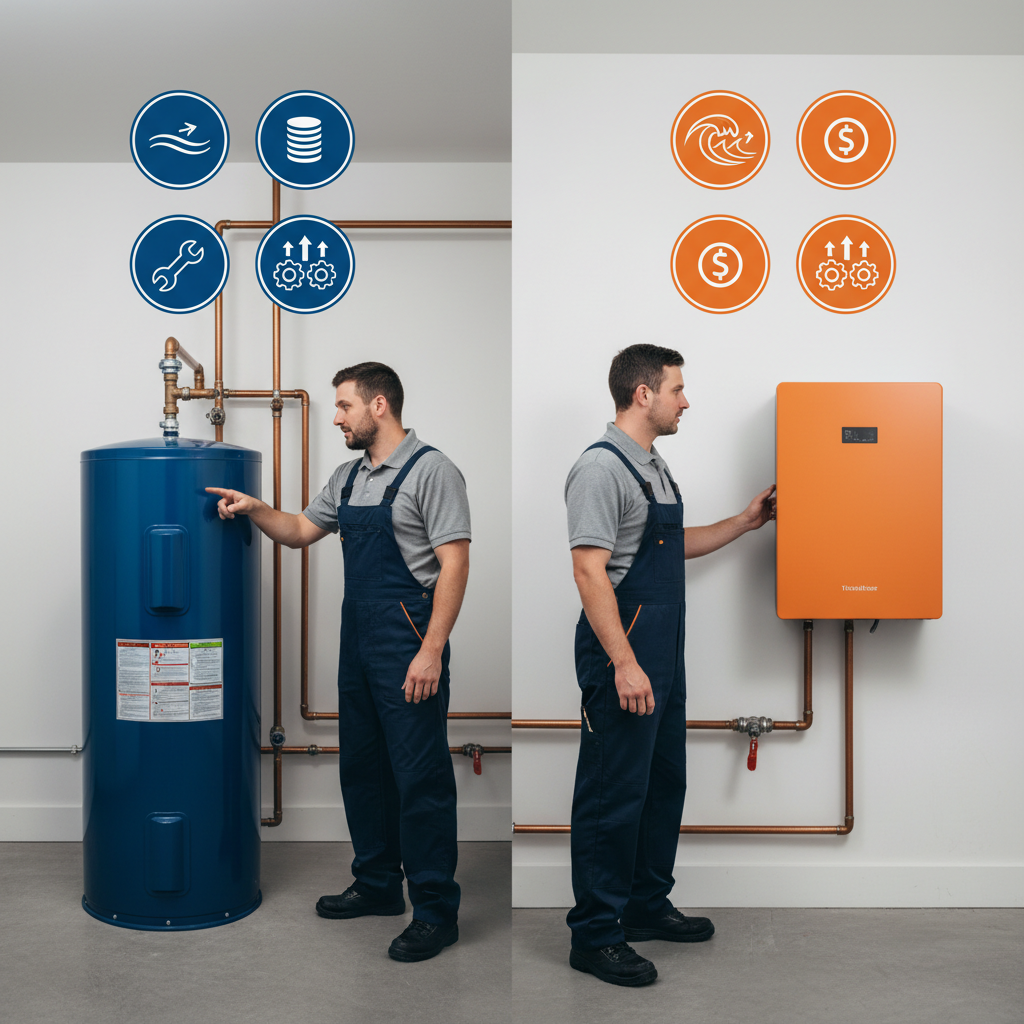
| Feature | 50-Gallon High-Recovery Tank | Whole-Home Tankless |
|---|---|---|
| Upfront Cost (Installed) | $2,000 – $3,500 | $4,500 – $7,500+ |
| Simultaneous Showers | 3-4 (Reliable) | 2-3 (Varies by GPM) |
| Maintenance Requirement | Annual Flush (Simple) | Annual Descaling (Technical) |
| Expected Lifespan | 10 – 15 Years | 20+ Years |
Need help deciding which system fits your family’s morning routine? Schedule a free consultation with our Bay Area experts to get an honest assessment of your home’s plumbing capacity.
The Maintenance and Reliability Gap
But wait—environmental impact matters, right? While tankless units are more efficient on paper, the tankless maintenance cycle is much more rigorous, especially in Bay Area regions with hard water like Santa Clara County.
Hard water scaling can reduce a tankless unit’s efficiency by 15% in just a few years if not professionally descaled annually. A 50-gallon tank is far more forgiving. Furthermore, in the event of a power outage, a standing pilot gas tank water heater will still provide hot water, whereas a tankless unit requires electricity to ignite and modulate the burner.
- Reliability: Fewer electronic components mean fewer proprietary circuit board failures.
- Simplicity: Repairs are generally faster and parts are more readily available.
- Hard Water Resilience: Tanks handle sediment buildup better than the narrow heat exchangers in tankless units.
The ‘Teenager Test’: Why Volume Wins
The real-world scenario we call the “Teenager Test” involves back-to-back 20-minute showers. A tankless unit theoretically wins here, but only if nothing else is happening in the house. The moment a second shower starts, the hot water delivery speed may drop, leading to the dreaded “cold water sandwich.”
A high-recovery 50-gallon tank acts as a massive thermal battery. For a typical Bay Area family, this “buffer” ensures that the dishwasher doesn’t cause a temperature scream in the upstairs bathroom. If you’re looking for more data on local efficiency standards, check out the Energy.gov guide on demand water heaters.
Space vs. Performance
While tankless units save space, most Bay Area homes have dedicated water heater closets or garage footprints already designed for a tank. Unless you are converting that closet into a pantry, the space savings of a tankless unit might not justify the 2x or 3x price premium. We often recommend high-efficiency storage tanks to clients who prioritize hot water delivery speed and budget over square footage.
If you’re worried about future regulations, you might also consider a Heat Pump Water Heater, which offers the storage benefits of a tank with efficiency that rivals or beats tankless systems.
Conclusion: Making the Right Choice
The honest, contrarian insight most contractors won’t tell you? Tankless isn’t always an upgrade; sometimes, it’s a lateral move with higher complexity. For large families, the reliability and massive first-hour volume of a 50-gallon tank often provide a better daily experience.
Your Monday Morning Action Plan:
Check the age of your current unit. If it’s over 10 years old, look at the “First Hour Rating” on the yellow EnergyGuide label. If your family is constantly running out of water, don’t just assume tankless is the fix—consider a high-recovery storage tank to solve your volume issues without the massive retrofit costs.
Ready to upgrade your home’s comfort? Contact Better Water Heaters today for a transparent, no-nonsense quote on a system that actually fits your lifestyle.
Frequently Asked Questions
Is a 50-gallon tank enough for a family of 5?
Yes, provided it is a high-recovery model. In a 50-gallon tank vs tankless comparison, the tank’s First Hour Rating (FHR) is the key. A model with an FHR of 85+ gallons can typically handle three back-to-back showers and a load of laundry without running cold.
Why does my tankless water heater get cold when I open a second tap?
This is often due to the unit reaching its maximum GPM capacity. When simultaneous hot water draw exceeds what the heater can produce at the desired temperature, it either reduces the flow or drops the temperature, leading to a “cold water sandwich” or lower pressure.
How much are gas line retrofit costs for tankless units?
In the Bay Area, you can expect to pay between $1,500 and $3,000 for gas line upgrades. Tankless units require much higher BTUs than standard tanks, often necessitating a larger pipe from the meter to the unit to ensure safe operation.
Which is better for hard water: tank or tankless?
Storage tanks are generally more resilient to hard water. While both need maintenance, the tankless maintenance cycle is critical; without annual descaling, the narrow copper heat exchangers in a tankless unit can become clogged with calcium, leading to expensive repairs.