
📋 Table of Contents
According to the Bay Area Air Quality Management District (BAAQMD), water heaters and furnaces account for roughly 90% of NOx emissions from local residential buildings. Starting in 2027, new 2027 gas water heater regulations will effectively ban the sale and installation of traditional natural gas units, mandating a shift to zero-emission technology.
Key Takeaways for Homeowners
- The 2027 Deadline: After 2027, you cannot replace a broken gas heater with another gas model in the Bay Area.
- Financial Optimization: Current rebates like TECH Clean California and BayREN can cover up to $4,900+ of installation costs today.
- Labor Shortage Risk: Waiting until 2027 will likely lead to a 30-50% spike in labor rates due to high demand and limited certified installers.
- Electrical Readiness: Assessing your panel capacity now prevents a $5,000 emergency upgrade later.
The BAAQMD Water Heater Ban: Why Procrastination is Expensive
The real kicker about the upcoming mandate isn’t just the equipment change—it is the inevitable supply chain bottleneck that will occur as millions of households scramble to comply. Here’s the thing: while the BAAQMD water heater ban doesn’t require you to rip out a working gas unit, the moment that unit fails after 2027, your only legal replacement option will be a zero-emission Heat Pump Water Heater (HPWH).
In our work with established Bay Area homeowners, we’ve observed that emergency replacements (when your tank is currently leaking on your floor) rarely allow for the time needed to secure permits, upgrade electrical panels, or maximize rebates. By acting during a “strategic replacement window,” you move from a position of desperation to one of financial advantage.
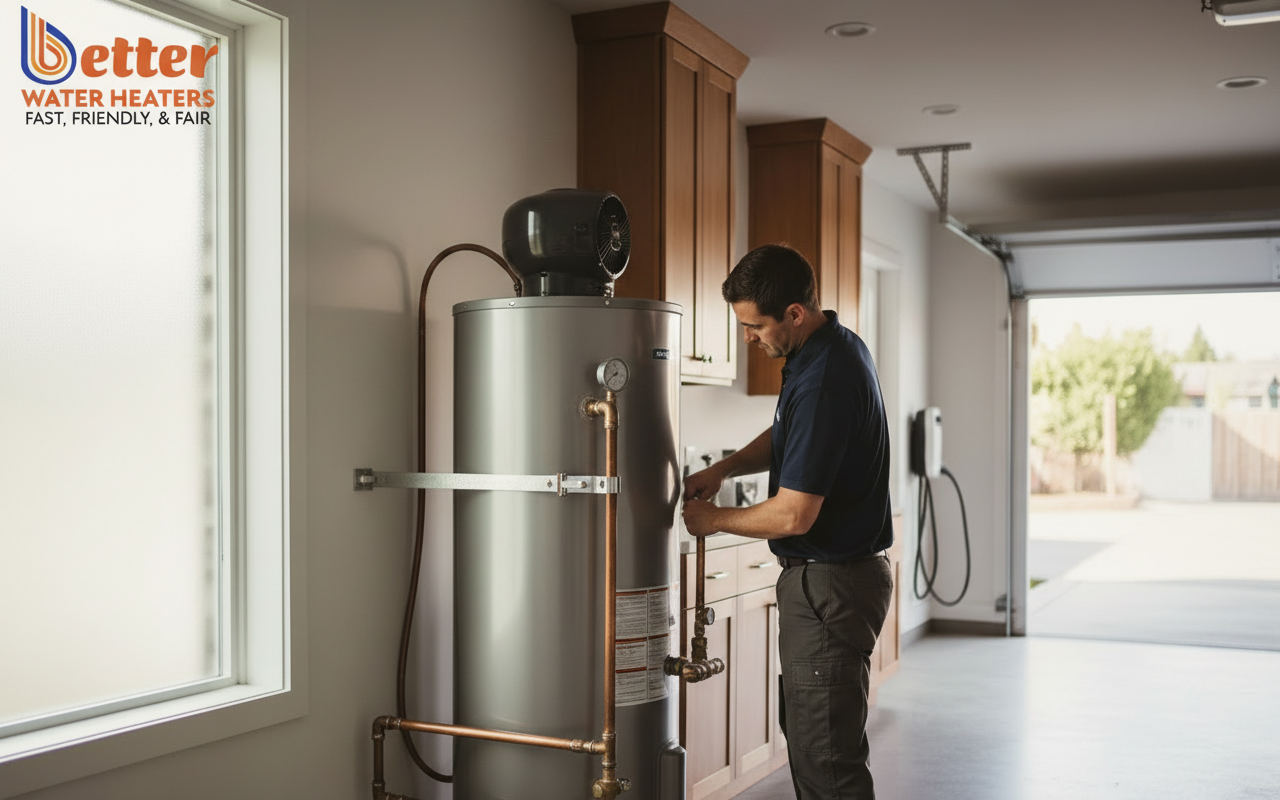
The Hidden Costs of Waiting Until 2027
- Inflated Labor Rates: Demand for HPWH-certified plumbers will outpace supply, driving up local service costs.
- Expired Incentives: Programs like HEEHRA and TECH Clean California have finite funding; waiting three years may mean missing out on thousands in grants.
- Permit Delays: Local building departments in San Jose and Oakland are already seeing increased lead times for electrification permits.
Year 1: The Home Readiness Audit (2024-2025)
What most people miss is that the transition to zero-emission water heating California standards starts at your circuit breaker, not your plumbing closet. A typical Bay Area mid-market home built before 1990 likely has a 100-amp or 125-amp electrical panel, which may not support the 30-amp dedicated circuit required for a standard HPWH.
However, the “120V Plug-In Revolution” is changing the game. New low-voltage heat pump models, like the Rheem ProTerra 120V, can often plug into a standard outlet, potentially saving you $2,000 to $5,000 in electrical panel upgrades. Schedule a professional site assessment to determine which path fits your home’s infrastructure.
| Feature | Standard 240V HPWH | 120V Plug-In HPWH |
|---|---|---|
| Electrical Req. | 30-Amp Dedicated Circuit | 15-Amp Shared/Dedicated |
| Recovery Speed | Fast (Hybrid Mode) | Moderate (Heat Pump Only) |
| Panel Upgrade? | Likely for older homes | Rarely required |
Year 2: Maximizing the Bay Area Appliance Transition Incentives
The strategic move in 2025 is to stack every available incentive before the Bay Area appliance transition reaches its fever pitch. Currently, a savvy homeowner can layer federal tax credits with state and local grants to offset nearly 60% of the total project cost. For example, the BayREN Home+ program offers significant rebates for residents in all nine Bay Area counties.
But wait—there is a contrarian reality most contractors won’t tell you: not every home is a perfect candidate for a heat pump. If your water heater is located in a tiny, unvented closet in the center of a San Francisco Victorian, the “cool air exhaust” from a heat pump could turn that hallway into a refrigerator. In these cases, we look at creative venting strategies or split-system heat pumps where the compressor sits outside, similar to an AC unit.
Current Rebate Stack (Estimated 2024-2025)
- Federal Tax Credit (25C): 30% of project cost, capped at $2,000 annually.
- TECH Clean California: Up to $3,100 (depending on utility and equipment).
- BayREN/Local Utility: $500 – $1,000 additional for switching from gas to electric.
- Total Potential Savings: Up to $4,900+.
Need help navigating the paperwork? Explore our guide to Bay Area water heater rebates to see which programs are currently active in your zip code.
Year 3: The Final Countdown to the 2027 Gas Water Heater Regulations
By 2026, the market will likely see a surge in “panic buying” of the remaining gas inventory before the sales ban. This is a risky strategy. Beyond the environmental impact, installing a brand-new gas unit in 2026 may actually hurt your home’s resale value. In the Silicon Valley market, buyers are increasingly looking for “future-proofed” homes with existing EV chargers and all-electric appliances.
The real kicker? Asset value protection. As the San Jose electrification ordinance and similar local mandates expand, homes that have already completed the 2027 gas water heater regulations transition will be marketed as “turn-key” and “compliant,” whereas gas-reliant homes may face price negotiations or credit requests during escrow.
Common Pitfalls: What to Avoid During the Transition
One honest observation from twenty years in the field: many homeowners buy the wrong size heat pump. Because heat pumps have a slower recovery rate than gas burners, you often need to “size up.” If you currently have a 40-gallon gas tank, you likely need a 50 or 65-gallon heat pump to ensure your family doesn’t run out of hot water during back-to-back showers.
- Avoid “Budget” Installers: HPWH systems require specialized condensate drainage and airflow management. An improper install can lead to mold or unit failure.
- Don’t Ignore the Noise: Heat pumps have a fan and compressor. While modern units like the Rheem ProTerra are quiet, placement near a bedroom wall requires vibration-dampening pads.
- Check Your Venting: Unlike gas units that need a chimney, heat pumps need to breathe. If the room is smaller than 1,000 cubic feet, you may need louvered doors.
Action Plan: What You Should Do This Week
Don’t wait for the 2027 deadline to dictate your home’s comfort and your wallet’s health. Take these three steps today to stay ahead of the curve:
- Check the Age: Find the serial number on your water heater. If it’s over 8 years old, you are in the “strategic replacement window.”
- Locate Your Panel: See if you have open space for a double-pole 30-amp breaker. If not, start researching 120V plug-in models.
- Get a Quote: Knowledge is power. Contact Better Water Heaters for a transparent, no-pressure assessment of your transition options.
Frequently Asked Questions
Is the 2027 gas water heater regulations a ban on owning gas heaters?
No, it is a ban on the sale and installation of new gas water heaters. You are legally allowed to keep and use your existing gas unit until it fails. However, once it breaks after the 2027 deadline, you will be required to replace it with a zero-emission model like a heat pump.
How much more does a heat pump water heater cost than gas?
In the Bay Area, a heat pump installation typically costs $3,500 to $6,000, whereas a gas replacement is $1,500 to $2,500. However, after applying $3,000+ in available rebates and tax credits, the net cost of a heat pump is often comparable to or lower than a traditional gas unit.
Will a heat pump water heater work during a PG&E blackout?
Standard heat pump water heaters require electricity and will not work during a blackout unless you have a backup battery system like a Tesla Powerwall. Some homeowners are now integrating their HPWH with smart home controllers to “pre-heat” water when solar production is high or before a scheduled Public Safety Power Shutoff (PSPS).
Do I need a permit for the Bay Area appliance transition?
Yes, all nine Bay Area counties require a plumbing and/or electrical permit for water heater replacements. This ensures the unit is safely strapped for earthquakes and meets Title 24 energy efficiency standards. Better Water Heaters handles the entire permit process for our clients to ensure full compliance with 2027 regulations.