Water heater article archive
2027 Gas Water Heater Ban: Strategic Guide for Bay Area Homeowners
Historical article, not newly reviewed advice. Verify current requirements, incentives and model guidance with the relevant authority or manufacturer before relying on them. Equipment and service needs require an assessment.
📋 Table of Contents
Key Takeaways:
- The 2027 gas water heater ban marks the end of new gas water heater sales in the Bay Area.
- Existing units are safe, but replacements after 2027 must be zero-emission models.
- Homeowners can currently access up to $4,900 in stacked rebates for heat pump conversions.
- Proactive replacement in 2026 avoids the 'emergency replacement trap' and higher labor costs.
The 2027 gas water heater ban is no longer a distant regulatory concept; it is a fast-approaching reality for every homeowner in San Jose, San Francisco, and the surrounding East Bay. As the Bay Area Air Quality Management District (BAAQMD) moves to slash nitrogen oxide (NOx) emissions, the landscape of home appliances is shifting permanently toward electrification. For sophisticated property owners, understanding these Bay Area water heater regulations is not just about environmental compliance—it is about protecting your property value and avoiding a multi-thousand-dollar emergency expense.
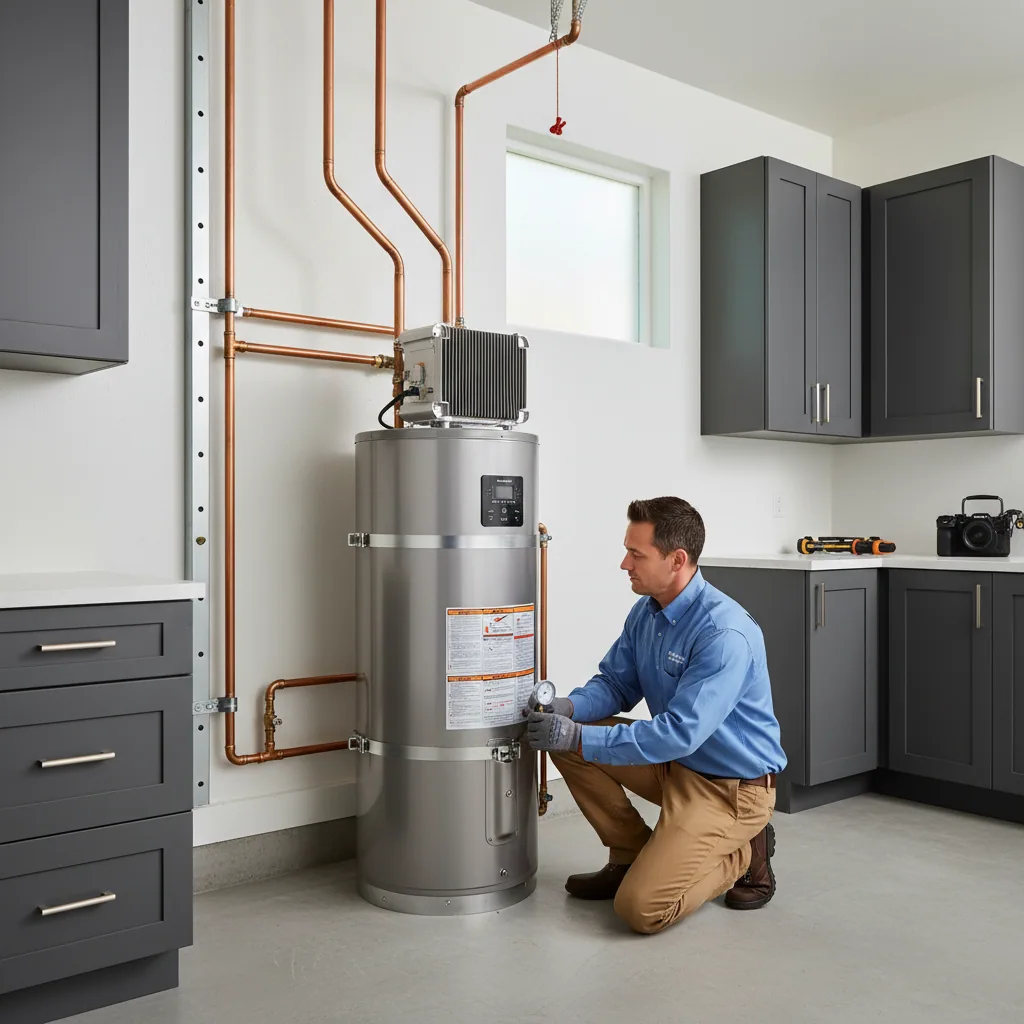
Furthermore, waiting until the last minute could leave you in a vulnerable position. When your current gas unit inevitably fails on a Friday night in late 2027, you won't have the luxury of shopping for the best deal or waiting for a backordered electric heat pump. By then, the demand for zero-emission water heater installation will be at an all-time high, likely driving up labor costs across the region.
Understanding BAAQMD Rule 9-6 and the 2027 Timeline
To navigate the 2027 gas water heater ban, we must first look at the specific mandates set by the Bay Area Air Quality Management District. Under Rule 9-6, the sale and installation of water heaters that emit any NOx will be prohibited starting in 2027 for small residential units (under 75,000 BTU).
Consequently, this regulation creates a 'point-of-sale' ban on the equipment itself. Here is what that looks like in practice for your household:
- No Forced Retrofits: You do not have to rip out a working gas water heater on January 1, 2027.
- Replacement Restrictions: If your gas heater breaks after the deadline, local suppliers will be legally barred from selling you a gas replacement.
- Zero-Emission Requirement: Any new unit installed must be 100% zero-emission, which currently points almost exclusively to Heat Pump Water Heaters (HPWH).
- Phased Approach: While small residential units face the 2027 deadline, larger commercial-scale units have until 2031.
Strategic homeowners are already looking at 2026 as the 'Golden Year' for replacement. By acting before the 2027 gas water heater ban takes full effect, you can transition on your own terms while BAAQMD compliance is still in its voluntary incentive phase.
The Cost of Waiting: Avoiding the Emergency Replacement Trap
Statistically, most water heater replacements in the Bay Area are 'distress purchases' made within 24 hours of a unit failure. However, the 2027 gas water heater ban changes the math of the emergency repair. If your unit fails in 2028, you cannot simply swap it for a $1,500 gas tank.
Instead, you may face immediate 'hidden costs' associated with electrification that are difficult to manage during an emergency:
- Electrical Panel Upgrades: Heat pump water heaters require a dedicated 220V circuit. If your panel is full, an emergency upgrade can add $2,500–$4,000 to the bill instantly.
- Permitting Delays: Converting from gas to electric often requires more complex municipal permits that can take days to clear in cities like Palo Alto or Fremont.
- Inventory Shortages: As thousands of homeowners are forced into the same market, lead times for top-tier brands like Rheem or Bradford White will likely increase.
- Contractor Premium: Emergency weekend labor for a complex conversion is significantly higher than a planned zero-emission water heater installation.
By planning your transition now, you can consult with specialized installers who can assess your current electrical capacity and prepare your home before the 2027 gas water heater ban makes it mandatory.

Stacking the Savings: Your Bay Area Rebate Roadmap
One of the most significant advantages of acting before the 2027 gas water heater ban is the current abundance of financial incentives. As of 2024, the 'stacking' of federal, state, and local rebates can offset a massive portion of the installation cost. For many of our clients in Santa Clara and San Mateo counties, the net cost of a high-end heat pump ends up being comparable to a traditional gas unit.
| Source | Incentive Type | Potential Value |
|---|---|---|
| Federal (25C Tax Credit) | Tax Credit | Up to $2,000 |
| TECH Clean California | State Rebate | Up to $1,000 - $3,100 |
| Local Utilities (SVCE/PCE) | Direct Rebate | Up to $1,000 |
| BayREN | Regional Rebate | Up to $900 |
Specifically, programs like TECH Clean California are designed to accelerate BAAQMD compliance. These funds are limited and operate on a first-come, first-served basis. By the time the 2027 gas water heater ban arrives, it is highly probable that these lucrative 'early adopter' incentives will be reduced or eliminated as the technology becomes the mandated standard.
Hybrid Technology: The Solution for Older Bay Area Homes
Many homeowners in established neighborhoods like Willow Glen or Rockridge worry that their 1940s-era electrical systems can't handle a modern heat pump. This is where 'Hybrid' or 120V 'Plug-in' heat pump water heaters become a game-changer. These units are specifically designed to meet Bay Area water heater regulations without requiring a heavy-duty panel upgrade.
- Efficiency: They use up to 70% less energy than traditional electric tanks.
- Installation: 120V models can often use existing outlets, saving thousands in electrical work.
- Climate Fit: Our moderate Bay Area climate is ideal for heat pump efficiency, whether you're in foggy Pacifica or sunny Livermore.
Moreover, these units are becoming a key selling point in the local real estate market. According to recent trends in San Jose and San Francisco, homes that have already completed the 'heavy lifting' of electrification often command a premium from environmentally-conscious buyers who want to avoid the headache of the 2027 gas water heater ban.
The Strategic Move: Why 2026 is Your Target Year
If your current water heater is 8–10 years old, it is effectively on 'borrowed time.' Replacing it in 2026, just before the 2027 gas water heater ban, is the most strategic move for several reasons. Primarily, it allows you to maximize the remaining life of your current unit while ensuring you aren't caught in the 2027 rush.
Consider this checklist for your 2026 planning:
- Professional Audit: Have a water heater specialist evaluate your current setup and electrical capacity.
- Rebate Verification: Confirm which heat pump water heater rebates California currently offers for your specific zip code.
- Panel Preparation: If you need an upgrade, schedule it as part of a larger home improvement project to maximize ROI.
- Contractor Selection: Choose an installer with deep experience in BAAQMD compliance to ensure all permits and seismic strapping are handled correctly.
Ultimately, the 2027 gas water heater ban represents a shift toward more sustainable, efficient, and safer homes. While change can be daunting, the financial and operational benefits of a planned transition far outweigh the risks of waiting for a system failure in a post-2027 market.
Frequently Asked Questions
Does the 2027 gas water heater ban mean I have to replace my working heater?
No, the 2027 gas water heater ban only applies to the sale of new units. You can continue to use and repair your existing gas water heater for as long as it remains functional. However, once it fails after the 2027 deadline, you must replace it with a zero-emission model.
How much more does a heat pump water heater cost than gas?
While the upfront cost of a heat pump can be $1,000–$2,000 higher than a gas unit, Bay Area water heater regulations have spurred massive rebate programs. When stacking federal tax credits and local incentives, many homeowners find the net cost is nearly identical to a traditional gas installation.
Will a heat pump water heater work during a PG&E power outage?
Like a modern gas water heater (which requires electricity for the igniter and sensors), a heat pump will not operate during an outage unless you have a battery backup or generator. However, because the tanks are highly insulated, they can keep water hot for up to 24 hours without power.
What is BAAQMD Rule 9-6 specifically?
BAAQMD Rule 9-6 is a regulation passed by the Bay Area Air Quality Management District that sets ultra-low NOx standards for natural gas furnaces and water heaters. By 2027, the standard drops to zero, effectively mandating electric heat pump technology for all new residential water heater installations.
Ready to get ahead of the 2027 deadline? Contact the experts at Better Water Heaters today for a free consultation and rebate assessment.