
📋 Table of Contents
- The Strategic Financial Move: Avoiding Electrical Panel Upgrades
- Recovery Rates and the First Hour Rating (FHR) Reality Check
- The ‘Hidden Cost’ Analysis: When 120V Actually Costs More
- Comparing the Big Names: Rheem ProTerra 120V vs. The Competition
- Tenant-Landlord ROI: Why 120V is the Rental Gold Standard
- The 2027 Gas Regulation: Why You Should Care Now
- FAQs
According to the U.S. Department of Energy, water heating is the second largest energy expense in most homes, accounting for roughly 18% of total utility costs. If you are a Bay Area homeowner looking to ditch gas, the 120V heat pump water heater has likely appeared on your radar as a way to bypass the $2,000 to $4,000 headache of electrical panel upgrades.
But here is the honest truth: while “plug-and-play” sounds like a dream, it isn’t a universal win for every household. At Better Water Heaters, we’ve spent 20 years watching technologies evolve, and the transition to 120V systems is one of the most significant shifts in local electrification. However, choosing the wrong voltage can lead to the one thing every homeowner dreads—a cold shower in the middle of a Tuesday morning rush.
The Strategic Financial Move: Avoiding Electrical Panel Upgrades
The primary reason a 120V heat pump water heater is gaining traction in cities like San Jose and Redwood City isn’t just energy efficiency; it’s infrastructure avoidance.
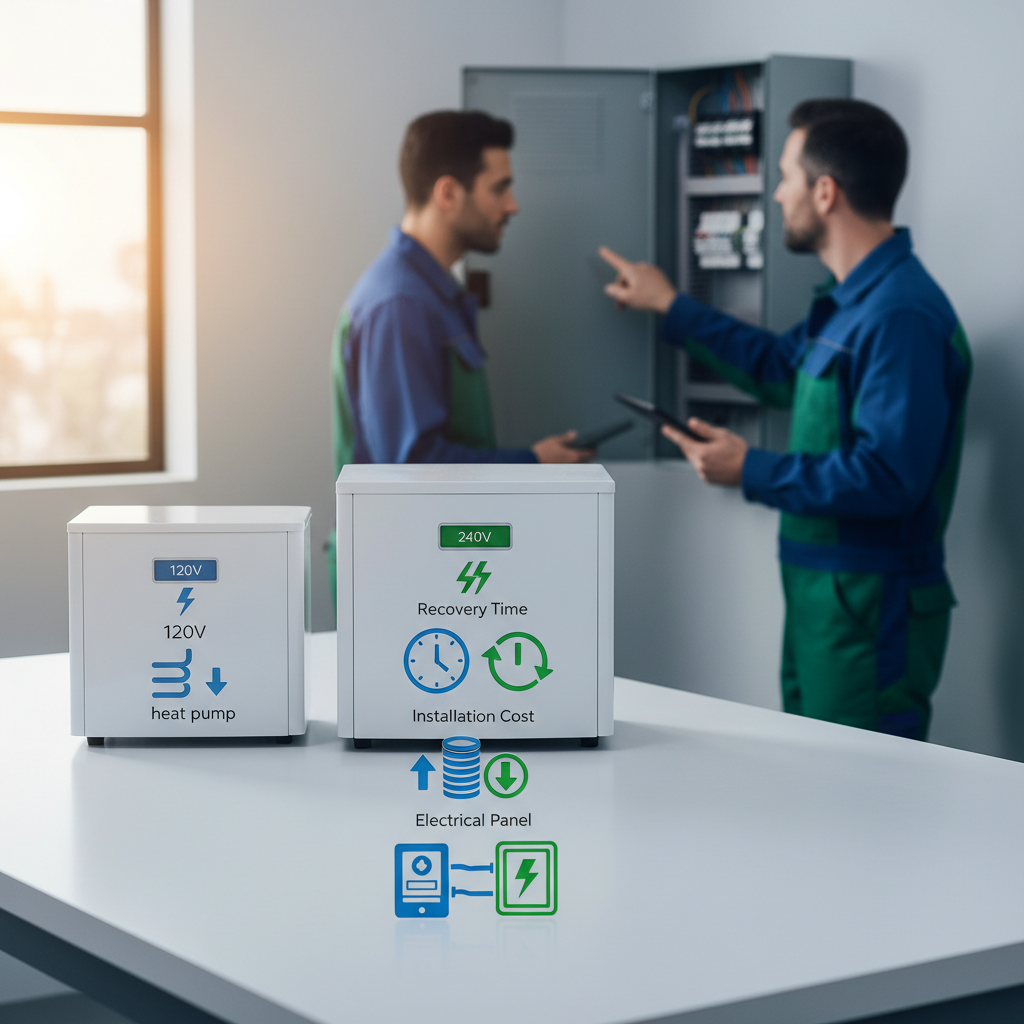
What most people miss is that many older Bay Area homes have 100-amp or 125-amp panels that are already maxed out by modern appliances. Adding a traditional 240V heat pump usually triggers a mandatory service upgrade. By opting for a 120V unit, you can often use an existing outlet in your garage, saving thousands in upfront labor.
- Panel Savings: Avoid $2,500–$5,000 in electrical contractor fees.
- Permit Simplicity: Fewer electrical circuits mean a faster sign-off from local building departments.
- Tax Credit Synergy: The Inflation Reduction Act 25C tax credit provides up to $2,000 for heat pump installations, which often covers a larger percentage of a 120V install since the base cost is lower.
Key Takeaways for Bay Area Homeowners
- 120V units are ideal for 1-3 person households with moderate hot water needs.
- 240V units are necessary for large families or homes with oversized soaking tubs.
- The Inflation Reduction Act (IRA) can offset up to 30% of your total project cost.
Recovery Rates and the First Hour Rating (FHR) Reality Check
If you switch from gas to a 120V heat pump, you must prepare for a different “recovery” rhythm because these units lack the high-powered backup heating elements found in 240V models.
The real kicker? A 120V unit relies almost entirely on the compressor. While a standard gas heater might recover 40 gallons of hot water in an hour, a 120V heat pump might only manage 15 to 20 gallons. This makes the First Hour Rating (FHR) the most critical stat you’ll look at during your sizing consultation.
| Technology Type | Typical Voltage | First Hour Rating (50 gal) | Recovery Speed |
|---|---|---|---|
| Standard Gas Tank | N/A | 75-85 Gallons | Fast |
| Standard Electric Tank | 240V | 60-70 Gallons | Moderate |
| Hybrid Heat Pump | 240V | 65-75 Gallons | Moderate/Fast |
| Plug-and-Play HPWH | 120V | 45-55 Gallons | Slow |
In our work with established homeowners in San Mateo, we often find that 120V units work perfectly for couples, but struggle when adult children move back home or when hosting guests. To mitigate this, we frequently recommend “upsizing” the tank—installing an 80-gallon 120V unit to provide a larger buffer of pre-heated water.
Need help determining if your home can handle a 120V unit? Schedule a free site assessment today to get a professional sizing recommendation.
The ‘Hidden Cost’ Analysis: When 120V Actually Costs More
It sounds counterintuitive, but a plug-and-play water heater can sometimes be the more expensive long-term choice if your existing wiring isn’t up to code.
Here’s the thing: the National Electrical Code (NEC) has specific requirements for high-draw appliances. Even though it’s 120V, many units require a dedicated circuit. If your garage outlet is shared with a refrigerator, a Tesla charger, or a workbench, you’ll still need an electrician to run a new line.
- Shared Circuit Risks: Plugging into an existing shared outlet can trip breakers and cause nuisance shutdowns.
- Mixing Valve Requirements: Because 120V units recover slowly, we often set the tank temperature higher (140°F) and install a thermostatic mixing valve to stretch the hot water supply. This is a mandatory added cost.
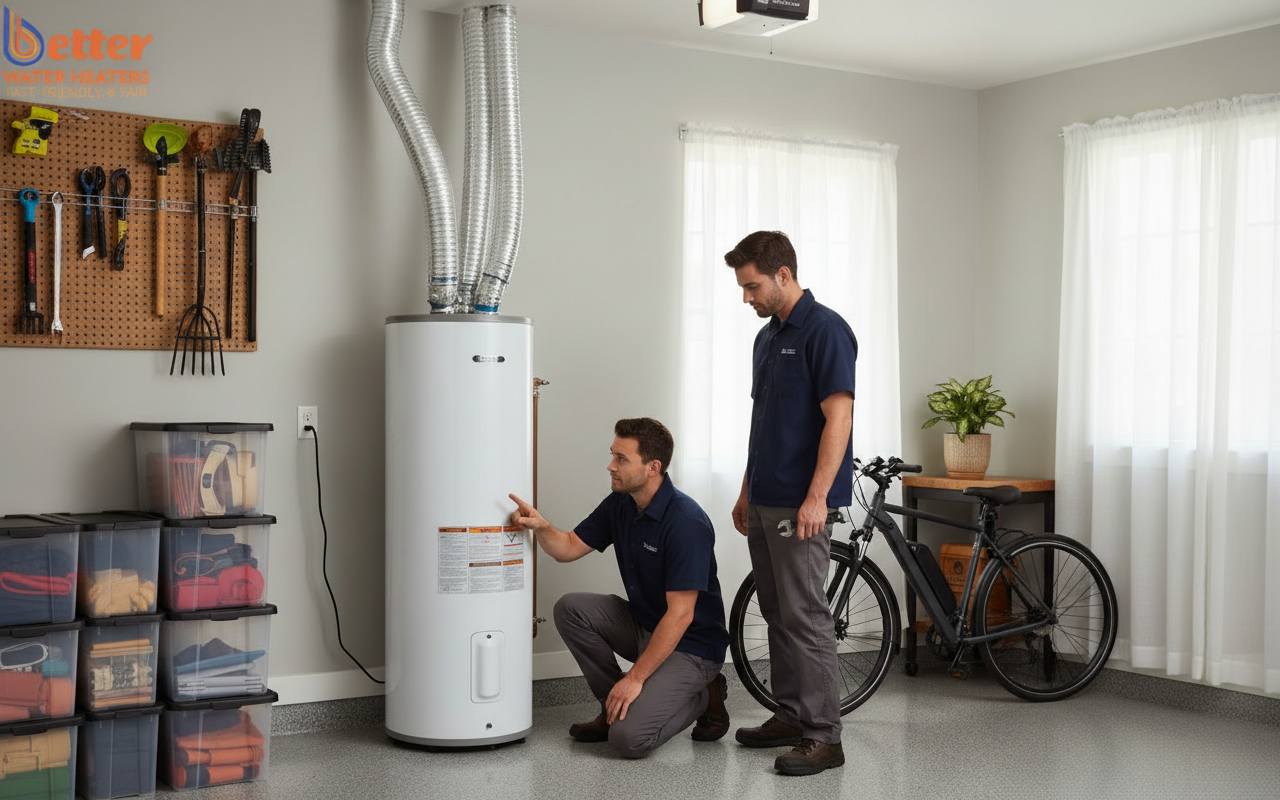
- Space Constraints: Heat pumps need roughly 700-1,000 cubic feet of air to breathe. If your water heater is in a tiny closet, you’ll need to install louvered doors or ducting.
Comparing the Big Names: Rheem ProTerra 120V vs. The Competition
Currently, the market is dominated by a few key players, with the Rheem ProTerra 120V leading the charge for retrofit-ready installations.
The ProTerra is specifically designed for gas-to-electric water heater conversion. It includes a built-in leak detection system and auto-shutoff valve, which is a huge plus for Bay Area property managers looking to reduce liability. However, compared to a 240V AO Smith or Bradford White, the Rheem 120V is a “heat-pump-only” machine. It does not have the resistive heating elements that kick in during high-demand periods.
But wait—this isn’t necessarily a bad thing. By removing those elements, the unit stays within the 15-amp limit of a standard household plug. It is a masterpiece of engineering, but it requires the homeowner to be a “smart user.” For example, we suggest residents program their dishwashers to run at midnight to avoid competing with morning showers.
Tenant-Landlord ROI: Why 120V is the Rental Gold Standard
For property managers in the East Bay, the 120V heat pump is becoming the go-to solution for meeting California’s aggressive decarbonization goals without gutting a building’s electrical system.
A typical Bay Area mid-market landlord might face a $15,000 bill to upgrade a multi-unit property’s electrical service just to support four 240V water heaters. By choosing 120V units, that same landlord can often complete the conversion for the cost of the units and basic plumbing labor. This preserves capital while increasing the property’s value and appeal to eco-conscious tenants.
Furthermore, since these units are significantly more efficient than the old gas models they replace, tenants see lower utility bills, which often leads to higher lease renewal rates. It’s a rare win-win in the world of property maintenance.
The 2027 Gas Regulation: Why You Should Care Now
The Bay Area Air Quality Management District (BAAQMD) has passed regulations that will effectively phase out the sale of natural gas water heaters starting in 2027.
While that feels far away, the electrical panel upgrades required for 240V systems are already seeing a backlog in many cities. If your gas heater is 10+ years old today, it will likely fail right as the rush for heat pumps begins. Evaluating the 120V vs 240V debate now allows you to take advantage of current incentives like the TECH Clean California rebates before they are potentially scaled back.
What most people miss is that the 120V technology is specifically designed to make this transition painless. It is the “bridge” technology that allows older homes to join the clean energy movement without a five-figure renovation bill.
Final Verdict: Which One Should You Choose?
The best way to decide is to look at your panel and your shower schedule. If your electrical panel is full and you have a 1-3 person household, the 120V heat pump water heater is a brilliant, cost-effective choice. If you have a large family, a massive bathtub, or already have 200-amp service, the 240V hybrid models provide better performance and faster recovery.
Ready to make the switch? Don’t leave your hot water to chance. Contact Better Water Heaters today at (408) 250-6672 for a professional consultation and maximize your Bay Area rebates.
Frequently Asked Questions
Is a 120V heat pump water heater enough for a family of four?
For a family of four, a 120V unit can be a struggle unless you upsize to an 80-gallon tank. Because the recovery rate is slower than a 240V model, back-to-back showers can deplete the hot water. We generally recommend 240V units or larger storage volumes for bigger households to ensure comfort.
Do I really need a dedicated circuit for a plug-and-play water heater?
Yes, most manufacturers and local Bay Area building codes require a dedicated 15-amp or 20-amp circuit. Even though it plugs into a standard outlet, sharing that circuit with other high-draw appliances like a garage freezer or power tools can cause the breaker to trip frequently.
How much can I save with the Inflation Reduction Act tax credit?
Under the 25C tax credit, homeowners can claim 30% of the total project cost, up to a maximum of $2,000 per year for heat pump water heaters. When combined with local Bay Area incentives from CCAs like Peninsula Clean Energy or Silicon Valley Clean Energy, your total out-of-pocket cost can drop significantly.
Will a 120V heat pump work in a cold garage during a Bay Area winter?
Yes. While heat pumps are slightly less efficient in cold temperatures, the Bay Area’s moderate climate is actually perfect for this technology. Even on our coldest nights, these units can efficiently extract heat from the air. However, they do require adequate clearance and airflow to operate correctly.